Lord of the Rings Filming Locations Near Rotorua
Can you visit real Lord of the Rings filming locations from Rotorua?
Hobbiton near Matamata, about 50 minutes from Rotorua, is the one complete set you can walk through. Mount Ngauruhoe, filmed as the exterior of Mount Doom, is a real peak in Tongariro National Park that you can view or hike near but not climb into a crater set, and most other locations used across the trilogy sit far to the south, out of reach of a Rotorua-based trip.
Middle-earth was assembled from real New Zealand landscapes scattered the length of both islands, and only a handful of them sit close enough to Rotorua to fit into an actual trip. This page separates the two categories plainly: the set you can walk through on foot, the real mountain you can see but not climb into, and the far-off river valleys and studio backlots that only ever existed as a few seconds of wide shot, hundreds of kilometres from where you’re standing.
Hobbiton Is the Only Full Set You Can Walk Through
Of everything filmed for the trilogy and the two Hobbit films, Hobbiton is the one location built to be permanent, and the one you can actually visit. It sits on the Alexander family’s working sheep farm near Matamata, about 50 minutes’ drive from Rotorua on ordinary roads, no ferry or long-haul flight required.
The set used for the original Lord of the Rings trilogy in the late 1990s was temporary and largely dismantled afterwards. What stands today was rebuilt from scratch for The Hobbit films starting in 2011, this time in solid, weatherproof materials rather than polystyrene and plywood, which is why it has survived as a fixed attraction rather than a ruin. The result is 44 hobbit holes built into a rolling hillside, the Party Tree above Bag End, a working mill, a double-arched bridge, and the Green Dragon Inn at the end of the walking route, where tours typically finish with a drink included in the ticket.
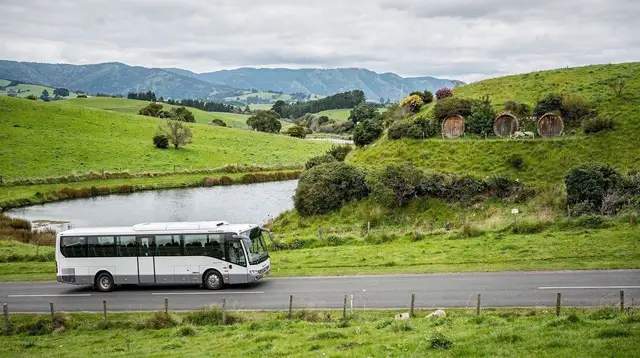
There is no independent or drive-up access to Hobbiton. It sits on private farmland, and every visit runs as a scheduled, guided walk-through booked in advance — you cannot simply turn up at the gate. From Rotorua, that means either a self-drive to Matamata to join a scheduled tour on site, or a coach tour that collects you in Rotorua and handles the whole day, including the drive.
a guided walk through the film set itself is the baseline way to see it; several operators also run it as a coach day trip departing Rotorua, which removes the need to drive.
For the practical side of getting there, timing the visit, and what a walk-through actually covers, see Hobbiton Movie Set: A Complete Guide and Hobbiton from Rotorua: How to Get There.
Mount Doom Is a Real Volcano You Can See, Not Climb Into
Mount Doom’s exterior shots used Mount Ngauruhoe, the sharply conical peak inside Tongariro National Park, roughly two hours and twenty minutes from Rotorua by road. Unlike Hobbiton, nothing was built here — the mountain itself did the work, filmed from various angles to stand in for Sauron’s volcano, with visual effects doing the rest for the crater and the lava.
Ngauruhoe is a genuinely active volcano, not a prop, and that changes what a visit means in practice. The Department of Conservation discourages climbing onto Ngauruhoe’s slopes because the scree is loose and unstable and the volcanic risk is real, not decorative. On top of the physical hazard, the mountain holds deep cultural significance to local iwi, who regard it as sacred — a further reason it is treated as a peak to be viewed and respected rather than conquered for a photo.
In practice, most visitors see Ngauruhoe from the Tongariro Alpine Crossing, a full-day alpine walk that passes close beneath the mountain’s flank without requiring anyone to summit it, or from lookout points and roads within Tongariro National Park. There is no “Mount Doom set” waiting at the end of a track, no crater rim you climb to, and no way to stand where the film’s lava sequences appear to have been shot — those were built and finished with effects work, not filmed live on the summit.
For the walk itself, distances, and what to expect from Rotorua, see Tongariro Alpine Crossing from Rotorua and the wider Tongariro National Park destination page.
The Anduin, the Argonath, and the Parts That Were Never Here
This is the category worth being honest about: a large share of the trilogy’s most memorable “wide shot” landscapes were never within reach of Rotorua at all, and no amount of clever day-trip planning changes that. The river journey associated with the Fellowship, including the towering Argonath statues carved into the cliffs, was filmed on a river system well to the south of Rotorua, on the North Island’s central-southern stretch — a location that has nothing built or visitable on site today, since the statues themselves existed only as film props and digital additions.
Further afield again, Isengard and the plains of Rohan were filmed on the South Island, around Queenstown, Twizel, and Wanaka — more than a thousand kilometres from Rotorua and a Cook Strait ferry crossing away. Rivendell used a forested gorge near Wellington, at the opposite end of the North Island from Rotorua. None of these fit into a Rotorua-based itinerary in any realistic sense, whether by day trip, overnight stay, or detour.
The pattern is consistent: anything filmed as a sweeping establishing shot — a river valley, a mountain range, a plain — tends to sit far from Rotorua, chosen for its emptiness and scale rather than its proximity to anything else. Anything you can actually walk into on a ticketed visit, by contrast, had to be built, and Hobbiton is the one example of that near Rotorua that still stands.
| What you remember from the films | What was actually filmed there | Distance from Rotorua | Can you visit it today |
|---|---|---|---|
| Hobbiton, the Shire | A real, built set on a working farm | ~50 min | Yes, guided tour only |
| Mount Doom (exteriors) | Mount Ngauruhoe, Tongariro National Park | ~2 h 20 | Viewed or hiked near, not climbed into |
| The Anduin, the Argonath | A river valley well south of Rotorua | Not a day-trip distance | No set remains; nothing built to see |
| Isengard, Rohan’s plains | South Island high country | Over 1,000 km, ferry required | No — outside North Island range |
| Rivendell | A forested gorge near Wellington | Full-day drive one-way | Not realistic from a Rotorua base |
Where This Leaves a Rotorua-Based Trip
If Lord of the Rings is a genuine reason for visiting this part of New Zealand, Hobbiton is the one stop that delivers on it directly, and it slots neatly into a Rotorua itinerary as a half-day or full-day trip depending on what else you attach to it. Tongariro National Park adds a second, very different kind of connection — not a film set, but the actual mountain the effects team pointed a camera at, set inside one of the country’s oldest national parks and a double World Heritage site in its own right.
Everything else — the rivers, the plains, the elven refuges — belongs to a different, much longer trip that would need to cross to the South Island or drive the length of the North Island, and has no practical place in a Rotorua-based plan. Treating them as background reading rather than as stops avoids the disappointment of arriving somewhere expecting a set and finding an ordinary paddock or river with nothing marked at all.
For travellers building a full day around Hobbiton, pairing it with other Waikato stops cuts down on driving without wasting the trip: a combined day covering Hobbiton along with Waitomo’s caves and the Blue Spring is one way operators package it, since all three sit within a similar radius west of Rotorua. Travellers heading south toward Taupō on the same trip sometimes combine the two ends of this itinerary into one long day: a day tour linking Huka Falls, geothermal hot springs, and Hobbiton covers Taupō and Waikato stops without requiring an overnight stay away from Rotorua.
The caves themselves are worth understanding on their own terms rather than as a film location — the glowworm caves at Waitomo were not used in the trilogy, but sit close enough to Hobbiton that most itineraries link the two anyway; see Waitomo Glowworm Caves: Which Tour to Choose for how that pairing usually works.
Practical Notes for Planning Around Film Locations
A few points make the planning easier once the geography is clear. First, driving distances matter more than film logic — Hobbiton and Ngauruhoe both sit within a manageable radius of Rotorua, but they are in opposite directions and rarely combine into a single day. See Rotorua Day Trips for how these fit against other options radiating from town, and Getting to Rotorua if you’re arriving from further afield and building the wider trip around this one.
Second, Hobbiton bookings fill up, particularly around New Zealand’s summer, so treat the guided visit as something to arrange ahead of arrival rather than a same-day decision. Third, nothing about visiting Ngauruhoe or the Tongariro Alpine Crossing is film-related in practice — it is an alpine day walk with its own weather risks, fitness demands, and track conditions that change with the seasons, entirely separate from anything to do with the movies. Track status and access can shift with weather and volcanic activity, so check current conditions with the Department of Conservation or a local operator rather than assuming the route described in older accounts still applies unchanged.
Finally, resist the urge to fold South Island or far-north locations into a Rotorua-based plan just because they appeared in the same films. A trip built around what’s genuinely reachable — Hobbiton, Tongariro, and the geothermal and cultural sites Rotorua is actually known for — holds together far better than one stretched to chase scenery that was always going to be a plane flight and a ferry away.
Questions About Visiting Middle-earth Locations Near Rotorua
Can you actually climb Mount Doom?
No. Mount Doom’s exterior shots used Mount Ngauruhoe, a real active volcano in Tongariro National Park. Climbing onto Ngauruhoe itself is discouraged by the Department of Conservation because of loose scree, volcanic hazard, and because the mountain is sacred to local iwi. Most visitors see it from a distance on the Tongariro Alpine Crossing rather than standing on its summit.
Is Hobbiton in Rotorua?
No. Hobbiton sits on the Alexander farm near Matamata, roughly 50 minutes’ drive from Rotorua. It is a genuinely popular day trip from Rotorua, but the town itself has no film set — Rotorua’s own drawcards are its geothermal parks and Māori cultural sites.
Was the Anduin River filmed near Rotorua?
No. The river sequences associated with the Fellowship’s journey, including the Argonath statues, were filmed well south of Rotorua, on a different river system entirely. There is no Anduin-adjacent site to visit from a Rotorua base.
Can you visit Isengard, Rivendell, or Edoras from Rotorua?
No. Those locations were filmed far from the Rotorua region — Rivendell near Wellington, and Isengard and Edoras on the South Island, hundreds of kilometres and a Cook Strait ferry crossing away. None of them fit into a North Island Rotorua itinerary.
Do you need a guided tour to visit Hobbiton?
Yes. Hobbiton sits on private farmland and is only accessible as part of a ticketed, guided visit — there is no self-guided or drive-up access to the set itself.
What is actually left of the film set at Hobbiton?
Hobbiton was rebuilt in permanent materials for The Hobbit films in 2011 and has stayed standing since, unlike the temporary set used for the original trilogy. The 44 hobbit holes, the Party Tree, and the Green Dragon Inn are all part of the same working farm you walk through on a tour.
Are there combined tours that cover Hobbiton and other nearby stops?
Yes. Several operators pair a Hobbiton visit with other Waikato stops on the same day, such as the Blue Spring or Waitomo’s glowworm caves, which suits travellers basing themselves in Rotorua rather than staying overnight near Matamata.
Hobbiton Movie Set tours on GetYourGuide
Verified deep-linked GetYourGuide tours. Book through these links and we earn a small commission at no cost to you.
Photos show the destination, not the operator's own images.