Things to do in Rotorua
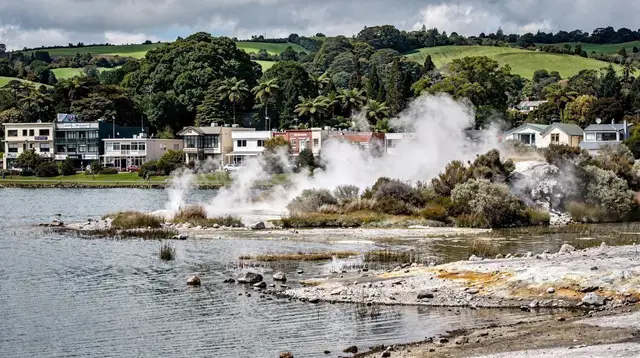
Rotorua sits on an active caldera in the Taupō Volcanic Zone, and it shows: steam rises from public parks, geysers erupt on a schedule nobody set, and the Te Arawa people have lived on this ground for six centuries. Around it, an hour in any direction opens caves, coastline and volcanoes.
Signature experiences
The six that define a first visit — the geothermal parks, Māori culture in a village where people still live, the hot pools, Hobbiton at Matamata, the Waitomo glowworm caves, and the Kaituna's seven-metre waterfall.

Geothermal parks
Wai-O-Tapu's Champagne Pool, Te Puia's Pōhutu geyser, Waimangu's valley born of the 1886 eruption, and Hell's Gate's boiling mud — six parks that are genuinely different from one another.
4 guides
Māori culture
Whakarewarewa, where Tūhourangi Ngāti Wāhiao still live and cook in the steam; Te Puia's carving and weaving school; and evening experiences with haka and a hāngī dinner.
5 guides
Hot pools and spa
Acidic and alkaline springs side by side at the lakefront, forest hot tubs among the redwoods, and free thermal streams for those who know where to look.
3 guides
Hobbiton Movie Set
Forty-four hobbit holes rebuilt permanently in 2011 on a Waikato sheep farm, fifty minutes from Rotorua. Guided visits only — there is no way to wander in.
3 guides
Caves and glowworms
Waitomo's limestone caves and their ceilings of Arachnocampa luminosa, reached by boat, by black-water tube or on a zipline — and closer glowworm spots around the Rotorua lakes.
2 guides
Whitewater rafting
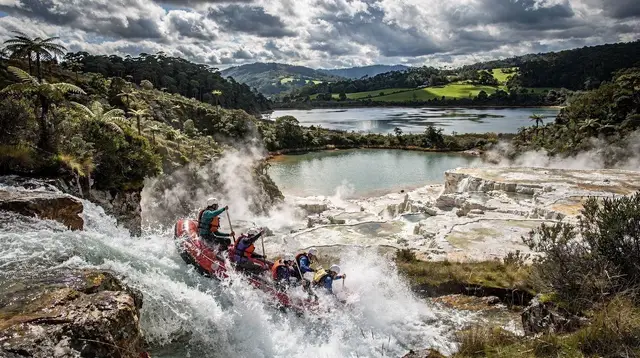
Tutea Falls on the Kaituna is seven metres high and the highest commercially rafted waterfall in the world. The Rangitāiki and Tongariro rivers offer gentler grades.
2 guidesMore ways to experience Rotorua
Specialist interests and practical planning — mountain biking in the Redwoods, scenic flights over Mount Tarawera, the Bay of Plenty beaches, and the seasonal timing and comparisons every first-time visitor searches for.

Adventure and adrenaline
Ziplines through native forest, the luge on Mount Ngongotahā, Velocity Valley's five rides, canyoning at Raglan, and the bungy and skydiving an hour south at Taupō.
3 guides
Lake cruises
Amphibious duck tours, dinner cruises on Lake Rotorua, and the sail across Lake Taupō to the Māori rock carvings that can only be reached from the water.
2 guides
Kayaking
Evening paddles to hot springs on Lake Rotoiti that no road reaches, glowworm tours after dark, and tandem descents of the Kaituna.
1 guide
Walks and hiking
Free trails through the Redwoods and Whirinaki, the Tarawera Trail along the lake, and the Tongariro Alpine Crossing — 19.4 km and a long day, two hours south.
2 guides
Mountain biking
Around 180 km of trails in Whakarewarewa Forest, from beginner loops to World Cup descents, with a shuttle to the top and rental in town.
1 guide
Volcanoes and craters
Mount Tarawera split open in 1886 and can only be visited with a guide; Waimangu and Whakaari tell the rest of the story.
1 guide
Scenic flights
Floatplanes from the lakefront, helicopter landings on the Tarawera crater rim, and flights over Whakaari — the only way to see the volcano since 2019.
1 guide
Wildlife and nature
The national kiwi hatchery, farm shows with shearing and lamb feeding, and dolphin trips from Tauranga and Whakatāne on the coast.
3 guides
Beaches and coast
Mauao's summit above Mount Maunganui, eleven kilometres of sand at Ōhope, the long left-hand break at Raglan, and Cathedral Cove on the Coromandel.
2 guides
4WD and off-road
Buggies on Mount Ngongotahā, four-wheel-drive routes to the Tarawera crater, and self-drive bush safaris on private forestry land.
1 guide
Food and drink
Hāngī cooked in geothermal steam rather than an earth oven, Eat Streat's restaurants, and the trout you have to catch yourself because nobody may sell it.
2 guides
Family-friendly
The luge, the treewalk, mini golf, farm shows and shallow warm pools — the activities that work for short legs and short attention spans.
1 guide
Arts and museums
Wood carving and flax weaving at the national institute, pounamu jade studios, the buried village of Te Wairoa, and the 1908 Bath House in the Government Gardens.
2 guides
Transport
Three hours from Auckland, one from Tauranga and Taupō. Buses, operator shuttles and rental cars — plus what is genuinely reachable without driving.
4 guides
Sightseeing and day tours
Guided runs that combine a geothermal park, a Māori experience and the forest in one day — and an honest account of what they skip.
2 guides
Day trips
Hobbiton in fifty minutes, Taupō and Tauranga in an hour, Waitomo in two, the Coromandel in three — ranked by driving time, not by brochure.
5 guides
With kids
What works at four, at eight and at thirteen — and the three activities where families most often waste their money.
1 guide
Where to stay
Town centre, lakefront, Ngongotahā or Fairy Springs, plus holiday parks and the accommodation that comes with its own thermal pool.
2 guides
Budget
What is genuinely free, what earns its price, and what a day actually costs — GST included, because in New Zealand the displayed price is the price paid.
3 guides
Planning
The sulphur smell and how fast you stop noticing it, geothermal safety, accessibility, the NZeTA, and what to pack for an extreme UV index.
7 guides
When to go
There is no dead season. Summer runs December to February, winter June to August, and the steam is at its most spectacular in the cold.
4 guides
Compare options
Te Puia or Whakarewarewa, which geothermal park, which Waitomo cave, which Māori evening — the choices first-time visitors actually face.
8 guides
The honest verdict
What is worth the trip, what is oversold, and who Rotorua will not suit. Written to be disagreed with.
2 guidesBrowse by destination
Tours and activities organised by where you're headed — the best of each city and region.
Good to know about things to do in Rotorua
Rotorua's things-to-do hub is organised by activity rather than by suburb, since most categories reach across the wider region rather than sitting inside the city itself. Geothermal Parks covers Te Puia and its Pōhutu geyser, Wai-O-Tapu with the Champagne Pool and the Lady Knox geyser, Waimangu Volcanic Valley, and Hell's Gate at Tikitere, the most active of the group. Maori Culture centres on Whakarewarewa, the living village of Tūhourangi Ngāti Wāhiao, alongside Te Puia's carving and weaving schools and Ōhinemutu on the lakefront, and often overlaps with Food & Drink through the hāngī, food cooked over geothermal steam or in an earth oven.
Hot Pools & Spa covers the mineral pools drawing on the same geothermal water as the parks. Hobbiton Movie Set is its own category, since it sits near Matamata rather than in Rotorua proper, and Caves & Glow-worms points the same way, to the limestone caves at Waitomo. Whitewater Rafting is anchored to the Kaituna River and Okere Falls, including Tutea Falls, said to be the highest commercially rafted waterfall in the world, while Adventure & Adrenaline covers the zorbing, luge and other purpose-built activities the region is known for.
Lake Cruises and Lakes & Kayaking both draw on Lake Rotorua and its neighbours — Rotoiti, Tarawera, Ōkataina and Tikitapu — with Rotokākahi excluded as a tapu lake closed to recreation. Hiking & Walks ranges from the flat trails of The Redwoods to routes around Lake Tarawera, while Mountain Biking is centred on the roughly 180 kilometres of purpose-built trails through the same redwood forest. Volcanoes & Craters covers Mount Tarawera, accessible only on a guided tour, and reaches south to Tongariro National Park, and Scenic Flights covers helicopter and small-plane trips over Tarawera's crater and, from the Bay of Plenty, out to Whakaari / White Island.
Wildlife & Nature includes native bird encounters and nocturnal kiwi enclosures, since wild kiwi are not something visitors see by day. Beaches & Coast points outward to the Bay of Plenty and the Coromandel Peninsula rather than to Rotorua itself, which is inland, and Off-Road & 4WD covers farm-park and backcountry driving experiences around the wider region. Arts & Museums brings together Te Puia's national arts institute and the 1908 Bath House, now the Rotorua Museum.
Transport, Sightseeing & Day Tours, Day Trips, Family, Where to Stay, Budget, Planning, Seasonal and Comparison exist to answer the practical questions underneath all of this — how to get between the geothermal parks without a car, what works with children, and how to choose between two similar options, such as Wai-O-Tapu against Waimangu for a first geothermal visit.
Frequently asked questions about things to do in Rotorua
What's the difference between Whakarewarewa and Te Puia?
They share the same thermal valley. Whakarewarewa is a living village where Tūhourangi Ngāti Wāhiao residents still cook with geothermal steam; Te Puia is the national institute of Māori arts and crafts and home to the Pōhutu geyser.
Which geothermal park should I visit, Wai-O-Tapu or Waimangu?
Wai-O-Tapu has the Champagne Pool and the daily Lady Knox geyser eruption; Waimangu formed in the 1886 Tarawera eruption and is walked downhill through a volcanic valley rather than around a fixed loop.
Where can I go whitewater rafting near Rotorua?
The Kaituna River, which includes Tutea Falls at Okere Falls, a 7-metre drop said to be the highest commercially rafted waterfall in the world.
Can I see kiwi in the wild around Rotorua?
Not by day — kiwi are nocturnal, so visitors see them in dedicated nocturnal enclosures rather than in the wild.
Are Hobbiton and Waitomo covered on this hub?
Yes, as their own categories, even though both sit outside Rotorua itself — Hobbiton near Matamata, about 50 minutes away, and the Waitomo Caves about two hours away.
Sightseeing day tours on GetYourGuide
Verified deep-linked GetYourGuide tours. Book through these links and we earn a small commission at no cost to you.
Photos show the destination, not the operator's own images.