The Hobbiton Set That Refused to Be Demolished
I stood at the top of the Hobbiton path looking down at the party tree and the Green Dragon roofline, and the thing that stuck with me was not how pretty it looked. It was how permanent it felt. Nothing about it read as a film prop. It read as a place that had decided to stay.
That struck me as odd, because I already knew the story of the first set. When Peter Jackson’s crew built Hobbiton on the Alexander family’s sheep farm in 1999 for the original trilogy, the deal was straightforward: build it, shoot it, take it down. The land was working farmland, leased for a film, not sold for a theme park. The facades were timber frames, polystyrene, and cloth stretched over structures never meant to survive a winter, let alone a decade. Once filming wrapped, most of it came down, the way every other New Zealand location used for that trilogy eventually reverted to paddock, forest, or riverbank.
A set built to disappear
That is the part people forget when they walk the property today: disappearing was the plan, not the exception. Look at the rest of the Lord of the Rings filming locations around the North Island and you will not find sets standing in any of them. You find a field, a riverbend, a patch of forest that looks like any other patch of forest, with a plaque if you are lucky. That is normal practice. Film sets are temporary by design, and farmland has to keep being farmland once the crew leaves.
Hobbiton should have gone the same way. A few hobbit-hole facades survived by accident rather than intention, left standing because taking them down was not worth the effort, and curious visitors started turning up on their own to see them. That accidental leftover is what eventually became a proper visitor operation, years before anyone at the studio was thinking about a second trilogy.
Why the second build was different
By the time The Hobbit went into production in 2011, the calculation had changed completely. The temporary leftovers from 1999 had already been pulling in paying visitors for the better part of a decade. So when the studio came back to the same farm to rebuild Hobbiton for the new films, the conversation with the Alexander family was not “build it, shoot it, tear it down” anymore. It was “build it to last.”
That is the whole answer to why Hobbiton is still there and almost nothing else from either trilogy is. It was not filmed differently. It was built differently, on purpose, because everyone involved already knew there would be a business standing on the site long after the cameras left.
| 1999 build (original trilogy) | 2011 rebuild (The Hobbit) | |
|---|---|---|
| Intended lifespan | Length of the shoot only | Permanent |
| Core materials | Timber frame, polystyrene, cloth | Solid, weather-resistant construction |
| Fate after filming | Mostly dismantled | Kept as a year-round visitor set |
| Hobbit-hole facades | Fewer, temporary | 44, built to stay |
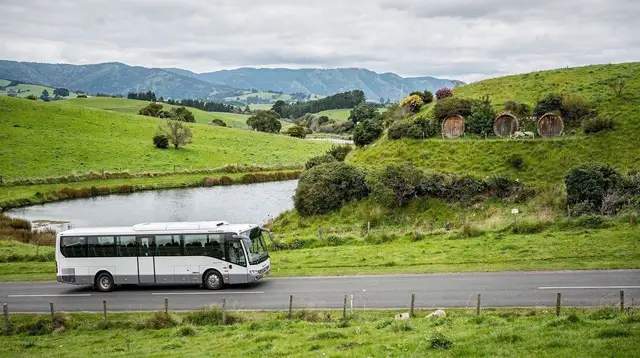
Walking round the 44 hobbit holes now, past the Green Dragon and back up toward the party tree, you can feel that difference under your feet. The paths are graded for foot traffic, not camera dollies. The doors and gardens are maintained the way you would maintain a real property, because in every practical sense it now is one.
What this means if you are planning the trip
Because Hobbiton is on private, working farmland with no public road access, you cannot simply drive up and wander in. Every visit runs through a booked tour that includes transport onto the property, which is worth knowing before you plan your Rotorua day trip. If you are coming from Rotorua, the standard way in is a half-day tour from Rotorua that includes transport and the walking tour of the set, since the farm sits near Matamata, roughly 50 minutes away rather than in Rotorua itself. Check how to get from Rotorua to Hobbiton if you are weighing a self-drive day against a coach tour, a question the self-drive versus guided tour comparison answers in more depth.
I found it worth pairing the visit with something that sits at the other end of the “what happens to a place after the story moves on” question. The buried village of Te Wairoa is the site actually destroyed by the 1886 Tarawera eruption, preserved as ruins rather than rebuilt as a set, its buried buildings sitting at the foot of Mount Tarawera itself. Seeing both on the same trip, one place kept standing by design and one place stopped in its tracks by an eruption, gave me a sharper sense of how differently “preservation” plays out depending on whether nature or a studio makes the call. A short guided visit to the buried village covers the excavated site and its small museum in an hour or two.
If you want the fuller picture before you go, the complete Hobbiton guide covers what the walking tour actually includes, and it is worth reading alongside a wider look at how the Lord of the Rings films reshaped New Zealand tourism, since Hobbiton is really the clearest physical evidence of that shift. For context on how Hobbiton fits into a Rotorua-based trip more broadly, I found Rotorua’s honest verdict and the piece on whether Rotorua feels too touristy useful for calibrating expectations, since Hobbiton draws a very different crowd than the geothermal parks do.
The part that surprised me most
What I did not expect, going in with the “it’s just a film set” mindset, was how much the permanence changes the experience. A leftover prop set would feel like visiting a ruin of someone else’s project. A rebuilt, maintained set feels like visiting a small, slightly surreal village that happens to have a very specific backstory. The Alexander farm is still a working sheep farm around the edges of the tour route, which somehow makes the illusion more convincing rather than less, because the ordinary rural land the set sits inside is completely real.
If you are still working out how many days to spend in Rotorua and whether the trip out is worth it, that is the honest case for it: not the promise of stepping into a film, but the oddity of a set that was allowed to become permanent, sitting on farmland that never stopped being farmland. Few film locations anywhere get that treatment, and knowing why this one did makes the walk through it land differently than it would if you thought it had simply always looked this way.
Hobbiton Movie Set tours on GetYourGuide
Verified deep-linked GetYourGuide tours. Book through these links and we earn a small commission at no cost to you.
Photos show the destination, not the operator's own images.