Rotorua: The Honest Verdict
Is Rotorua actually worth visiting?
Yes, for the geothermal landscape and living Māori culture — both genuinely rare and hard to find combined elsewhere. It suits travellers less well if they dislike sulphur smell, crowded thermal parks in the middle of the day, or come expecting alpine or glacier scenery, neither of which exists here.
Rotorua sits on top of one of the most active pieces of ground in the Pacific, and it has been selling that fact to visitors since the 1880s. Nearly a century and a half of tourism marketing has built up expectations that the town itself does not always meet. This is an attempt to separate what actually delivers from what is riding on reputation, and to say plainly who should spend their limited North Island days elsewhere.
What Actually Delivers
Two things in Rotorua are genuinely hard to replicate anywhere else, and they justify the trip on their own.
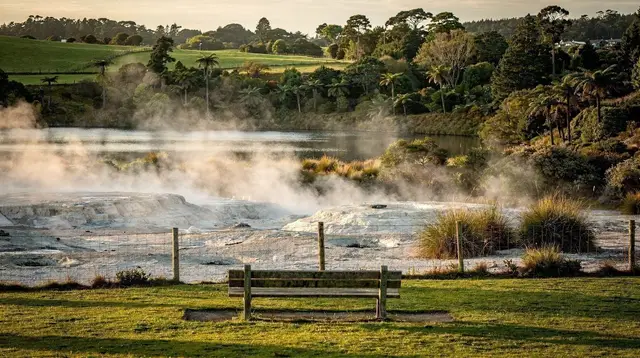
The first is the geothermal field itself, not as a curiosity but as a working landscape. Pōhutu geyser at Whakarewarewa erupts one to two times an hour without any artificial trigger, which is rarer than it sounds — most commercial geysers worldwide need help. Wai-O-Tapu, roughly 27 km south, adds colour chemistry that photographs undersell: the Champagne Pool’s orange rim is mineral deposit, not filter. Waimangu is the only geothermal system on Earth with a known birth date, the 10 June 1886 Tarawera eruption, and walking down through it makes that history tangible rather than read off a plaque.
The second is the Māori cultural experience, and specifically that it is lived rather than reconstructed. The Whakarewarewa village is a place people actually live and cook in, using the same geothermal steam their families have used for generations — it is not a re-enactment. Ōhinemutu, a working Ngāti Whakaue village inside the town itself, gets a fraction of the visitor numbers Whakarewarewa does despite sitting on the lakefront with St Faith’s church and its etched-glass Christ. For a guided version that pairs the geothermal and cultural sides in one stop, the Te Puia visit covering the national arts and crafts institute alongside Pōhutu is a reasonable single booking rather than two separate tickets.
The Redwoods forest is a smaller but honest surprise: sequoias planted in 1901 that now form one of the more respected mountain-biking networks in the world, plus a canopy walkway that works equally well after dark. None of this requires a tour company to be worthwhile — see the free walking tracks around the Redwoods for a no-cost version of the same forest.
What’s Overrated
Reputation and current reality have drifted apart in a few specific places, and it is worth naming them rather than let a first-time visitor discover it on arrival.
The Bath House, the 1908 building at the centre of the Government Gardens that appears on most postcards of the town, has been closed since 2016 for seismic strengthening. It reopens in stages, and at the time of writing there is no complete public interior to visit — it remains a facade to photograph, not a destination in its own right. Check current status with the museum and Government Gardens guide before planning around it.
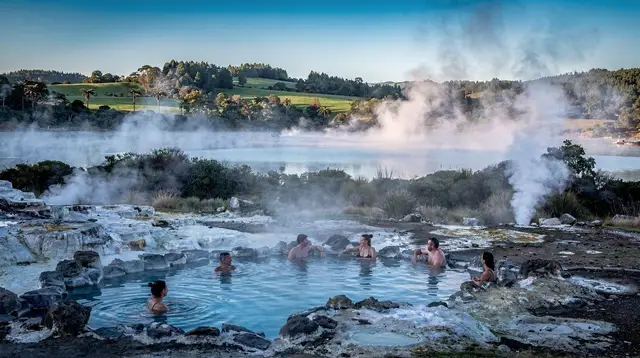
Several mud-bath and spa add-ons sold heavily to visitors overlap almost entirely with what a single well-chosen geothermal park already shows for less money. If you have already walked through Wai-O-Tapu or Waimangu, a separate paid mud-pool stop rarely adds anything new — see the geothermal parks comparison to pick one park properly rather than sampling several thinly.
Midday crowding at the two best-known parks is real and avoidable. Tour buses cluster at Whakarewarewa and Wai-O-Tapu from roughly mid-morning through early afternoon; arriving at opening or in the two hours before closing changes the experience substantially, and rain does not hurt the geothermal parks the way it hurts a beach day — steam and colour often look better in overcast light.
The town centre’s general geothermal theming — steaming drains, sulphur branding on shopfronts — is authentic but repetitive after the first day. It is not a reason to extend a stay; it is a backdrop, not an activity.
Who Rotorua Won’t Suit
Some travellers will leave disappointed, and it is more useful to say so than to oversell the town to everyone.
Anyone with a strong aversion to the smell of hydrogen sulphide — a rotten-egg odour that is unavoidable inside the thermal parks and noticeable in pockets around town — should know this going in; it is not a minor detail that fades with a nice view. Read why Rotorua smells of sulphur for where it is strongest and where it isn’t.
Anyone picturing glaciers, fjords, or permanently snow-capped peaks has the wrong island. Milford Sound, the Southern Alps, and Aoraki/Mount Cook are all on the South Island, over 1,000 km away — nothing in the Rotorua area resembles them, and no itinerary from here should try to include them as a side trip.
Visitors with only one full day in the North Island are usually better served staying near Auckland or heading to the Bay of Islands; Rotorua’s value is in the combination of sights across two-plus days, and a single rushed day tends to produce one geothermal park and not much else. The one-day itinerary is honest about how much that actually covers.
Travellers who want their culture kept at a comfortable, non-participatory distance may find the marae protocols and cultural performances more involving than expected — this is a request for respectful engagement, not passive viewing. See Māori cultural etiquette in Rotorua before booking a performance or hāngī.
Finally, anyone hoping to see Whakaari / White Island up close should know that landings stopped after the 9 December 2019 eruption, which killed 22 people. Only scenic flights and boat approaches from a distance now operate — see Whakaari after 2019 for what is and isn’t currently offered.
Accessibility: More Manageable Than It Looks
One more group deserves a direct answer: travellers unsure whether reduced mobility rules Rotorua out. It mostly doesn’t. The boardwalks at Whakarewarewa, Wai-O-Tapu, and Te Puia are flat, wide, and built for the volume of visitors they get, which makes them more manageable underfoot than many outdoor attractions elsewhere in New Zealand. Waimangu’s descending walkway and the guided ascent of Mount Tarawera are the exceptions — both involve sustained gradient or uneven ground with no easy alternative route built in. The practical answer is to check the specific site rather than assume either way applies to the whole town; the Rotorua accessibility guide breaks this down park by park instead of treating Rotorua as uniformly easy or uniformly difficult.
Rotorua vs. the Alternatives
| If you’re deciding between… | Rotorua wins when | The alternative wins when |
|---|---|---|
| Rotorua or Taupō as a base | Geothermal parks and Māori culture are the priority | The lake itself, Huka Falls, or an early Tongariro Alpine Crossing start matter more |
| Rotorua or Queenstown | Geothermal landscapes and cultural depth | Alpine scenery, glaciers, and adrenaline sports at scale |
| A full day here or a cruise-ship stopover from Tauranga | You have two or more days to spend | You have under six hours and need to prioritise ruthlessly |
When Half a Day Is All You Have
Sometimes a full day genuinely isn’t on the table — a cruise-ship call at Tauranga, a tight stopover between other North Island stops. In that case the honest move is to pick one thing and accept the trade-off, rather than try to compress the highlights list into a rushed loop. A single geothermal park plus a short cultural stop such as Ōhinemutu covers more ground per available hour than trying to string together a park, a village, and a lake cruise in four hours. Wai-O-Tapu also asks for a longer round trip from town than Whakarewarewa does, which matters more once the clock is fixed rather than flexible. The cruise-ship day trip guide sizes a half-day realistically against that constraint, rather than optimistically against the full list of what Rotorua offers.
The Honest Cost of a Visit
Rotorua is not a cheap add-on to a North Island trip once tour entries stack up, but it scales down reasonably well. As a rough per-person, per-day guide: budget travellers land around 150 NZD, mid-range around 350 NZD, and a higher-comfort visit around 700 NZD — these bands cover the range from hostel-and-free-attractions to private tours and better accommodation. New Zealand’s 15% GST is already included in every price you see, and tipping is not expected anywhere. For ways to keep the lower end realistic without missing the two things that actually matter, the Rotorua on a budget and free things to do guides are more useful than trying to cut corners on the geothermal parks themselves, which are the reason to come.
For a day trip that bundles the geothermal and cultural highlights into one booking rather than several separate entries, the day tour from Hamilton covering Wai-O-Tapu, Te Puia, and a haka performance is a reasonable option for visitors without a car, though self-driving the same combination costs less if you already have transport — see guided tours versus self-drive for the trade-off.
What’s Genuinely Underrated
A few things get less attention than they deserve, usually because they compete against the two headline attractions for a visitor’s limited time.
Hell’s Gate / Tikitere, roughly 16 km northeast, is the most active geothermal site in the area and the only one where entering a mud bath is actually part of the visit — it draws noticeably fewer visitors than Wai-O-Tapu despite arguably more raw activity. Kuirau Park, free and inside the town itself, delivers a real geothermal park experience with zero entry fee, which makes it worth a stop even for budget-conscious visitors who skip the paid parks.
Further from the tourist core, guided walks through native forest away from the geothermal circuit offer a different side of the region entirely — old-growth bush rather than steam vents. The guided Whirinaki Forest walk led by local guides is a useful counterweight if two straight days of geothermal parks start to feel repetitive.
Mount Tarawera itself, the mountain that opened up in 1886 and destroyed the Pink and White Terraces, is accessible only with a guide because the land belongs to the iwi — this restriction is often read as an inconvenience, but it is also why the site remains uncrowded compared to almost everything else on this list.
Season Changes What You’re Actually Getting
The verdict above holds in any season, but what a visit actually delivers shifts noticeably between them, and it is worth setting expectations before booking dates rather than after. Winter (June to August) means shorter daylight and maxima around 12-13°C, but the steam and colour at the geothermal parks read more dramatically against cold air than they do in summer haze — a genuine trade rather than simply a downside to tolerate. Summer brings maxima near 23-24°C, long evenings, and swimmable lakes, but also the fullest car parks of the year and a UV index that visitors regularly underestimate until they are sunburnt on day one. Neither season is a wrong time to come; each changes which part of the experience is strongest and which requires more planning around. See Rotorua in winter and Rotorua in summer for the specifics, or best time to visit Rotorua for a single side-by-side comparison.
Making the Call
Rotorua earns its long-standing status as the North Island’s most visited destination through two genuinely distinctive things: a geothermal landscape you can walk through safely, and a Māori cultural presence that is lived rather than performed for tourists. It does not earn it through the town centre, the closed Bath House, or the mud-bath upsells layered onto tours that already cover the same ground. Two to three days spent deliberately — one geothermal park chosen well rather than several sampled thinly, one cultural experience taken seriously rather than rushed — will show most visitors what the reputation is actually built on. See how many days in Rotorua to size a visit against your own itinerary, and is Rotorua touristy for a closer look at which specific spots to avoid at peak times.
Rotorua Honest Verdict: Common Questions
Is Rotorua worth visiting?
Yes, for two things nowhere else combines: an active geothermal field you can walk through and a Māori cultural presence that is lived, not staged for a museum case. Beyond those two, the town itself is unremarkable, and several attractions trade on reputation more than on what they currently deliver.
Is Rotorua too touristy?
Parts of it are. Whakarewarewa and Wai-O-Tapu get full car parks and tour-bus waves around late morning, and the town centre leans hard into geothermal branding. Ōhinemutu, Kuirau Park, and the Redwoods forest see far fewer people for a comparable or better experience.
How many days do you need in Rotorua?
Two full days cover one geothermal park and one cultural experience without rushing. Three to four days let you add a lake, a walk, and a day trip to Waitomo or Hobbiton. Beyond four days, most visitors are repeating variations on the same geothermal theme.
Does Rotorua really smell of sulphur the whole time?
The hydrogen sulphide smell is noticeable in pockets — near Kuirau Park, some accommodation close to the geothermal field, and inside the thermal parks themselves — but it is not constant across the whole town, and most visitors stop registering it within a day.
Is Rotorua a better base than Taupō?
For geothermal parks, Whakarewarewa, and Māori cultural experiences, Rotorua is the shorter drive to almost everything. Taupō suits visitors prioritising the lake itself, Huka Falls, or an early start on the Tongariro Alpine Crossing.
Who should skip Rotorua?
Travellers with a strong sulphur-smell aversion, anyone expecting glaciers, fjords, or snow-capped peaks (that is the South Island, over 1,000 km away), and anyone with only one day in the North Island who would get more from Auckland or the Bay of Islands.
What’s overrated in Rotorua?
The Bath House building has been closed for seismic strengthening since 2016 and is worth a photo from outside, not a stop. Several mud-bath and geothermal spa add-ons sold as must-do experiences duplicate what a single well-chosen thermal park already shows you for less money.
Is Rotorua accessible for visitors with mobility limitations?
Many of the geothermal boardwalks at Whakarewarewa, Wai-O-Tapu, and Te Puia are flat and wide, which is not always obvious in advance. Waimangu’s descending walkway and the guided ascent of Mount Tarawera involve steps or uneven ground with no easy alternative. Check the specific site rather than assuming either way.
Is Rotorua worth visiting in winter?
Yes — winter shortens the daylight and cools the evenings, but it also makes the steam and colour at the geothermal parks more dramatic against cold air than in summer haze. It suits visitors prioritising the thermal parks over lake swimming or long outdoor days.
Rotorua tours worth booking, on GetYourGuide
Verified deep-linked GetYourGuide tours. Book through these links and we earn a small commission at no cost to you.
Photos show the destination, not the operator's own images.