Mount Maunganui: Mauao Summit, Beach and Hot Pools
What can you do at Mount Maunganui in one day?
Walk to the summit of Mauao (about 45 minutes up, roughly 1.5-2 hours return), do the flat 3.4 km base loop, spend time on the ocean beach, and finish with a soak in the hot saltwater pools at the foot of the mountain. It works comfortably as a day trip from Rotorua, about an hour's drive away.
Mauao: the mountain that isn’t in Rotorua
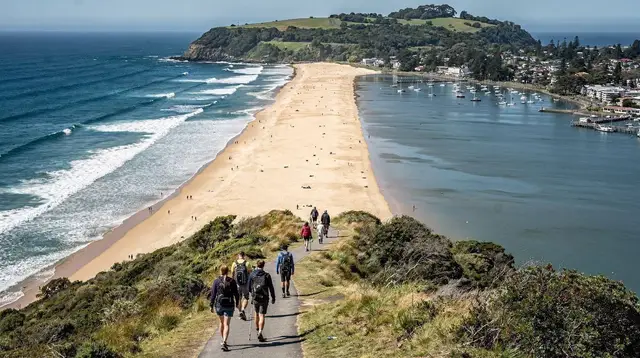
Mount Maunganui sits about an hour north of Rotorua, on a narrow peninsula where the Bay of Plenty coastline meets Tauranga harbour. It’s a different kind of landscape from the geothermal valleys around Rotorua: no steam, no sulphur smell, just an extinct volcanic cone called Mauao standing 232 metres above a long ocean beach. Locals call the town “the Mount,” and the name covers both the cone itself and the small peninsula suburb wrapped around its base.
The appeal here is straightforward and doesn’t need much selling: climb the mountain, walk the flat loop around it, spend time on the beach, then soak in hot saltwater pools at the end of the day. It’s a full day out, or a relaxed half-day if you skip the summit. Either way, it pairs naturally with a stop in Tauranga itself, since the two towns sit either side of the harbour bridge.
Climbing Mauao: the summit walk
The summit track starts from the base of the mountain, on the ocean side near the surf club, and climbs through farmland and coastal bush to the top. Most people take around 45 minutes to reach the summit from the base car park, though the pace varies a lot — some walkers move faster, families with young children take longer, and everyone stops for the views at some point.
The track is sealed for the lower and middle sections, switching to a gravel and stepped path higher up. There’s no scrambling and no exposure that requires hands, but the gradient is real: several stretches are steep enough that most walkers slow to a steady plod rather than a stroll. Benches are placed at intervals, mostly at the points where the view opens up over the harbour on one side and the open ocean on the other.
From the top, on a clear day, the view takes in the whole sweep of the Bay of Plenty coast, Ōhope Beach and Whakatāne to the east, and — weather permitting — the plume of Whakaari / White Island further out on the horizon. Coming down takes noticeably less time than going up; most people are back at the base within 30 to 40 minutes of leaving the summit.
A few practical points:
- Footwear matters more than the distance suggests. The steeper gravel sections get slippery when wet, and the Bay of Plenty gets rain year-round, so trainers with some grip are worth it over flat sandals.
- Start early or late in summer. New Zealand’s UV levels are extreme in the December-to-February months, and there’s limited shade on the upper track. An early morning or late afternoon climb is more comfortable than a midday one.
- Sunrise and sunset climbs are popular. Because the peninsula faces both the harbour and the open ocean, the mountain catches both ends of the day well, and it’s common to see other walkers timing their climb around either.
- The track can close after heavy rain or storm damage. Slips happen on this coastline the way they do across the rest of the North Island, so if a visit falls right after severe weather, it’s worth checking with Tauranga City Council or the Department of Conservation for the current track status rather than assuming it’s open.
The base track: the easy option
Around the foot of Mauao runs the base track, a flat, roughly 3.4-kilometre loop that circles the mountain at sea level. It’s sealed for most of its length, wide, and largely accessible to prams, wheelchairs and anyone who wants the coastal scenery without the climb. It passes rocky shoreline on the ocean side and gives views back across the harbour toward Tauranga’s port on the other.
This is the piece of Mauao that works for almost anyone, including visitors who’d rather not tackle the summit, or who want a shorter add-on after already climbing it. Walking the full base loop plus the summit return in the same outing is a common combination and fits into two to three hours total, including stops.
The ocean beach
On the seaward side of the peninsula runs a long stretch of ocean beach, one of the more popular swimming and surfing beaches in the Bay of Plenty. It’s patrolled by surf lifesavers during the main summer season, with flagged sections marking the areas considered safest for swimming on a given day — worth checking, since conditions along open Pacific coastline can shift with wind, swell and rips faster than they look from the sand.
The beach also has a reliable-enough surf break for people learning. A number of operators run lessons and board hire out of the Mount Maunganui area, aimed mostly at complete beginners rather than experienced surfers chasing a specific swell. A two-day beginner surfing course in Mount Maunganui is a practical way to get proper instruction over two sessions rather than trying to work it out solo on a rented board.
If the plan is to keep surfing further along the coast, Raglan on the west side of the North Island is the country’s best-known learner-friendly break, though it’s a separate trip in a different direction, not something to combine with a Mount Maunganui day.
The hot saltwater pools
At the base of Mauao, on the harbour side rather than the ocean side, is a small complex of hot saltwater pools. They draw on geothermal water from underground, similar in origin to the springs around Rotorua but delivered here as a set of open-air soaking pools rather than a spa treatment centre. They’re mineral, mildly sulphurous, and kept at a noticeably warmer temperature than the harbour water beside them.
The pools work well as the last stop of the day: after a summit climb and a walk on the beach, a soak takes the edge off tired legs before the drive back. They’re a public, walk-in facility rather than a resort — expect changing rooms and several pools of different temperatures rather than a luxury spa experience. This is a different thing from the geothermal spas around Rotorua itself, which sit inside an active caldera and draw on a different, larger geothermal field; the Mount Maunganui pools are smaller and more of a local amenity than a destination in their own right.
Getting there from Rotorua
Mount Maunganui is about an hour’s drive from Rotorua, mostly along State Highway 33 to Te Puke and then State Highway 2 into the Bay of Plenty. There’s no rail option, so a rental car, campervan or an organised tour are the practical choices. Parking near the base of Mauao fills up on fine summer weekends and over the main holiday season, so arriving before mid-morning makes a noticeable difference, especially if the plan includes the summit walk while the day is still cool.
For a different way to see the peninsula and the wider coastline without doing all the walking, a Tauranga and Mount Maunganui scenic tour by V8 trike covers a fair stretch of the area in around an hour and a half, which suits visitors short on time or travelling with people who can’t manage the summit climb.
Mount Maunganui also sits right beside Tauranga, the country’s busiest port and a regular cruise ship stop. If arriving that way, see the dedicated guide to spending a cruise ship day in the Rotorua area from Tauranga for how the timing usually works, and the wider Rotorua to Tauranga day trip guide for the reverse direction.
Planning a day at Mount Maunganui
| Activity | Approx. time needed | Notes |
|---|---|---|
| Summit walk (return) | 1.5–2 hours | Steep in sections; sealed then gravel/steps |
| Base track loop | 45–60 minutes | Flat, sealed, pram and wheelchair friendly |
| Beach time | Flexible | Patrolled in summer; check flags |
| Hot saltwater pools | 45–90 minutes | Best saved for the end of the day |
| Drive from Rotorua | About 1 hour | Via SH33 and SH2 |
A realistic full day looks like: leave Rotorua mid-morning, climb Mauao and walk part or all of the base loop, have lunch in the town at the base of the mountain, spend the afternoon on the beach or trying a surf lesson, then finish with the hot pools before the drive back. Families travelling with younger children, or anyone planning Rotorua with kids more broadly, can drop the summit climb and still get a full day out of the base loop, beach and pools alone.
Season and conditions
The Bay of Plenty follows the same reversed, southern-hemisphere seasons as Rotorua: summer runs December to February, winter June to August. Summer brings warm, swimmable conditions and the busiest beach and parking, along with the strongest UV of the year. Winter is quieter and cooler — swimming becomes a cold-water proposition rather than a casual one, but the summit walk and base loop stay pleasant, often with clearer air for the views. Rain falls year-round across the wider region, so a wet forecast doesn’t rule out a visit; it mainly changes whether the beach and pools, rather than the walk, become the focus of the day. For the wider pattern across the region, see when to visit Rotorua.
Anyone extending the trip further along the Bay of Plenty coast, or continuing on to the Coromandel Peninsula on a longer North Island route, will find a similar mix of beaches, walks and coastal activity — a guided zipline tour on the Coromandel is one option if that leg of a longer trip is on the itinerary. Closer to Mount Maunganui itself, keeping an eye out for dolphins in the bay is also possible on a dolphin swimming trip out of the Bay of Plenty, usually run as a separate half-day activity from Tauranga.
Mount Maunganui questions people ask
How long does it take to climb Mauao?
Most walkers reach the summit in about 45 minutes to an hour from the base, with several short, steep sections near the top. Coming down takes less time. Allow 1.5 to 2 hours for the full return trip if you also want to stop at the lookout points along the way.
Is the Mauao summit walk hard?
The base loop around the mountain is flat and easy, suitable for almost anyone. The summit track is a different matter: it’s a steady, at times steep, climb on a sealed and gravel path with steps. It is not technical, but it is a genuine uphill walk, not a stroll.
Can you swim at Mount Maunganui beach?
Yes. The main ocean beach runs along the outside of the peninsula and is patrolled by surf lifesavers during the summer season, with flagged areas for swimming. Conditions can change quickly with wind and swell, so check the flags and any posted warnings before going in.
What are the hot pools at Mount Maunganui?
They are a small complex of hot saltwater pools at the base of Mauao, on the harbour side of the peninsula, drawing on geothermal water rather than fresh spring water. They are separate from Rotorua’s geothermal spas and are used mainly for relaxing after the walk or a swim, not for treatment-style bathing.
Is Mount Maunganui good for surfing?
The main beach has a consistent enough break for beginners and intermediate surfers, and board and lesson operators run out of the area. It isn’t a specialist big-wave destination, but it’s an easy, accessible spot to try surfing for the first time or to get a few sessions in.
How far is Mount Maunganui from Rotorua?
It’s about an hour’s drive, mostly via State Highway 33 and State Highway 2 through the Bay of Plenty. It’s a manageable day trip, though an overnight stay lets you catch sunrise or sunset from the summit without rushing.
Do you need to book anything in advance?
The summit walk, base loop and beach are free and open access, no booking required. Surf lessons, guided tours and some parking areas in peak summer can fill up, so booking a lesson or arriving early for parking is worth doing between December and February.
Bay of Plenty coast tours on GetYourGuide
Verified deep-linked GetYourGuide tours. Book through these links and we earn a small commission at no cost to you.
Photos show the destination, not the operator's own images.