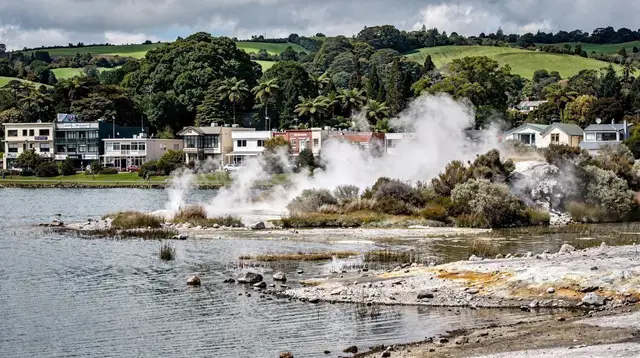
Dolphin Swimming in the Bay of Plenty
Where can you swim with dolphins near Rotorua, and how likely is it?
Trips leave from Tauranga and Whakatāne, both about an hour from Rotorua, in search of wild short-beaked common dolphins in the open water of the Bay of Plenty. Operators run under Department of Conservation permits and publish their own rolling encounter rate, which is not a guarantee for any single trip and shifts with the season.
Common dolphins, not bottlenose: what you’re actually in the water with
Rotorua sits inland, so a dolphin swim is never a Rotorua activity in the strict sense — it is a day trip out to the coast. The boats leave from Tauranga and Whakatāne, both roughly an hour’s drive from Rotorua, and head out into the open water of the Bay of Plenty looking for wild pods.
The species involved matters more than most visitors expect, because New Zealand’s dolphin swimming rules are not the same everywhere. In the Bay of Plenty, the animals are short-beaked common dolphins (Delphinus delphis): fast, highly social, and found in large open-water pods that can number in the dozens. That is a different animal, and a different regulatory situation, from the bottlenose dolphins associated with the Bay of Islands further north. Confusing the two matters, because the rules that apply to one do not automatically apply to the other, and a lot of general information about “swimming with dolphins in New Zealand” is really about a population and a set of restrictions that don’t apply here.
Common dolphins are not resident in the same fixed-territory way as some bottlenose pods. They range widely across open water searching for fish, which is both why sightings can be excellent on a good day — pods of thirty or more animals riding the bow wave — and why no operator can point to a guaranteed spot and promise dolphins will be there.
Where the trips leave from: Tauranga and Whakatāne
Two towns run these trips, and the choice mostly comes down to where you are already based rather than any real difference in the dolphins themselves.
Tauranga is the larger base, sitting next to Mount Maunganui and its cargo and cruise-ship port. If you are staying in Mount Maunganui, arriving on a cruise ship, or combining the swim with a Mount Maunganui day, this is the more convenient departure point. Boats head out from the harbour into the open Bay of Plenty, and the same stretch of water is searched regardless of which town you left from.
Whakatāne is smaller, further east, and puts you closer to Ōhope Beach and the view out to Whakaari / White Island. It has a longstanding reputation as a dolphin-swimming town going back decades, partly because it is one of the sunniest parts of the country and partly because it sits directly on the common dolphins’ coastal range. If your route already has you heading east past Tauranga, or you are combining the day with a look at Whakaari from the water, Whakatāne is the natural choice.
Neither location has a documented, reliable edge in sighting frequency over the other — both search the same population in the same body of water, and a good or bad day for one boat is largely a good or bad day for dolphins in the Bay of Plenty generally, weather and sea state included.
Season: when common dolphins are actually around
Common dolphins are present in the Bay of Plenty across the calendar, but “present” and “reliably found close enough inshore for a half-day boat trip” are not the same thing. Sightings and swim conditions both improve from spring into autumn, roughly October through April — the same stretch covered by New Zealand’s best time to visit window for outdoor activity generally. Warmer water, calmer seas, and longer daylight all favour both the dolphins moving inshore to feed and the boats being able to get swimmers in safely.
Winter trips (June to August) still run, but two things change. Sea conditions are rougher more often, which affects both comfort and the operator’s ability to get people into the water even if dolphins are sighted, and encounter rates published for the winter months tend to run lower than the summer figures. None of this is unique to dolphins — it tracks the same seasonal swing covered in Rotorua’s month-by-month weather, just applied to open coastal water rather than the inland lakes and geothermal valleys.
Remember that New Zealand’s seasons run opposite to the northern hemisphere’s calendar. A booking made for “summer” from a European or North American perspective needs to land between December and February here, not June.
The encounter rate operators publish — and what it actually means
Most Bay of Plenty dolphin-swim operators publish some form of running encounter rate on their own websites: the proportion of recent trips on which dolphins were sighted, sometimes broken down further into trips where guests actually got in the water with them. It is worth reading before booking, but it is worth reading correctly.
Three things are true of any published encounter rate. First, it is a rolling average, usually updated regularly, not a promise for your specific date — a strong recent run can be followed by several quiet days, and vice versa. Second, “sighted” and “swam with” are different figures on some operator sites; a pod can be seen from the boat and not be one that swimmers are put into the water with, most commonly because it includes young calves (more on that below) or because sea conditions on the day make an in-water encounter unsafe. Third, rates are seasonal even when the headline number on a site isn’t broken down by month, since the underlying presence of dolphins close to shore genuinely does move with the water temperature and time of year discussed above.
Treat a high published rate as a reasonable basis for booking, not as a guarantee. Ask the operator directly what happens if no dolphins are found — most Bay of Plenty operators offer some form of free return trip or partial credit, but the policy is set by each business individually rather than by any national standard.
What a swim actually involves
A dolphin swim day is built around several hours of active searching, not a scheduled encounter. Boats leave the harbour, and crew (sometimes assisted by aircraft or shore-based spotters) scan open water for pods. Once dolphins are found, the skipper assesses the pod — its size, behaviour, and crucially whether it includes calves — before deciding whether swimmers go in.
If conditions are right, swimmers enter the water in a group, generally holding onto a rope or float line trailed from the boat, and the boat manoeuvres to put the group in the dolphins’ path rather than swimmers chasing the animals directly. Wetsuits, snorkels, and masks are standard equipment, since Bay of Plenty water even in summer is genuinely cool. Encounters can last anywhere from a couple of minutes to a sustained pass with a curious pod, and it is common to have several separate approaches across the day if the first pod moves off or turns out to be off-limits.
Basic swimming ability is required, and most operators state a minimum age for entering the water rather than accepting all ages — check this directly with the operator you book, since it is not standardised. Non-swimmers and younger children can usually still join the trip and watch from the boat.
Tauranga and Whakatāne trips compared
| Tauranga departures | Whakatāne departures | |
|---|---|---|
| Typical trip length | Half-day to full-day | Half-day to full-day |
| Nearby base | Mount Maunganui, cruise port | Ōhope Beach |
| Distance from Rotorua | About 1 hour | About 1 hour 15 minutes |
| Add-ons sometimes offered | Snorkelling, coastal scenery | Snorkelling, view toward Whakaari |
| Reputation | Larger operator base, more sailing options | Long-established dolphin-swim town |
Durations, exact inclusions, and whether lunch or snorkelling gear is bundled in vary by operator and by trip, so treat this table as a starting point for comparing options rather than a fixed itinerary.
The rules that changed — and why swimming isn’t guaranteed everywhere
New Zealand’s approach to dolphin swimming has tightened noticeably over the past several years, and it is worth understanding why, because it shapes what you will and won’t be offered on the water. Dolphin encounters are managed under the Marine Mammals Protection Regulations, administered by the Department of Conservation, which sets permit conditions for every operator running these trips.
The clearest example of the shift happened further north: after years of monitoring showed a sustained decline in the resident bottlenose dolphin population in the Bay of Islands, DOC stopped issuing swim-with permits for that population in 2019. Boat-based dolphin viewing there continues, but swimming does not. That decision does not apply to the common dolphins of the Bay of Plenty, which are a separate, more numerous, and more wide-ranging population — but it reset the national conversation around dolphin tourism, and permit conditions across the country reflect a more cautious baseline than a decade ago.
In the Bay of Plenty specifically, the rules that operators work under include restrictions against swimming with, or pursuing, pods containing calves; limits on how boats approach and how long they can stay with a given pod; and codes of conduct around vessel speed and number of boats around one pod at a time. None of this is a reason to avoid booking — common dolphin swims remain a legally offered, actively monitored activity — but it explains why a sighting does not automatically become a swim, and why “the rules changed” is a fair thing to mention to visitors expecting an older, less restricted version of this activity.
Booking a dolphin swim from Rotorua
Both Tauranga and Whakatāne are comfortably reachable as a long day trip from Rotorua, similar in structure to the day trip to Tauranga many visitors already build into a Bay of Plenty stop. Because the activity depends on finding dolphins on the day, book with some flexibility in your itinerary rather than scheduling it for your last available morning before a flight — a same-day return trip due to no sighting, where offered, is only useful if you have another day free to use it.
a half-day dolphin swim departing Tauranga is the more compact option if you want to keep the rest of the day free for Mount Maunganui or the drive back to Rotorua. For a longer day that folds in snorkelling and a meal, a full dolphin swim, snorkel and barbecue day trip from Tauranga covers more of the coast and gives the boat more time searching before calling the day.
As with any wildlife encounter, factor in the standard costs of a full day away from Rotorua — fuel or transfers, wetsuit hire if not included, and a meal — which sit comfortably inside a mid-range daily budget for New Zealand travel. If you are travelling on a visa-waiver passport, confirm your NZeTA and entry requirements are sorted before you fly, since it is checked before boarding rather than on arrival.
If you don’t want to swim, or the dolphins don’t show
Open-water wildlife is not the only wildlife encounter based around Rotorua, and it is worth having a fallback in mind — either for a day when the boat returns without a sighting, or simply if getting into cool open water isn’t for you. New Zealand’s native wildlife, including the kiwi, is land-based, on a fixed schedule, and not weather-dependent in the same way.
a kiwi encounter at Rotorua’s National Kiwi Hatchery puts you close to New Zealand’s national bird in a nocturnal enclosure, which is the only realistic way to see one at all — kiwi are nocturnal and effectively unseeable in the wild during the day. Closer to a working-farm feel, a farm and kiwi experience at the Rotorua Agrodome pairs the same species with a broader look at New Zealand farm animals, and works well as a half-day activity that doesn’t depend on tides, boats, or a pod turning up offshore.
Either works as a standalone Rotorua morning or afternoon, or as the fallback plan if your dolphin-swim day happens to be the quiet one in that rolling encounter rate. Whatever you choose, New Zealand asks visitors to keep the same baseline respect for wildlife covered in the Tiaki Promise — keeping distance, not feeding animals, and letting a guide or skipper make the calls around approach.
Dolphin swimming in the Bay of Plenty: frequently asked questions
What kind of dolphins do you swim with in the Bay of Plenty?
Almost always short-beaked common dolphins, which travel in large, fast-moving open-water pods offshore from Tauranga and Whakatāne. They are a different species from the bottlenose dolphins found further north in the Bay of Islands, and the two populations are managed under separate rules.
Is dolphin swimming guaranteed on every trip?
No. Dolphins are wild and the boats search for them on the day, so no operator can promise a swim. Most publish an annual encounter rate on their own site and offer some form of return trip or credit if no dolphins are found, but the exact policy varies by operator.
What is the best time of year for dolphin swimming near Rotorua?
Common dolphins are seen year-round but are more reliably found close to shore from spring through to early autumn, roughly October to April, when the water is calmer and warmer. Winter trips still run but conditions are rougher and sightings less consistent, in line with New Zealand’s reversed hemisphere seasons.
Can children swim with dolphins in the Bay of Plenty?
Most operators set a minimum age for entering the water, often around 8 years old, with younger children welcome to watch from the boat. Check the age and swimming-ability requirements directly with the operator before booking, since they are not standardised across the Bay of Plenty.
Why did New Zealand change its dolphin swimming rules?
After a sustained decline in the Bay of Islands bottlenose dolphin population, the Department of Conservation stopped issuing swim-with permits there in 2019 and tightened the national code of conduct for all dolphin encounters. Bay of Plenty operators now work under permit conditions that can include seasonal restrictions and rules against approaching mothers with calves.
Tauranga or Whakatāne: which departure point is better?
Both search the same stretch of open water and see the same common dolphin pods, so neither has a structural advantage in encounter rate. Tauranga suits travellers basing themselves in Mount Maunganui or arriving by cruise ship, while Whakatāne is closer if you are also heading toward Ōhope Beach or looking at a Whakaari boat trip.
What happens if the dolphins have a calf with them?
Under the Marine Mammals Protection Regulations, boats and swimmers must not enter the water with, or pursue, a pod that includes very young calves. The skipper makes this call from the boat, so a pod can be sighted and still not be one you swim with that day.
Wildlife & nature tours on GetYourGuide
Verified deep-linked GetYourGuide tours. Book through these links and we earn a small commission at no cost to you.
Photos show the destination, not the operator's own images.