Rotorua isn’t a stop on the way to somewhere else. It’s a town built directly on top of a volcanic system, and once you’ve walked its centre for an afternoon, that stops being an abstract fact and becomes something you notice with your nose. This page is about the city itself: where it sits, why it smells the way it does, what you can reach on foot, and where a car (or a tour) starts to be worth it.
A Town Built Inside a Caldera
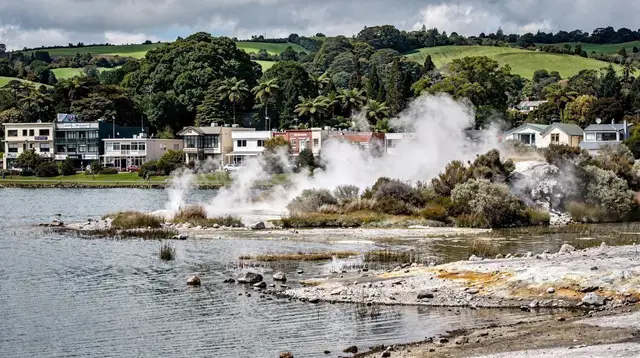
Rotorua sits at roughly 290 metres above sea level on the southern shore of Lake Rotorua, one of a string of lakes that fill old volcanic craters across the region. The town itself is part of the Taupō Volcanic Zone, a roughly 250-kilometre tear in the earth’s crust running from Whakaari / White Island in the Bay of Plenty down to Mount Ruapehu in the central North Island. Rotorua sits almost in the middle of it, which is why the ground here does things ground doesn’t usually do: it steams, it bubbles, and in a few places it’s genuinely too hot to touch.
The lake itself is the flooded caldera of an old volcano, and the town wraps around its southern and western edges in a fairly tight grid. Central Rotorua is small enough to walk end to end in well under an hour, which matters more here than in most towns its size, because a surprising amount of what people come for is inside that walkable core rather than out on the highway.
The Smell, Explained
The sulphur smell — often described as rotten egg, and not unfairly — comes from hydrogen sulphide gas escaping through the ground as groundwater is heated by magma close to the surface and rises back up through cracks and vents. It’s strongest near active geothermal ground: Kuirau Park, a free public geothermal park a short walk from the town centre, has steaming craters and boiling pools right next to a children’s playground, and it’s usually most people’s first close encounter with it.
The smell varies by weather, wind direction, and which part of town you’re in, and it fades with distance from active vents — most visitor accommodation away from the geothermal pockets isn’t affected much once you’re inside. It’s worth reading why Rotorua smells of sulphur before you arrive, mostly so it doesn’t come as a surprise on the drive in. It isn’t a flaw to work around; it’s the same activity that produces the geysers, the hot pools, and the mud pots people travel here to see.
What’s Walkable From the Centre
This is the part that surprises people who assume Rotorua requires a car from the moment they arrive. A fair amount doesn’t.
- Kuirau Park — free, geothermal, and inside the town grid.
- Ōhinemutu — a living Ngāti Whakaue village on the lakeshore, a short walk from the centre, with St Faith’s Church and its engraved-glass Christ figure looking out over the water.
- The lakefront itself and the Government Gardens — flat walking along Lake Rotorua, with the 1908 Bath House building as a landmark (currently closed for seismic strengthening, so treat it as a building to look at rather than to enter).
- Whakarewarewa Village and the Redwoods forest — a little further out, reachable on foot from the centre for reasonably fit walkers, or a short drive/bus otherwise; the redwood grove is one of the few genuinely free, all-ages things to do in the whole region.
If you’re staying centrally and don’t want to rent a car at all, getting around Rotorua without a car covers what actually works — walking, local buses, and organised transport for the sights that sit further out.
Cruise Ship Days and Tour Bus Timing
Tauranga, roughly an hour north on the coast, is New Zealand’s busiest cruise port, and on days when a ship is in, coach tours bring a wave of day visitors inland to Rotorua for a few hours around midday. The effect is most noticeable at Whakarewarewa Village, Te Puia, and the more central parts of the Government Gardens, where car parks and ticket queues can feel busier than the rest of the week would suggest. Kuirau Park and the lakefront rarely feel the same crush, since day-tour itineraries tend to favour paid, ticketed experiences over the free geothermal park. If you’re staying overnight rather than passing through, visiting the same sights before 10am or after 3pm avoids most of it; a closer look at how cruise days play out in Rotorua breaks down the pattern in more detail.
What Needs a Car (or a Tour)
Most of what makes Rotorua a multi-day destination rather than a half-day curiosity sits outside the walkable centre. This is where the region does most of its work, and it’s genuinely worth planning around rather than squeezing in.
| Sight | Distance from town | How to get there |
|---|---|---|
| Whakarewarewa Village & Te Puia | ~3 km | Short drive, taxi, or local bus |
| Wai-O-Tapu | ~27 km south, SH5 | Car or organised tour (Lady Knox geyser goes off at a fixed morning time) |
| Waimangu Volcanic Valley | ~20 km south | Car or tour |
| Hell’s Gate / Tikitere | ~16 km northeast, SH30 | Car or tour |
| Te Wairoa, the Buried Village | ~15 km southeast | Car or tour |
| Mount Tarawera | ~24 km southeast | Guided access only — the mountain is iwi land |
| Hamurana Springs | ~20 km north | Car |
For the two or three parks you don’t plan to reach independently, a half-day tour that bundles transport with entry is often the simplest option, especially if you don’t want to rent a car for the whole trip. An afternoon geothermal tour out of Rotorua is one straightforward way to see one of these valleys without organising your own transport, and a combined Wai-O-Tapu and Waimangu day tour covers both of the bigger southern parks in one trip. If the 1886 Tarawera eruption story interests you, a visit to the Buried Village of Te Wairoa pairs well with either.
For choosing between the geothermal parks themselves, which one to pick lays out the practical differences — they aren’t interchangeable, and picking the wrong one for your interests is a common regret.
If You Only Have Half a Day in Town
Half a day in Rotorua itself — as opposed to a half-day out at Wai-O-Tapu or Hobbiton — usually means choosing between two different kinds of morning, not combining them. One option is the free, self-paced walk: Kuirau Park, Ōhinemutu, and the lakefront, done at your own speed in two to three hours with no bookings required. The other is a single paid cultural or geothermal experience, such as Whakarewarewa Village or Te Puia, which runs on a fixed schedule built around a geyser eruption or a cultural performance and doesn’t leave much room either side of it. Trying to fit both into one morning usually means rushing the free walk to make a booking, which defeats the point of it. Comparing the geothermal parks properly helps before committing to either, and a full one-day Rotorua itinerary shows how the choice fits into a longer day.
Rotorua as a Base
This is the role Rotorua actually plays for most visitors: not a single-attraction stop, but the base from which the wider central North Island opens up. Matamata and the Hobbiton Movie Set sit about 50 minutes away; Taupō and its lake are roughly an hour south; Tauranga on the coast is about an hour north; Waitomo and its glowworm caves are around two hours west. All of that is reachable as day trips without changing accommodation, which is why so many multi-day itineraries use Rotorua as the fixed point rather than moving hotels every night.
If you’re weighing how long to actually stay, how many days in Rotorua is the more detailed answer; as a starting point, two nights covers the geothermal and cultural core, three to four leaves room for one or two of the day trips above without feeling rushed. A structured 2-day Rotorua itinerary or a 4-day Rotorua–Taupō road trip are both built around exactly this pattern.
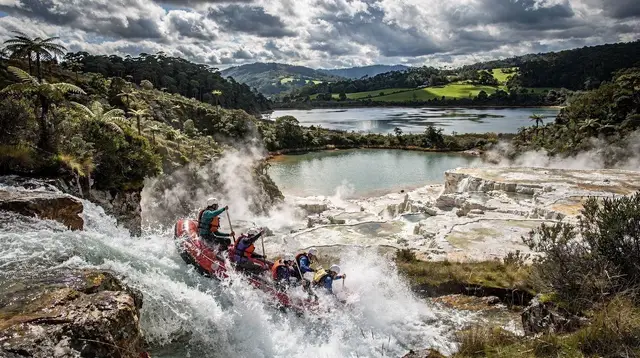
Adventure travellers passing through often add the Kaituna River into the mix — its rapids are a short drive northeast of town — and a combined zipline and rafting day near Okere Falls is a common way to fit that in alongside a geothermal day, since neither activity takes a full day on its own.
What Surprises First-Time Visitors
A few things about the town itself catch people out. The smell is real but far more localised than photos and warnings suggest — most of central Rotorua, including most accommodation, doesn’t smell of sulphur at all, and the reaction of “wait, where is it” is at least as common as the opposite. The 1908 Bath House in the Government Gardens photographs well but has been closed to visitors since 2016 for seismic strengthening, so arriving expecting a museum experience inside it is a common letdown; the Government Gardens and museum guide explains what’s actually open. And the Redwoods forest, despite sitting close to Whakarewarewa Village on the map, is an entirely separate, non-thermal experience — a plantation forest with a canopy walkway and mountain bike trails, not an extension of the geyser and mud pool sights nearby.
Practical Basics for the Town
New Zealand’s official languages are English, te reo Māori, and New Zealand Sign Language, and in Rotorua — the cultural heart of Te Arawa — te reo is genuinely part of the everyday landscape, not decoration. Prices you see quoted already include the country’s 15% GST, so there’s no tax added at the till, and tipping isn’t expected anywhere in town. Traffic drives on the left, power sockets are the type I three-pin standard at 230V, and tap water is safe to drink. The national emergency number is 111.
Weather is worth planning around rather than around a season: rain falls year-round, roughly 140 days of it, and there’s no reliable dry season to time a trip against — geothermal parks are often at their most atmospheric in light rain or cold air, when the steam is more visible. Summer UV is genuinely intense here, not just a formality on a packing list. None of this rules out any particular month; it just means Rotorua reads differently depending on when you go, which Rotorua’s weather month by month covers in more detail, alongside a broader look at the best time to visit.
One local rule worth knowing before a restaurant menu confuses you: trout can be caught throughout the Rotorua and Taupō lakes, but it can’t legally be sold anywhere in New Zealand, so it never appears on a menu unless you caught it yourself.
Getting Started
For a first pass at where to stay, Rotorua’s accommodation areas breaks down lakefront, central, and out-of-town options against how much walking you’re willing to do. For a broader sense of what the region’s activities actually cost against no-cost alternatives, Rotorua on a budget and free things to do in Rotorua are worth reading before booking anything.
And if a slower, only-tangentially-thermal day appeals after a few geothermal parks in a row, a scenic tour that pairs Hobbiton’s rolling film-set countryside with Rotorua’s treewalks is a change of pace worth considering: the Hobbiton Movie Set day tour from Rotorua is the most direct way to fit that in without renting a car for the day.
Rotorua City: Frequently Asked Questions
Is Rotorua safe to visit, given all the geothermal activity?
Yes — the geothermal parks, walkways, and viewing platforms open to the public are managed and fenced around genuinely hazardous ground, and the town itself sits on ground that’s stable enough to build on and live on, as around 60,000 residents do. The sulphur smell is a nuisance, not a hazard, at the concentrations you’ll encounter as a visitor.
How many days should I spend in Rotorua?
Two nights covers the geothermal and Māori cultural core of the town and its nearest sights; three to four nights leaves room to add one or two day trips, such as Wai-O-Tapu, Hobbiton, or Waitomo, without rushing.
Do I need a rental car in Rotorua?
Not for the town centre itself — Kuirau Park, Ōhinemutu, the lakefront, and the Redwoods are all walkable or close to it. A car (or an organised tour) becomes worth it for the geothermal parks further out, such as Wai-O-Tapu or Hell’s Gate, and for day trips beyond the town.
Why does Rotorua smell like sulphur?
The smell is hydrogen sulphide gas, released as underground water heated by the Taupō Volcanic Zone’s geothermal activity rises to the surface through cracks and vents. It’s strongest near active geothermal ground like Kuirau Park and fades with distance from those vents.
What’s the best time of year to visit Rotorua?
There isn’t a dry season to plan around — rain is possible any month — so timing comes down to what you want: summer (December–February) for warmer days and lake activities, winter (June–August) for more dramatic steam in cold air and fewer visitors.
Can I see a live volcano from Rotorua?
Not up close on land — Mount Tarawera, which erupted in 1886, is accessible only by guided tour onto iwi-owned land, and Whakaari / White Island is an offshore volcano near Whakatāne reachable only by boat or scenic flight, with no landings since the fatal 2019 eruption.
Is Rotorua touristy?
It’s the country’s oldest tourist town, dating to the 1880s, and the main sights around the town centre are well set up for visitors. That said, places like Ōhinemutu and Whakarewarewa Village are lived-in communities first — people’s homes, marae, and daily life — not attractions built purely for tourism.
What currency and payment methods are used in Rotorua?
New Zealand uses the New Zealand dollar (NZD). Card payment is accepted almost everywhere in town, prices already include the 15% GST, and tipping isn’t expected.