Cruise Ship Day in Rotorua from Tauranga: What Fits Between 8am and 5pm
Can you visit Rotorua on a cruise ship day in Tauranga?
Yes. Rotorua is about an hour's drive from the Tauranga cruise berth, and a typical 8am-to-5pm call leaves enough time for one geothermal park plus one Māori cultural experience, or a single well-chosen combined tour. It does not leave time for both Rotorua and a second region.
Why Rotorua works on a cruise call, and why the clock matters more than the map
Rotorua has no port of its own. Ships calling on this part of the North Island dock at Tauranga, on the coast, and Rotorua is reached inland by road — which means every hour spent travelling is an hour not spent at a geothermal park or a cultural site. On paper the distance is short: about 60 to 80 kilometres depending on the exact berth, roughly an hour’s drive each way. In practice, a cruise call is not a full day. It is a fixed window bookended by two hard constraints — when passengers can first go ashore, and when the ship needs everyone back aboard — and everything in between has to fit inside it with margin to spare.
This page works through that window in practical terms: how much of it is actually usable once transfer time is subtracted, what a ship-booked excursion buys that independent travel does not, what realistically fits in a single call, and how much margin to hold back so a delayed coach or a queue at a thermal park does not turn into a missed departure.
The time budget: what an 8-to-5 call actually gives you
Cruise schedules vary by line and itinerary, so treat any specific hour as an example, not a promise — always check the ship’s daily programme for the day’s actual all-aboard time. But the shape of the day is consistent enough to plan around.
| Stage | Rough time cost |
|---|---|
| Disembarkation and port formalities | 20–40 minutes from the doors opening |
| Transfer to Rotorua (each way) | About 1 hour by road |
| Time actually in Rotorua | What’s left after transfers, minus a safety buffer |
| Return transfer and re-boarding | Build in extra time before all-aboard, not right up to it |
Subtract two transfers of roughly an hour each from an 8am-to-5pm window and the travelling alone accounts for a fifth to a quarter of the whole day. Add reasonable allowances for disembarkation, a comfort stop, and getting back through port security before the ship’s cut-off, and a realistic budget for actually being in Rotorua sits at around five to six hours — not the eight or nine the total call length suggests. That five-to-six-hour window is the number to plan the day’s activities against, not the gangway-to-gangway total.
Ship excursion or independent trip — the real difference is risk, not price
The two options are often compared on price alone, but the more useful comparison is what happens if something runs late.
| Ship-booked excursion | Independent trip | |
|---|---|---|
| If the tour runs late | The ship is held, or a backup transfer is arranged | No guarantee — the traveller absorbs the risk |
| Transport | Included, coordinated with the ship’s schedule | Arranged separately: taxi, shuttle, or rental car |
| Flexibility | Fixed itinerary and pace | Choose exactly what to see and how long to stay |
| Typical cost | Generally higher for the same activity | Often lower, but with more coordination effort |
| Best suited to | A single geothermal park plus one cultural stop | Travellers confident managing their own return margin |
This is the trade-off in one sentence: a ship excursion buys a guarantee, and an independent trip buys flexibility. For a single-region day like Rotorua — no side trips, one clear plan — that guarantee is worth real consideration, because the ship has no obligation to wait for passengers who arranged their own transport and misjudge the return drive. Independent travel is not reckless, but it puts the entire safety margin in the traveller’s hands rather than the operator’s.
a Wai-O-Tapu tour built specifically around cruise ship timings is one of the more direct ways to solve the guarantee question: the schedule is designed around the ship’s own clock, not a generic tour time.
What actually fits in the window
With five to six hours in Rotorua, the realistic target is one geothermal park and one cultural stop, or a single combined tour that covers both. Trying to add a second geothermal park, a lake cruise, and a cultural show in the same call is where cruise-day plans start eating into the safety margin.
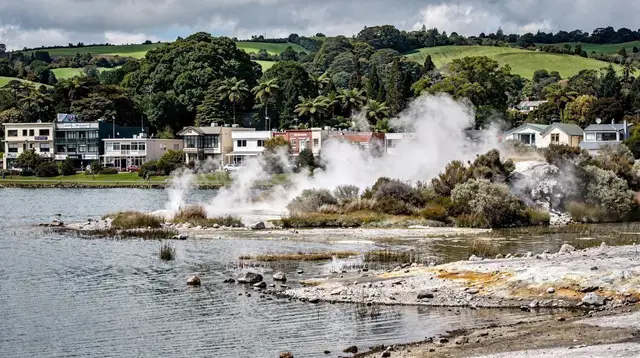
One geothermal park. Wai-O-Tapu, about 27 kilometres south of Rotorua on the SH5, is the most complete single stop — Champagne Pool, the Devil’s Bath, and the Lady Knox geyser, which is triggered each morning rather than erupting naturally, so its timing has to be checked against the day’s plan rather than assumed. Closer to town, Te Puia sits inside the wider Whakarewarewa thermal valley and adds the national institute of Māori arts and crafts alongside the geothermal walk, with Pōhutu — the most reliable geyser in the Southern Hemisphere — erupting once or twice an hour.
For a guide to choosing between the geothermal parks given a fixed number of hours, see which geothermal park to pick and the direct comparison of Te Puia against Whakarewarewa Village.
One cultural experience. Te Puia doubles as a cultural stop, but a hāngī meal and a performance take longer and usually mean giving up part of the geothermal time. If culture is the priority for the call, weigh that trade-off against the geothermal one rather than trying to fit both fully.
A combined tour that solves the sequencing for you. a Rotorua highlights tour departing from Tauranga packages several of these stops into a single coach itinerary, which removes the planning work of sequencing geothermal and cultural sites against a hard return deadline — the operator has already built the margin in.
If the call is genuinely short. Mount Maunganui sits directly at the port, with no road transfer at all — walk off the ship and the base track around Mauao, or the summit climb, is right there. For calls too tight for a confident Rotorua round trip, this removes the transfer risk entirely rather than compressing it. A dolphin and wildlife cruise departing from the same harbour is another way to fill a short call without a road transfer: a dolphin and wildlife cruise from Tauranga stays close to the ship for its entire duration.
What does not fit, and why it matters to say so
Hobbiton, near Matamata, is a further drive beyond Rotorua — not inside it, and not on the way from Tauranga. Adding it to a Rotorua stop in the same cruise call generally removes whatever safety margin the day had left; it belongs on a longer stay, not a single port call. Waitomo is further again, in the opposite general direction from a straightforward Tauranga–Rotorua loop, and the same logic applies. Tongariro National Park and the Tongariro Alpine Crossing are a multi-hour undertaking on their own and are not a cruise-day option from Tauranga under any itinerary. None of these are wrong choices for a longer trip — see how many days to allow in Rotorua if the cruise call is only a preview — but folding them into an 8-to-5 window is where cruise-day plans go wrong.
It’s also worth being direct about one thing some itineraries imply without saying: a cruise call to Tauranga is not a stop at Whakaari / White Island, and landings on the volcano have not been offered since the eruption of December 2019. Any activity involving that island from this coast is a boat approach or a scenic flight, not a shore visit.
Getting from the ship to Rotorua independently
For travellers arranging their own transport rather than a ship excursion, the practical options are a private transfer or taxi booked in advance, a shared shuttle if one is running that day, or a rental car picked up near the port. A rental car adds the most flexibility but also the most exposure: driving on the left in an unfamiliar country, on a road that may carry more holiday traffic than expected, is its own source of delay risk on a day with a hard deadline. The driving in New Zealand guide covers the basics for visitors who choose this route, and the wider comparison of guided tours against self-drive is worth reading before deciding, specifically for the return-margin question a cruise call adds.
Whichever way the outbound trip is arranged, the return leg is the one to plan conservatively — aim to leave Rotorua with a wider buffer than the outbound drive suggested, since traffic, a missed turn, or a queue at a thermal park’s car park all cost time on the way back that they didn’t cost on the way in.
Building the safety margin into the plan
The single most useful habit for a cruise-day Rotorua trip is working backward from the ship’s all-aboard time rather than forward from arrival. Start with the fixed number from the ship’s daily programme, subtract a buffer for port re-entry and security, subtract the return transfer time plus a margin for traffic, and only then look at what’s left for Rotorua itself. Whatever that number is becomes the actual planning constraint — not the gap between disembarkation and departure printed on the itinerary.
A short list of margin habits that hold up across most Tauranga calls:
- Treat the ship’s all-aboard time as fixed and non-negotiable; plan everything else around it, not up to it.
- Add a buffer to the return transfer beyond the outbound driving time — afternoon traffic and car park queues are common at popular thermal parks.
- Pick one geothermal park, not two, unless the call is unusually long.
- If arranging independent transport, confirm pickup and return times in writing before leaving the port.
- Keep a phone number for the transfer or tour operator on hand in case a return pickup needs adjusting.
- When in doubt between two activities, choose the one closer to Rotorua’s centre over one further out, such as Wai-O-Tapu versus a park requiring a longer detour.
A short thermal walk near the town centre — Kuirau Park area sightseeing or a stroll past Ōhinemutu on the lakefront — is a reasonable way to use fifteen or twenty spare minutes if the main activity finishes early, without adding a driving detour to the day.
For travellers who want the sequencing and the return guarantee handled by someone else, an afternoon eco-thermal tour is built around a half-day window rather than a full one, which suits a call where the morning was needed for something else.
FAQ: Rotorua on a Tauranga cruise call
How far is Rotorua from the Tauranga cruise port?
Around 60 to 80 kilometres depending on the exact berth and route, which is roughly an hour’s drive each way in normal traffic. Coach transfers on ship excursions typically build in extra time for boarding and comfort stops.
Do cruise ships dock in Rotorua itself?
No. Rotorua has no port; it is inland and landlocked. Ships dock at Tauranga, on the coast, and Rotorua is reached by road as a shore excursion or independent day trip.
Is it safer to book a ship excursion or go independently to Rotorua?
A ship-booked excursion is the lower-risk choice for a single-region day like Rotorua, because the cruise line holds the ship for its own tours if one runs late. An independent trip has no such guarantee, so the return margin has to be built in by the traveller.
What can you realistically see in Rotorua in one day from the ship?
One geothermal park such as Te Puia or Wai-O-Tapu, combined with a Māori cultural experience or a short walk around a thermal area in town, is a realistic pairing. Trying to add a second geothermal park or a separate region in the same call usually removes the safety margin.
What time does the ship usually leave when calling at Tauranga?
Departure times vary by cruise line and itinerary, so this guide gives no fixed hour. Check the daily programme on board for the exact all-aboard time and treat it as the one number that cannot move.
Is Mount Maunganui a better option than Rotorua for a short call?
For a call with a genuinely short window, Mount Maunganui sits right at the port and needs no road transfer, which removes the return-time risk entirely. Rotorua needs a longer call to be worth the drive.
Can you do Hobbiton on a Tauranga cruise day as well as Rotorua?
Not realistically. Hobbiton is near Matamata, a further drive beyond Rotorua, and combining it with a Rotorua stop in one cruise call leaves little to no safety margin for getting back to the ship.
Lake cruises on GetYourGuide
Verified deep-linked GetYourGuide tours. Book through these links and we earn a small commission at no cost to you.
Photos show the destination, not the operator's own images.