Surfing Raglan for Beginners
Where should a beginner learn to surf near Raglan, and where do experienced surfers go?
Beginners learn at Ngarunui Beach, a patrolled sandy-bottom beach break with surf lifeguards on duty. Manu Bay, a few minutes further along the coast, is a rocky left-hand point break for experienced surfers only — worth a look from the car park, not a first lesson.
Two Beaches, Two Different Jobs
Raglan gets mentioned as a surf town more often than it gets explained, and the two names that come up most — Ngarunui and Manu Bay — do two completely different jobs. Ngarunui is where you learn. Manu Bay is where you watch someone else who already knows how. Mixing the two up is the single most common mistake a first-timer makes when planning a day on this stretch of Waikato coast, and it’s an easy mistake to fix once you know which beach does what.
This guide is built around that split: where a beginner should actually put their board in the water, where to go instead to see Manu Bay do what it’s famous for, what tide matters for which spot, and how to fit either — or both — into a day trip from Rotorua.
Ngarunui Beach: Where Beginners Learn
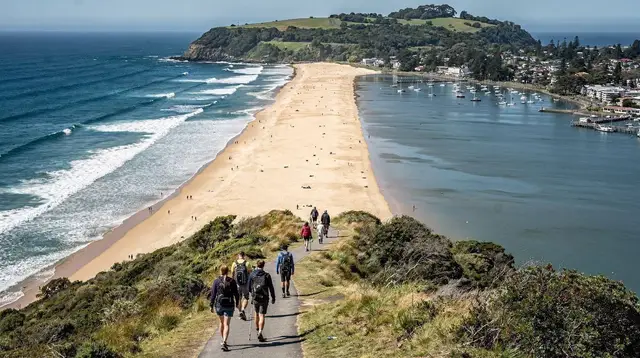
Ngarunui is a wide, sandy beach break on Raglan’s ocean side, and it’s the beach nearly every surf school in town uses for first lessons. Three things make it the right choice for a beginner rather than a compromise:
- Sandy bottom. Falling off a board at Ngarunui means landing in sand, not on a reef or a field of boulders. That single fact removes most of the physical risk from a first session.
- Surf lifeguard patrol. Ngarunui is patrolled in season by volunteer surf lifeguards, the same organisation that watches over beaches around the country. A patrolled beach with flagged swimming and surfing areas is a meaningfully safer place to be learning than an unpatrolled one.
- A forgiving wave. As a beach break, Ngarunui produces whitewater and smaller, more consistent waves close to shore — exactly the kind of wave a first-time surfer needs to practise standing up, rather than the fast, hollow, current-driven wave of a point break.
Morning Beats Afternoon
Raglan’s west coast tends to pick up an onshore sea breeze as the day warms up, which turns a clean morning into a choppier, harder-to-read afternoon. It’s not a hard rule — some days stay calm well into the afternoon and some mornings are blown out from the start — but if a surf school offers a choice of session times, an earlier start generally means flatter, easier water to learn in. Parking at Ngarunui is a casual area right behind the beach, a short flat walk to the sand, which matters less for the surf itself than for how much gear you’re hauling before you’ve even caught a wave.
None of this makes Ngarunui a lesser beach — it’s simply built for a different stage of surfing than Manu Bay is. Surf schools run their group lessons here specifically because the beach does the hard part of the safety equation for them.
a half-day group surf lesson at Ngarunui is the standard way to try surfing at Raglan for the first time: board and wetsuit included, an instructor working with a small group, and enough time in the water to get past the awkward first ten minutes.
Manu Bay: Where You Watch, Not Learn
A few minutes’ drive south-west of Ngarunui, Manu Bay is one of the most recognised left-hand point breaks in the world — the kind of wave that made Raglan a surf destination in the first place, decades before “surf town” became a marketing phrase. It breaks over a rock and boulder bottom rather than sand, and on a good day it peels for a long, rideable distance along the point.
That length and consistency is exactly what makes it unsuitable for a first lesson. A point break like Manu Bay rewards a surfer who can already paddle strongly, read where a wave is going to break, and get out of the way of the rocks if things go wrong. There’s no soft landing here, and no lifeguard tower watching the lineup the way there is at Ngarunui.
What Manu Bay is genuinely good for is watching. There’s a car park and a grassy headland directly above the point, free to access, with a clear view down the line of the wave. On a working swell it’s one of the more accessible places anywhere to watch a world-class break from land, without needing a board, a wetsuit, or any surfing ability at all. Pair it with the walking tracks on nearby Karioi for a longer stop, or simply pull up, watch a set or two, and move on.
On a good swell, the lineup at Manu Bay fills up fast with experienced surfers who know the wave and each other, and it’s not a spot where an outsider paddles out uninvited — part of why watching from the headland, rather than trying to join in, is the sensible call for anyone who isn’t already surfing at that level. The headland itself is grassy and uneven rather than paved, with no formal path down to the rocks below, so it suits a stop on foot rather than anyone needing a wheelchair-accessible viewpoint; the car park is the flattest vantage point if getting onto the grass isn’t practical. None of this takes away from the free part — there’s no charge to park, walk up, and watch.
Which Tide Matters, and for Which Beach
Tide advice for surfing is one of the places where being vague on purpose is more honest than being precise and wrong, because it depends on the shape of the seabed at each spot and on the swell and wind on the day.
The general pattern, though, is this: point breaks depend on their reef. Manu Bay’s wave is shaped by the rock beneath it, which means it tends to work well over a narrower band of the tide and can go flat or close out outside that window. Beach breaks are more forgiving of tide. Ngarunui, with its open sand bottom, generally holds a rideable wave across a wider range of tide states than a point break does, which is one more reason it suits lessons — a surf school can run a booked session without needing to chase a single perfect hour.
The practical version of this: if you’re booking a lesson at Ngarunui, the school will already have worked tide, swell and wind into their scheduling — that’s part of what you’re paying for. If you’re driving out independently to watch Manu Bay, check conditions on the day with a local surf shop, a surf report, or simply by looking at the point when you arrive, rather than planning your whole trip around an assumed tide window from a guidebook.
Getting There From Rotorua
Raglan sits on the Waikato’s west coast, and the drive from Rotorua takes roughly two and a half hours, mostly via Hamilton. That makes it a genuine day-trip commitment rather than a quick detour, and it’s worth being realistic about what that means for your day:
| Plan | Rough shape of the day |
|---|---|
| Single long day trip | Early start from Rotorua, most of the day at Ngarunui and Manu Bay, drive back in the evening |
| Overnight in Raglan | Drive out in the afternoon, surf lesson the next morning when you’re not tired from the road, drive back |
| Multi-day surf package | Book two days of lessons and gear hire, basing yourself in or near Raglan for the stretch |
If a single long day feels like too much driving for one surf lesson, it’s worth reading up on driving in New Zealand before you commit, and checking how best to get around without your own car if you’re not self-driving.
For anyone who wants more than one session in the water, a two-day lesson and equipment package makes better use of the drive than a single half-day trip does — the second day tends to go noticeably better than the first once the basics have clicked.
If You Only Have Half a Day
Not every visitor has a full day to give the west coast, and if you’re weighing up how to spend a shorter window, the two beaches aren’t equally flexible. A surf lesson at Ngarunui is built around a fixed booking — usually a couple of hours including the safety briefing, warm-up and time in the water — so it needs to be the anchor of the day if surfing itself is the goal. Watching Manu Bay, by contrast, takes as little as twenty minutes: park, walk onto the headland, watch a few sets, walk back.
That asymmetry makes the choice easier than it first looks. Book the lesson first, then fit Manu Bay in on the way to or from it rather than treating the two as separate outings that both need their own slot in the day. If the drive itself has already eaten most of your morning, it’s the lesson that should survive the cut — the headland is the kind of stop that still works as a five-minute detour on the way out of town, even after the schedule has slipped.
The Closer Alternative: Mount Maunganui
If two and a half hours each way doesn’t fit the trip, Mount Maunganui is roughly an hour from Rotorua and has its own beginner-friendly beach break, with surf schools running lessons much the way Raglan’s do. It isn’t Manu Bay — there’s no equivalent point break to watch — but for the specific goal of standing up on a board for the first time without a long drive, it’s a realistic substitute.
a two-day beginner surfing course at Mount Maunganui covers the same ground as the Raglan package — board, wetsuit, instruction across two sessions — while keeping the round trip from Rotorua to under two hours each way. It’s worth weighing against a Rotorua to Tauranga day trip if you’re planning to combine surfing with other Bay of Plenty stops on the same outing.
What to Actually Bring
Surf lessons at either beach typically supply the board and the wetsuit, since the water off both coasts stays cool enough year-round that a wetsuit isn’t optional even in summer. What you bring yourself is simpler:
- Togs (swimwear) to wear under the wetsuit.
- A towel and a full change of clothes — you will be salty, sandy and possibly still a little wet on the drive home.
- Sun protection. New Zealand’s summer UV index runs high, and standing on a beach for a two-hour lesson is more sun exposure than most people expect. A hat and reef-safe sunscreen matter even on a mild-looking day.
- Motion sickness tablets, only if the drive itself is the part you’re worried about — the road from Rotorua isn’t difficult, but it does wind through hill country.
- Cash or a card for lunch in Raglan town, which has a small but well-regarded food scene worth building into the day either side of the lesson.
None of this needs to be expensive. A group lesson at Ngarunui sits comfortably within a budget day out from Rotorua, and — as with everything else priced in New Zealand — the number you’re quoted already includes GST, with no tipping expected on top of it; see tipping and costs in New Zealand if that’s still unfamiliar.
Building It Into a Longer Day
A day built around Ngarunui and Manu Bay doesn’t have to be only about surfing. The headland above Manu Bay and the walking tracks on nearby Karioi both reward an extra hour or two if you’re not in a rush back to Rotorua, and Raglan’s town centre — a short drive from both beaches — is worth a stop for food regardless of how the lesson went. If you’re treating the west coast as one stop on a wider loop rather than a there-and-back trip, it’s worth checking what else fits into a longer day trip from Rotorua and slotting Raglan in alongside it, or building it into a broader adventure-focused stay if surfing is one of several activities on the list.
For an evening back in Rotorua after a full day on the coast, a sunset canyoning and glowworm outing is a genuinely different kind of adrenaline to end the day on — wet in a different way, and considerably closer to home. It’s not a substitute for the surf lesson; it’s a reasonable answer to “what now” once you’re back and the salt’s washed off.
When to Go
There’s no dead season on this coast in the sense of nothing being open, but the practical differences between summer and winter are worth knowing before you book. Summer brings warmer air temperatures, longer daylight and — usually — smaller, more forgiving swells, which tends to suit a first lesson better than a big winter groundswell does. Winter can bring more powerful, more consistent swell that experienced surfers chase deliberately, but it also means a colder wind on the beach between sets. If you’re planning purely around the surf lesson rather than the swell itself, check Rotorua’s weather by month and the best time to visit as a starting point, then let the surf school’s own booking calendar and daily conditions call confirm the day.
A Few More Questions
Does the lifeguard patrol at Ngarunui run all year?
No. Like most patrolled beaches in New Zealand, the surf lifeguard presence at Ngarunui is seasonal, concentrated around the warmer months when visitor numbers are highest. Outside that window a booked lesson still comes with an instructor watching the group directly, but anyone swimming or surfing independently should treat an unpatrolled day the same as an unpatrolled beach anywhere — check conditions yourself rather than assuming a flag or a tower will be there.
Is Manu Bay too crowded to enjoy watching?
Not from the headland. The lineup in the water can get busy on a good swell, since it’s one of the most recognised breaks in the country and draws surfers accordingly, but that crowding is a feature of the wave itself rather than of the viewing area. The headland stays open and free regardless of how many surfers are out, and a busy lineup arguably makes for a better show from land — more waves being ridden, not fewer.
Ngarunui and Manu Bay Compared
| Ngarunui Beach | Manu Bay | |
|---|---|---|
| Best for | Learning to surf, first lessons | Watching, experienced surfers |
| Bottom | Sand | Rock and boulder |
| Patrol | Surf lifeguards in season | None |
| Wave type | Beach break, gentle whitewater | Long left-hand point break |
| Tide sensitivity | Works across a wider tide range | Works over a narrower tide window, reef-dependent |
| What a visitor does there | Takes a lesson | Parks up and watches from the headland |
That table is really the whole guide compressed: pick Ngarunui to get in the water yourself, and treat Manu Bay as the reason to bring a jacket, a coffee, and twenty minutes to stand on the headland and watch a wave that took decades to become famous.
Bay of Plenty coast tours on GetYourGuide
Verified deep-linked GetYourGuide tours. Book through these links and we earn a small commission at no cost to you.
Photos show the destination, not the operator's own images.