Best Time to Visit Rotorua
When is the best time to visit Rotorua?
There isn't a single best time, because Rotorua's main draws are geothermal and cultural, not weather-dependent. December to February suits lake swimming and long daylight; March to May brings stable weather, autumn colour in the Redwoods and lower prices; June to August makes the geothermal steam more dramatic in cold air and empties the hot pools.
Why Rotorua Doesn’t Really Have a Dead Season
Most “best time to visit” questions assume a place has a clear peak and a clear off-season, usually built around a beach, a snowfield, or a single migratory event. Rotorua doesn’t work that way. Its core attractions are geothermal and cultural rather than seasonal: Pōhutu geyser at Te Puia erupts on its own schedule regardless of the calendar, the mud pools at Hell’s Gate bubble the same way in July as in January, and a hāngī comes out of the ground steaming whatever the outside temperature happens to be. Whakarewarewa Village is lived in twelve months a year, not opened for a season.
That doesn’t mean every month feels the same on the ground. What changes across the year is daylight, temperature, rainfall pattern, crowd levels and price, and those four things push different activities up or down the priority list. Lake swimming makes sense in summer and not much sense in winter. The Redwoods turn colour and thin out in autumn. Hot pools feel best against cold air, which is a winter thing by definition. This guide breaks the year into its four New Zealand seasons and lines up what each one actually gives you, so the decision is about what you want to do, not about avoiding a season that doesn’t really exist here.
One thing worth saying upfront because it trips visitors from the northern hemisphere: New Zealand’s seasons are reversed. December to February is summer, June to August is winter. Christmas falls in warm weather. If you’re used to planning a “winter trip” or a “summer trip” by month name out of habit, check the season column below rather than the month name from home.
Summer (December-February): The Water Season
Summer is when Rotorua’s lakes stop being scenery and start being something you actually get into. Days are long, maximum temperatures generally sit around 23-24°C, and the region’s five main lakes - Rotorua, Rotoiti, Tarawera, Tikitapu and Ōkataina - go from photogenic to swimmable. It’s the obvious window for lake cruises, kayaking, and the kind of long, unhurried outdoor day that doesn’t work as well when the sun sets at five.
It’s also the busiest and most expensive stretch of the year, largely because it overlaps with New Zealand’s own summer school holidays through late December and January. Accommodation books up faster and costs more, and popular time slots at geothermal parks and cultural shows are worth securing ahead rather than showing up and hoping. None of that makes summer feel crowded in the way a major European or Asian tourist city does in high season - Rotorua’s geothermal valleys are large and its cultural venues are built to host groups - but it’s the season where planning ahead pays off most.
The one genuine caution for summer is UV. New Zealand’s summer UV index reaches extreme levels, and it does so even on days that don’t feel particularly hot, since it’s driven by sun angle and atmospheric ozone rather than air temperature alone. This is a real planning factor, not a throwaway line: broad-spectrum sunscreen, a hat and cover for the middle of the day matter here more than they would in a comparable European summer. A morning walk through the Redwoods canopy, then a swim at Tikitapu once the day has warmed up, followed by an evening on the water is a reasonable way to structure a summer day around that risk rather than fighting it.
Summer is also the strongest season for the region’s outdoor adventure activities, since the Kaituna River and its rafting and sledging runs, mountain biking through the Redwoods network, and horse trekking through farmland and native bush are all more comfortable in warm, dry-leaning conditions. A guided ride through the countryside works particularly well at this time of year, and a scenic horse trek through Rotorua’s farmland and forest is worth building into a summer itinerary if riding appeals. For a broader look at how the water-based options compare against each other, Rotorua’s adventure activities ranked is a useful next stop.
Autumn (March-May): Light and Lower Prices
Autumn is the season locals and repeat visitors tend to rate highest, and the reasoning is fairly simple: the weather has usually settled from the more erratic swings of late summer, prices have dropped from the December-February peak, and the introduced trees planted through the region - most visibly the 1901 Californian redwoods - turn colour before dropping their needles-and-leaves through April and May. Add lower rainfall variability than winter and daylight that’s still generous through March, and it becomes the shoulder season that behaves more like a second high season without the summer price tag.
Because the geothermal parks don’t depend on weather to function, autumn is a strong time to prioritise them. Steam reads more clearly against cooler air than in the heat of January, without yet reaching the dramatic winter contrast, and Wai-O-Tapu and Waimangu Volcanic Valley tend to be comfortable to walk for a full loop at this time of year. It’s also a good window for the Redwoods Treewalk, whether by day for the colour or after dark, when the canopy lights up against the earlier evening dark that autumn brings. A nighttime fast-pass through the Redwoods canopy walkway makes sense from March onward, once darkness falls early enough to make an evening booking practical without cutting into the rest of the day.
Autumn is also a sound choice if the Tongariro Alpine Crossing is on the list, since March and April often still carry summer-adjacent conditions on the track before the alpine season turns properly wintry, though conditions there change fast enough that checking with the Department of Conservation or a guiding operator close to the date always matters more than the calendar month. For travellers weighing up how many days to give the region at this time of year, how many days in Rotorua covers pacing in more depth, and Rotorua on a budget is worth reading alongside autumn’s lower rates if cost is a factor in timing.
Winter (June-August): Steam, Hot Pools and Cold Air
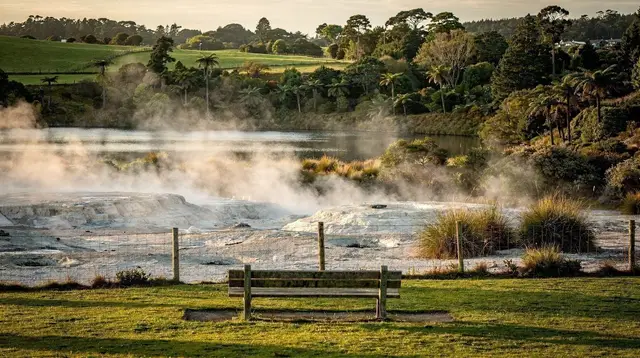
Winter is Rotorua’s most underrated season, and the reason comes down to physics rather than marketing: geothermal steam is far more visible against cold air than warm air, so the plumes rising off Kuirau Park, the thermal reserves and the geyser fields look noticeably more dramatic in June, July and August than they do in January. Daytime highs generally sit around 12-13°C with frosty mornings, and it essentially never snows in Rotorua itself - the city sits at around 290 metres, not in the mountains - so this is cold-and-crisp weather, not a snow-season shutdown. Anyone picturing snow-dusted streets should look instead to Ruapehu, roughly two hours south, where the ski season actually runs.
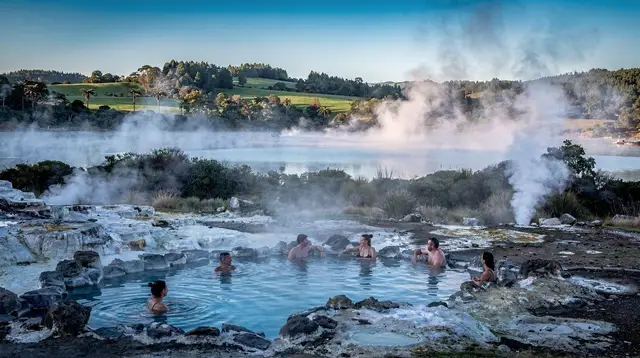
The obvious pairing with cold air is a hot pool, and this is the one season where the contrast does real work: sitting in naturally heated mineral water while your breath fogs in front of you is a specifically winter experience that summer simply can’t replicate. Rotorua’s hot pools, from the developed Polynesian Spa to the region’s free geothermal soaking spots, are worth prioritising specifically in this window rather than saving for a warmer month.
The same logic extends to cultural experiences built around warmth and shelter - a hāngī dinner and evening performance feels more fitting on a cold night than a warm one, and a Te Puia Māori village visit paired with a rejuvenation experience combines the geyser field, the cultural centre and a warming finish in a single winter-friendly afternoon.
Winter is also the quietest season for visitor numbers, which makes it the easiest time to get a walking track, a geothermal boardwalk or a cultural show without competing for space. It suits travellers who’d rather trade a few degrees of warmth for thinner crowds and lower accommodation rates. The trade-off is shorter daylight hours, which compresses how much can realistically be packed into a single day, and a slightly higher chance of a wet or foggy morning delaying an early start. A guided walk through native forest works well regardless of that, since tracks like those covered by Whirinaki Forest walks are sheltered under canopy for much of their length; a guided Whirinaki Forest walk with a local operator is a reasonable way to get outdoors on a cool, damp winter day without depending on clear skies.
For a fuller rundown of what to prioritise in this window, Rotorua in winter and the ready-made Rotorua winter 3-day itinerary both go further than this section can.
Spring (September-November): The Changeable Middle
Spring is the least predictable of the four seasons here, and that’s really its defining feature rather than a flaw. Temperatures climb steadily from winter’s low teens back toward summer’s low-to-mid twenties, but the transition isn’t linear - a warm, still day can be followed by a cold front with little warning, and packing for spring genuinely means packing for both ends of the range in the same bag. Daylight lengthens through the season, which helps with planning full days again after winter’s shorter window.
What spring offers that the other seasons don’t is a second shoulder-season price advantage before the summer peak sets in, generally without winter’s frosty mornings, plus native forest coming back into growth after the winter dormancy. It’s a workable time for the geothermal parks, which are unaffected by the season either way, and for the Kaituna River rafting and sledging runs once the weather has warmed enough to make getting wet appealing again, typically from October onward. A combination day that stacks ziplines, rafting and a hot pool finish makes particular sense as spring turns toward summer, and the Rotorua ziplines and rafting combo with a free sauna is built around exactly that kind of shoulder-season pacing, cooling water balanced against a warm finish.
Spring is also a fair window for the Tongariro Alpine Crossing, though - as with autumn - alpine conditions there can lag well behind what the lowland weather in Rotorua suggests, and late-spring snowmelt or lingering ice on the higher sections is a real factor into October in some years. As always with that specific track, current advice from the Department of Conservation or a guiding company matters more than any seasonal generalisation.
Month-by-Month Snapshot
| Season | Months | Typical daytime high | What stands out |
|---|---|---|---|
| Summer | December-February | ~23-24°C | Lake swimming, long days, peak crowds and prices, extreme UV |
| Autumn | March-May | Mild, cooling through May | Redwoods colour, stable weather, lower prices |
| Winter | June-August | ~12-13°C | Dramatic steam, best hot-pool contrast, quietest, shortest days |
| Spring | September-November | Rising through the season | Changeable weather, second shoulder-season pricing, rivers warming up |
Rain falls in every one of these seasons - Rotorua sees roughly 140 rainy days a year spread across the calendar, so there’s no defined dry season to plan around. A wet forecast is reason to prioritise the geothermal parks and indoor-leaning cultural experiences over an outdoor hike, not a reason to cancel a day. For the detail behind these averages month by month, see Rotorua weather month by month.
Matching the Season to What You Want to Do
| If your priority is… | Best season | Why |
|---|---|---|
| Swimming in the lakes | Summer (Dec-Feb) | Water and air temperature both cooperate |
| Lower prices, stable weather | Autumn (Mar-May) or Spring (Sep-Nov) | Shoulder-season rates without deep-winter cold |
| Hot pools and dramatic steam | Winter (Jun-Aug) | Cold air maximises the visible geothermal contrast |
| Geothermal parks and culture | Any season | Pōhutu, mud pools and hāngī run year-round regardless of weather |
| Thinnest crowds | Winter (Jun-Aug) | Lowest visitor numbers of the four seasons |
| Redwoods forest colour | Autumn (Mar-May) | Introduced deciduous trees turn through April-May |
| Rafting and river sledging | Late spring through summer (Oct-Feb) | Warmer water and air make getting wet more comfortable |
Whatever the season, the geothermal parks themselves make a fair anchor point for a first day in the region, since they’re the one category of activity genuinely unaffected by weather or time of year. A half-day eco thermal afternoon tour works as a same-day booking in any month, which makes it a reasonable fallback if a rained-out morning forces a change of plan. For cruise passengers arriving through Tauranga with a single day ashore, the same logic applies to a Rotorua shore excursion built around Te Puia, since it isn’t weather-contingent and fits inside a fixed port window regardless of season.
Packing and Practical Notes for Any Season
A few things hold true no matter when you land. Rain gear belongs in the bag in every month, since no season here is genuinely dry. Layers work better than a single heavy coat, because the daily swing between morning and afternoon temperature can be significant even in the warmer months, and winter mornings can start well below the daytime high. Sun protection matters specifically in summer, when the UV index reaches extreme levels regardless of how warm or mild the air feels - this is worth taking seriously rather than treating as standard travel advice. A fuller packing rundown, organised by season, is covered in what to pack for Rotorua, and the reversed-hemisphere seasons that catch out first-time visitors are explained in more depth in New Zealand’s upside-down seasons.
None of these seasonal notes should overshadow the basic point: Rotorua doesn’t have a wrong time to visit so much as it has different versions of the same core experience. The geysers, mud pools, Māori cultural experiences and hāngī that most visitors come for run on their own clock, not the calendar’s. Deciding when to go is really a question of which supporting experience - lake swimming, forest colour, or a hot pool against cold air - matters most to the trip, and building the season around that answer rather than searching for a single “best month” that doesn’t really exist here.
Choosing the Best Time to Visit Rotorua: Frequently Asked Questions
Is there a bad time to visit Rotorua?
Not really. Geysers, mud pools and hāngī still run year-round, and the geothermal parks and cultural experiences that anchor most visits are largely indoor-or-sheltered-friendly. Rain falls in every month, so no season is dry, and no season shuts the city down.
What is the wettest month in Rotorua?
Rotorua gets rain roughly 140 days a year spread across the calendar, so there is no defined dry season. Winter months see slightly more rainy days on average, but summer afternoon showers are also common.
Is Rotorua worth visiting in winter?
Yes. Winter (June to August) brings cooler days around 12-13°C and frosty mornings, but the geothermal steam is far more visible in cold air, the hot pools feel better by contrast, and visitor numbers drop. There is no snow in Rotorua itself; skiing happens on Mount Ruapehu, about two hours south.
When are prices lowest in Rotorua?
Shoulder seasons - autumn (March to May) and spring (September to November) - typically bring lower accommodation rates than the December-February peak, without the coldest weather of deep winter.
Do I need to avoid summer because of crowds?
Summer (December to February) is the busiest period, partly because it overlaps with New Zealand’s own school holidays around Christmas and January. Booking key experiences ahead helps, but Rotorua’s geothermal parks and cultural venues rarely feel as saturated as major overseas attractions.
Is the Tongariro Alpine Crossing open all year?
It’s a mountain crossing, so conditions vary sharply by season and can require alpine experience or a guide outside the main summer walking window. Check current conditions with the Department of Conservation or a local operator before planning around it.
What should I pack regardless of season?
A rain layer, since showers can happen in any month, and sun protection, since the UV index gets extreme in summer even when the air feels mild. Layers work better than one heavy jacket, because daily temperature swings can be large.
Seasonal experiences on GetYourGuide
Verified deep-linked GetYourGuide tours. Book through these links and we earn a small commission at no cost to you.
Photos show the destination, not the operator's own images.