Rotorua with Kids: The Family Itinerary That Actually Works
What's the best Rotorua itinerary for families with a mix of ages?
Base three days around one geothermal park, one cultural experience with a hāngī, and one outdoor half-day (redwoods, a lake, or a farm), and let the youngest child set the pace. Skip anything sold as extreme or all-day for kids under eight, and check age and height limits before booking rather than after.
Rotorua gets pitched to families as an easy win: geysers, mud, a lake, a forest, all within a short drive. That’s mostly true. What the marketing skips is that a 4-year-old, an 8-year-old and a 13-year-old want almost nothing in common here, and a chunk of what’s for sale — combo passes, all-day adventure packages, guided treks — is priced and timed for adults who don’t have a small person losing patience by 2pm. This guide is built the other way round: by age, then by what to actually skip.
Building a family day around the youngest child, not the itinerary
The single rule that saves a Rotorua family trip: the itinerary is set by the youngest child’s stamina, not by how much there is to see. A toddler and a teenager can be in the same geothermal park at the same time and have completely different experiences of it — one is fascinated by bubbling mud for ten minutes and done, the other could read every information panel. Plan half-day blocks with a clear exit point, not a checklist of sights, and treat anything beyond about two hours of standing and walking as a stretch for anyone under six.
The other structural point: Rotorua’s core sights are close together. You are not driving 90 minutes between activities, so it’s realistic to do a short morning outing, a long lunch and pool break back at accommodation, then a second short activity in the late afternoon. That rhythm works far better with kids than one long day trip.
What works at 4: short, sensory, no walking marathons
Preschoolers respond to Rotorua’s sensory side, not its scale. The things that land:
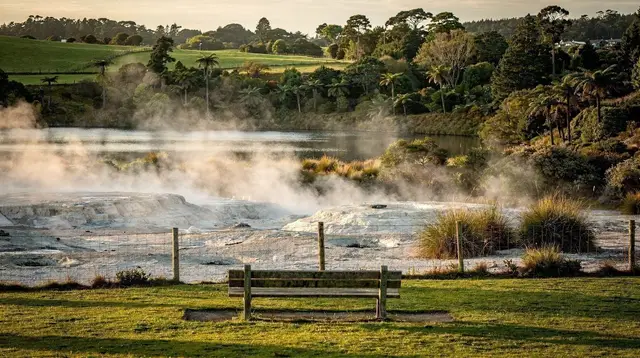
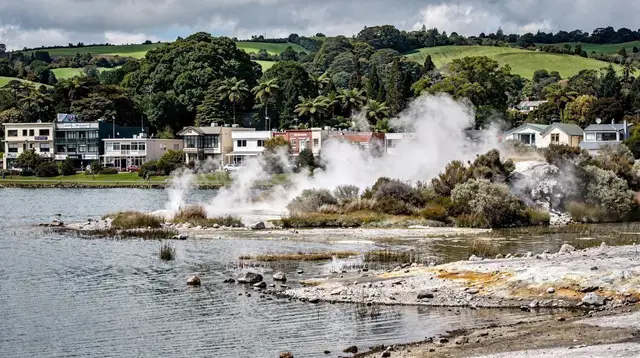
- Bubbling mud and steam at a geothermal park, in short doses. Whakarewarewa Village is the best fit for this age because it’s a compact, guided loop through a village where steam vents and hot pools sit right beside the path — not a sprawling reserve requiring an hour of walking.
- Warm water they can actually get into. A managed hot pool complex beats a “look, don’t touch” geothermal walk for a 4-year-old’s attention span. See the Rotorua hot pools guide and, for a calmer family session, what to know before Polynesian Spa.
- Animals at eye level — a farm show format holds attention far longer than a nature walk does for this age, because the pace is short bursts of activity rather than sustained looking.
- A short forest walk on a flat path, not a full loop. The Redwoods has enough flat, shaded track near the entrance to satisfy a short legs-and-attention-span outing without committing to the full network.
Skip at this age: anything described as a “trek,” a boat trip longer than about an hour, and geothermal parks that are laid out as one long walking circuit with no shortcut back to the car park. Wai-O-Tapu is spectacular but is a genuine walking loop of over an hour with limited shade — doable, but plan for carrying a tired child on the way back.
What works at 8: hands-on, a bit of thrill, still needs an off-ramp
This is the age Rotorua is arguably built for. Eight-year-olds can walk further, follow a guide’s explanation, and handle a bit of controlled thrill without the full adrenaline-park experience.
- A hāngī and cultural evening genuinely works at this age — the food-cooked-underground story, the haka, the singing, hold interest in a way a straight museum visit doesn’t. Read what a hāngī actually is before booking so expectations about food and format are set correctly.
- Grade 1–2 river activity. A calm scenic float or a gentle rafting stretch suits this age far better than a full whitewater run — see the Kaituna River rafting guide for which stretches and operators run family-graded trips versus the harder sections built for teens and adults.
- Wildlife encounters with structure — a kiwi house, a nocturnal enclosure, or a farm park format. Rotorua doesn’t offer wild daytime kiwi sightings (they’re nocturnal birds), so a managed encounter is the realistic way to see one; see the Rotorua wildlife and kiwi guide and whether a farm show is worth it for this age group specifically.
- The redwoods canopy walkway, day version. It’s elevated but not extreme, and an 8-year-old handles the height and the walking distance comfortably.
An eco-thermal park visit with a guide who explains what’s actually happening underground tends to outperform a self-guided version at this age, because the narration keeps kids engaged past the first ten minutes:
a guided afternoon through Rotorua’s geothermal featurespitches its pace and explanations at a general family audience rather than a specialist one, which matters more for an 8-year-old’s attention span than the specific park chosen.
What works at 13: real adventure, but check the fine print first
Young teens are usually ready for what’s actually marketed as adventure in Rotorua — but this is exactly the age where families overspend on combos with parts nobody in the group can use. Height, age and fitness minimums are real and enforced, not suggestions.
- Ziplining and grade 3–4 rafting genuinely suit a fit 13-year-old, provided they clear the operator’s minimum age and weight requirements — check these before booking, not after arriving. A combo format that bundles the zipline with a rafting run and a free sauna afterward suits a teen’s stamina and appetite for variety in a single afternoon:
covers a half-day of activity without requiring a second booking. A hot-pool version of the same pairing exists too, for a family that wants the adrenaline half without the whitewater:
a zipline, rafting and hot pool combination with a free sauna- A longer lake cruise with a food stop works better for teens than for younger kids, because the pace is slower and the payoff (scenery, a hot drink, boat time) needs patience a 4-year-old doesn’t have yet:
Lake Rotoiti’s hot springs are only reachable by water, which is exactly the kind of detail a cruise format solves and a self-drive day doesn’t.
- A day trip to swim with dolphins off Tauranga is squarely a teen-and-up activity — it depends on a wild-animal sighting (never guaranteed), involves open water, and is a full day away from Rotorua:
a half-day boat trip from Tauranga with the chance to swim with dolphins
is worth setting expectations on: it’s a wildlife encounter, not a guaranteed swim, and it suits teens who are confident swimmers.
- The Tongariro Alpine Crossing is realistic for a fit teenager but is a serious undertaking: 19.4 km, six to eight hours, roughly two hours’ drive each way from Rotorua, with weather that turns fast above the treeline. Read the Tongariro Alpine Crossing from Rotorua guide before committing a family day to it — it is not a casual half-day extra.
The three activities where families lose money
1. Full geothermal park admission for a toddler who won’t walk the loop. Family tickets are often priced per person with only a small child discount, and a park like Wai-O-Tapu is a genuine one-hour-plus walking circuit with limited shortcuts. Paying full price for a child who will be carried the second half is the single most common overspend. The fix is choosing a park built around a shorter, guided loop — Whakarewarewa Village or a short eco-thermal session — for the youngest member of the group, and saving the bigger walking parks for a day when the kids are older or absent.
2. An adrenaline combo bought for the whole family when only the teens can use it. Zipline-and-rafting combos, black-water cave rafting, and the higher-grade river runs carry minimum ages and heights that rule out younger siblings — meaning a parent ends up buying a combo pass for a teen and then paying separately, and often more per person, for a completely different activity for the younger kids at the same time slot. Check the age and height minimums on the operator’s own listing before comparing prices, not after.
3. A guided all-day trek priced as a family package that only the fittest half of the family can finish. Full-day forest treks and the Tongariro Alpine Crossing are sometimes bundled into “family adventure” marketing that doesn’t reflect the actual walking distance or terrain. A guided half-day walk — through Whirinaki Forest or a shorter redwoods loop — delivers the same “we did an adventure” feeling for a fraction of the time and cost, without a family member finishing on a parent’s shoulders.
A sample three-day family itinerary
| Day | Morning | Afternoon | Evening |
|---|---|---|---|
| 1 | Whakarewarewa Village guided walk | Pool break, Redwoods short walk or canopy walkway (day) | Hāngī and cultural show |
| 2 | Te Puia or eco-thermal park visit | Farm show or kiwi encounter for younger kids; zipline-rafting combo for teens | Free evening, Kuirau Park area for a walk |
| 3 | Hamurana Springs short forest walk | Lake cruise with morning tea, or free time at accommodation pool | Pack up, optional evening at a free hot spring |
Adjust the order for weather — geothermal parks and pools work fine in light rain and can be better in cool, damp weather when the steam is more dramatic, while forest walks and cruises are better saved for a clear day. A wet-weather backup list is worth keeping handy; see the rainy day activities guide for what holds up when the forecast doesn’t.
Practical logistics for a family visit
| Consideration | Detail |
|---|---|
| Base budget per person, per day | Budget ~150 NZD, mid-range ~350 NZD, top-end ~700 NZD — family bookings add up fast on combo tickets, so price each activity separately per age group before assuming a bundle is cheaper |
| Currency | New Zealand dollar (NZD); the displayed price already includes 15% GST, so there’s no tax added at the till |
| Tipping | Not expected anywhere, including on tours |
| Driving | Left-hand side; distances between Rotorua sights are short, most under 30 minutes |
| Sun | UV can be extreme in summer — hats and sunscreen matter more here than the mild air temperature suggests |
| Water safety | Some lakes and hot pools have posted temperature or depth warnings for children; read signage on-site rather than assuming a pool is toddler-safe because it looks calm |
For families without a rental car, see getting around Rotorua without a car — several of the sights above run shuttle or pickup options that remove the need to self-drive between activities. And if accommodation is the harder decision than the itinerary, the Rotorua where to stay guide breaks down which areas suit a family base versus a couple’s short stay.
Frequently asked questions about visiting Rotorua with kids
Is Rotorua a good destination for young children?
Yes, with limits. Toddlers and preschoolers tolerate short, sensory-rich stops — bubbling mud, warm water, animals — far better than long guided walks or driving days. Plan half-days, not full ones, and build in a nap or pool break.
What age is Whakarewarewa Village suitable for?
Most ages. It’s a short, guided walk through a lived-in village with steam vents and a hāngī demonstration, paced for a family group rather than a fitness test, so it works from toddlers to teens.
Which Rotorua activities should we skip with kids under 8?
Anything sold as a full-day trek, a black-water rafting cave trip, or the Tongariro Alpine Crossing. These involve hours of walking, cold water immersion, or exposed alpine terrain that isn’t matched to a young child’s stamina or thermoregulation.
Is the smell of sulphur safe for children?
The hydrogen sulphide smell around Rotorua’s geothermal areas is a normal feature of the volcanic zone and not, at typical outdoor exposure, a health risk for a short visit. Children with asthma or respiratory sensitivity should be watched, and nobody should linger directly over a steaming vent.
How many days do we need in Rotorua with kids?
Three days covers one geothermal park, one cultural half-day, and one outdoor or adventure half-day without rushing. Two days works if you accept doing less; five or more suits families who want a slower pace with pool afternoons built in.
Can teenagers do the Tongariro Alpine Crossing from Rotorua?
A fit teenager can, but it’s a 19.4 km alpine day walk of six to eight hours, roughly two hours each way from Rotorua to the start, with weather that changes fast at altitude. It suits capable teens with proper footwear and layers, not a casual add-on to a family day.
What’s the biggest waste of money for families in Rotorua?
Paying full adult-plus-child combo prices for attractions where one age group in the group won’t get much out of it — a toddler on a full geothermal walking loop, or a young child on an adrenaline combo priced and timed for teens and adults.
Is Rotorua safe for kids given the geothermal activity?
Rotorua’s geothermal parks are managed sites with marked paths, barriers around hot pools and mud, and staff on duty — they’re built for public visits, including families. The usual rules apply: stay on paths, hold small children’s hands near boardwalks, and don’t let anyone touch the water or mud.
Family activities on GetYourGuide
Verified deep-linked GetYourGuide tours. Book through these links and we earn a small commission at no cost to you.
Photos show the destination, not the operator's own images.