Rotorua Weather Month by Month
What is the weather like in Rotorua month by month?
Rotorua sits in the southern hemisphere, so summer runs December to February with maxima around 23-24°C, and winter runs June to August with maxima around 12-13°C and morning frosts. Rain falls year-round, roughly 140 days a year, with no true dry season.
Reading Rotorua’s climate one month at a time
Rotorua sits at roughly 38° south, on the North Island of New Zealand, at about 290 metres above sea level on the shore of Lake Rotorua. That position in the southern hemisphere is the single fact that reorganises everything else in this guide: the calendar runs backwards compared with Europe or North America. Christmas falls in the middle of summer, and the coldest, darkest stretch of the year lands in June and July. Nothing about the town’s geothermal character resets with the seasons — the steam, the smell of hydrogen sulphide, the mud pools and the geysers run on their own clock, not the weather’s — but temperature, rainfall and daylight hours shape how a visit feels and what it’s comfortable to do outdoors.
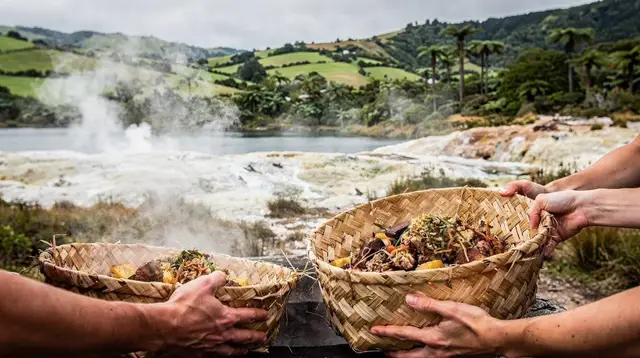
There is no dry season here. Rotorua gets rain in every month, spread out at roughly 140 rainy days a year rather than concentrated in a wet season and absent the rest of the time. That single fact should shape packing and planning more than any month-by-month temperature chart: an umbrella and a light waterproof layer belong in the bag whichever month you land. For the geothermal parks in particular, a wet or overcast day often produces better viewing than flat summer sun, since steam and colour tend to stand out more against grey skies. Trail and track conditions, not the calendar, are the detail worth checking close to a trip — see the free walking tracks guide for a sense of what’s affected by weather versus what runs regardless.
Rotorua’s four seasons, southern hemisphere style
| Season | Months | Typical daytime maximum | Character |
|---|---|---|---|
| Summer | December – February | ~23-24°C | Longest days, warmest water, extreme UV |
| Autumn | March – May | Cooling from summer toward winter | Settling weather, shorter days |
| Winter | June – August | ~12-13°C | Morning frosts, most dramatic steam, short days |
| Spring | September – November | Warming from winter toward summer | Changeable, lengthening days |
These are broad bands rather than fixed switches — late autumn can still feel mild, and early spring can still bite in the morning. What doesn’t change with the season is the rain: it’s a year-round visitor, not a seasonal one.
Month by month
The table below gives an approximate feel for each month — daytime temperature range, how many days typically see some rain, and roughly how many hours of daylight to expect. These are indicative figures for planning purposes, not a forecast: for actual trail, road and weather conditions close to a trip, check the Department of Conservation or the relevant operator directly, since geothermal areas and hiking routes can be affected by conditions that outlast or outpace any seasonal average.
| Month | Season | Typical daytime range | Rain | Approx. daylight |
|---|---|---|---|---|
| January | Summer | ~23-24°C down to mid-teens overnight | Occasional, often brief | ~14.5 hours |
| February | Summer | Similar to January, still warm | Occasional | ~13.5 hours |
| March | Early autumn | Cooling, still mild by day | Regular | ~12.5 hours |
| April | Autumn | Noticeably cooler than summer | Regular | ~11.5 hours |
| May | Late autumn | Cool days, colder mornings | Regular | ~10.5 hours |
| June | Early winter | ~12-13°C, frosty mornings possible | Regular | ~9.5 hours |
| July | Midwinter | Coolest month, morning frost common | Regular | ~9.5 hours |
| August | Late winter | Still cool, first signs of warming | Regular | ~10.5 hours |
| September | Early spring | Warming, changeable | Regular | ~11.5 hours |
| October | Spring | Milder, more settled | Regular | ~12.5 hours |
| November | Late spring | Approaching summer warmth | Occasional | ~13.5 hours |
| December | Early summer | Warming toward the January peak | Occasional | ~14.5 hours |
Summer — December to February
Summer is Rotorua’s warmest and longest-day stretch, with daytime maxima typically around 23-24°C and evenings that stay light late. This is also when the region gets crowded, since it lines up with New Zealand’s own school holidays as well as international summer travel. The lakes — Lake Rotorua, Lake Rotoiti, Lake Tarawera and the Blue and Green Lakes — are at their most swimmable, and outdoor activity around the Redwoods forest and its mountain biking network is most comfortable in warm, dry conditions.
The one genuine hazard of a New Zealand summer is UV, not heat. The UV index reaches extreme levels here in summer, well above what visitors from higher-latitude countries are used to, and it burns skin far faster than the air temperature suggests. Sun protection is a real precaution in this season, not a formality. For a fuller seasonal breakdown of what summer suits and what it doesn’t, see the dedicated Rotorua in summer guide.
Autumn — March to May
Autumn is a transition rather than a season with its own strong identity: temperatures ease down from summer’s warmth toward winter’s chill, days shorten steadily, and the crowds of the summer peak thin out. It’s often a comfortable stretch for walking and for the geothermal sites, since the heat and UV of summer have faded but the frosts of deep winter haven’t yet arrived. A guided walk on Mount Tarawera or a day exploring Wai-O-Tapu both work well in this window, weather allowing on any given day.
Winter — June to August
Winter brings Rotorua’s coolest days, typically maxing out around 12-13°C, with morning frosts a real possibility, especially in July. It does not snow here — Rotorua’s own elevation is far too low and too far north for that — but the higher volcanic country to the south, particularly Ruapehu in Tongariro National Park, does carry snow and supports a ski season through these months. What winter does deliver at Rotorua’s own elevation is arguably its best visual trade: in cold air, the geothermal steam rising from parks, roadside vents and even suburban lawns becomes far more dramatic than in summer, when warmer air absorbs it more quietly. Days are short, with darkness setting in by mid-afternoon around the June solstice, so plan outdoor time accordingly.
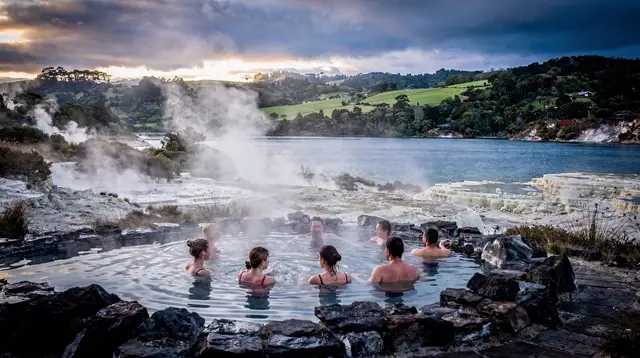
The Rotorua in winter guide and the three-day winter itinerary both go into what this season suits best, and a hot pools soak on a cold evening is one of the more obvious pairings between climate and activity here.
Spring — September to November
Spring is the mirror of autumn: a warming, lengthening, changeable stretch as the region climbs back out of winter toward summer. Weather can shift within a single day in this season more than in any other, so layering matters more than it does at either extreme of the year. It’s also a season without the summer crowding, which makes it a reasonable window for activities that benefit from quieter trails and車 parks — though checking current conditions before a hike remains sound practice regardless of month.
Rain, all year round
The detail that matters more than any single month’s average is that Rotorua has no dry season at all. Roughly 140 days a year see some rain, distributed across the calendar rather than clustered into a handful of wet months. That has two practical consequences. First, packing a light waterproof layer and reasonable footwear isn’t a hedge against one unlucky season — it’s sensible in January exactly as it is in July. Second, choosing a travel month specifically to “avoid the rain” isn’t really an option here; the better approach is planning a mix of indoor and outdoor options for any multi-day stay, which the rainy day activities guide covers directly.
Because the geothermal parks are largely outdoor walking circuits over boardwalks and gravel paths, a day of rain there is rarely a reason to cancel — many visitors and operators alike note that the steam, colour and contrast at sites like Wai-O-Tapu or Hell’s Gate can look more striking under cloud than under bright sun. An afternoon geothermal walking tour runs rain or shine for exactly this reason.
Matching activities to the season
Some of Rotorua’s signature activities are essentially weather-proof, run year-round on a fixed operating schedule, and don’t need to be timed around a particular month at all. Others benefit noticeably from a specific season.
- Geothermal parks and cultural sites — work in any month; a village visit or Te Puia experience runs on its own daily schedule regardless of weather.
- Lake swimming and water activities — best in the warmer months, from late spring through to early autumn.
- Mountain biking and forest walking — comfortable across most of the year, though summer heat and UV call for an earlier start and winter’s short days call for finishing before dusk.
- Hot pools and spa soaking — arguably at their best in winter, when the contrast between the cold air and the warm water is most pronounced; the hot pools guide has the detail.
- The Tongariro Alpine Crossing — a day walk best attempted outside the depths of winter, when snow and ice on the higher sections raise the difficulty and risk considerably; see Tongariro from Rotorua for what a day trip involves.
- Horse trekking and forest walks — pleasant across most seasons; a scenic horse trek or a guided forest walk with local guides both suit spring and autumn particularly well, when temperatures are moderate and trails less crowded.
For a cultural half-day that isn’t weather-dependent at all, a Te Puia village and rejuvenation experience combines an indoor and outdoor programme that holds up whatever the sky is doing.
Planning around the calendar, not just the weather
Weather is only one input into when to visit. New Zealand’s own school holidays cluster around the summer months and around a shorter break in winter, and those periods bring more visitors and more competition for accommodation regardless of what the thermometer says. The best time to visit Rotorua guide weighs weather against crowding and pricing together, which matters more for most trip planning than temperature alone. Visitors arriving from a visa-waiver country should also note the practical side of planning ahead — the NZeTA and entry requirements guide covers what needs sorting before departure, independent of season. And for a broader sense of why the calendar runs the way it does here, the seasons upside down explainer unpacks the mechanics behind a Christmas that falls in summer.
Deciding how many days to spend is a separate question from when to go, and one that interacts with the weather less than it might seem — a three or four-day stay leaves enough room to swap a rained-out plan for an indoor one without losing the trip.
Weather-related questions about visiting Rotorua
What is the coldest month in Rotorua?
July is typically the coldest month, with daytime maxima around 12-13°C and morning frost a real possibility. It sits in the middle of the southern hemisphere winter, which runs June to August.
What is the warmest month in Rotorua?
January and February are the warmest months, with daytime maxima typically around 23-24°C. Both fall within New Zealand’s summer school holiday period, so they’re also the busiest months to visit.
Does Rotorua have a rainy season?
No. Rain falls across the whole year, at roughly 140 days annually, rather than concentrating into a distinct wet season followed by a dry one. Any month should be planned with a waterproof layer in the bag.
How many daylight hours does Rotorua get in winter versus summer?
Around the June winter solstice, daylight runs to roughly nine and a half hours; around the December summer solstice, it stretches to roughly fourteen and a half hours. The swing between the two is the most noticeable seasonal change alongside temperature.
Is it worth visiting Rotorua in winter?
Yes, for specific reasons rather than in spite of the cold. The geothermal steam is more visually dramatic against cold air, hot pools feel better in contrast to the cool temperature, and crowds thin out compared with summer. Short daylight hours are the main trade-off to plan around.
Should I avoid Rotorua during a particular month because of rain?
Not really. Since rain is distributed fairly evenly across the year rather than concentrated in a specific season, avoiding one month for weather reasons alone doesn’t meaningfully improve the odds. Planning flexible, partly indoor days matters more than picking a supposedly drier month.
Does the weather affect the geothermal parks much?
Less than most visitors expect. Boardwalk paths at sites like Wai-O-Tapu and Hell’s Gate operate in most weather, and overcast or rainy conditions often make the steam and colour more visually striking rather than less. Extreme weather events are the exception, and current conditions are always worth a quick check with the operator beforehand.
What should I pack for Rotorua regardless of month?
A light waterproof layer, footwear suited to boardwalks and gravel trails, and sun protection even outside summer, since UV levels in New Zealand run higher than many visitors expect at any time of year. Layers matter more than a single heavy coat, since temperature swings within a day are common in the shoulder seasons.
Food & drink tours in Rotorua on GetYourGuide
Verified deep-linked GetYourGuide tours. Book through these links and we earn a small commission at no cost to you.
Photos show the destination, not the operator's own images.