New Zealand's Upside-Down Year: Christmas in Summer, Explained
The first time I worked out that Christmas Day in Rotorua would be spent in a T-shirt, sunscreen already on my arms, I remember feeling faintly cheated. Somewhere in my head, Christmas came with a coat. Here it comes with jandals and a chilly bin of drinks in the car boot, because December sits in the middle of the New Zealand summer, not at the start of winter.
It’s a small fact with big consequences for anyone planning a trip. If you’ve flown in from London, Berlin or Chicago, your body and your calendar both assume the year works the way it always has: cold in December, warm in July, school out in June, back in September. None of that applies south of the equator, and Rotorua — a town that runs on tourism and on school-holiday crowds in roughly equal measure — is a good place to feel the difference.
The seasons run exactly backwards
New Zealand sits in the Southern Hemisphere, so its seasons are flipped relative to Europe or North America. Summer runs December to February, autumn March to May, winter June to August, and spring September to November. When I say “summer holidays” to a Kiwi, they picture January at the beach. When someone from Toronto says the same thing, they picture July.
That flip explains why the fields at Hobbiton look impossibly green and gold in what a Northern Hemisphere calendar calls the depths of winter — late December here is early summer growth, long light, and warm evenings. It’s also why the Rotorua guides I’ve spoken to over the years talk about “the season” starting around Labour Weekend in late October, not around Easter.
For a full month-by-month breakdown of what that means for temperature, rain and daylight, Rotorua Weather Month by Month goes through it properly. The short version: there’s no dry season here, just a warmer wet season and a cooler wet season, and Best Time to Visit Rotorua is the honest starting point if you’re choosing dates from scratch.
Christmas, New Year, and the six weeks that fill everything up
Here’s the part that catches visitors out. New Zealand school holidays don’t map onto a European or North American summer break — they map onto the New Zealand summer, which means the big one runs from roughly mid-December to early February. That’s not a school holiday tacked onto an already-warm season; it is the reason the season feels full. Kiwi families travel domestically in huge numbers in that window, because it’s the only stretch of the year when the weather, the light and the time off all line up at once.
Add Christmas Day and New Year’s Day sitting inside that same six weeks, plus a public holiday called Waitangi Day on 6 February, and you get a compressed period where accommodation in and around Rotorua, Lake Tarawera baches, and holiday parks fill up well ahead of time. If you’re weighing up a summer trip, Rotorua Holiday Parks and Camping: Freedom Camping, DOC Sites and Thermal Pools is worth reading before you assume a site will be free on the day.
There are three shorter school holiday blocks through the rest of the year too — roughly two weeks in April around Easter, two weeks in July in the middle of winter, and two weeks in late September or early October. Each one gives Rotorua a smaller, more local bump in visitors: more school groups at the geothermal parks, more families on the Mountain Biking Rotorua: The Redwoods Trail Network Explained trails, more cars on the road to Tongariro Alpine Crossing from Rotorua if the July break lines up with good weather, which in a Ruapehu winter it sometimes does and sometimes very much doesn’t.
What this means if you’re planning from the other hemisphere
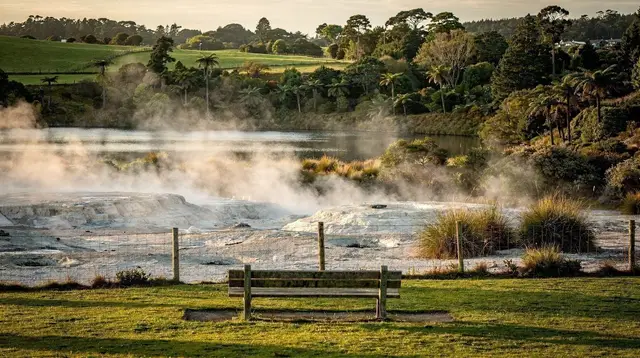
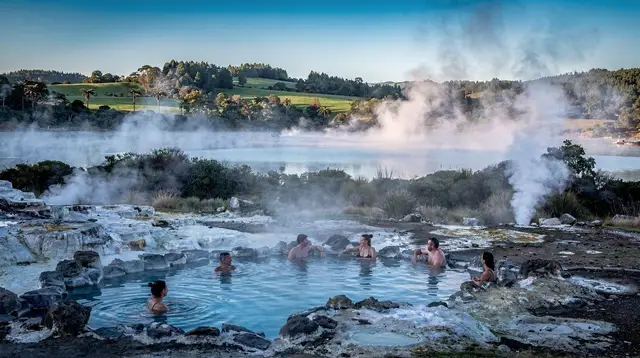
I’ve made the mistake myself, on an earlier trip, of assuming “winter” meant quiet and cheap the way it might in a European ski town’s off months. In Rotorua, winter — June to August — does bring cooler days, around 12 to 13°C at the top end, and proper morning frosts. But it’s also the season when the geothermal steam is at its most dramatic against cold air, when the town isn’t dealing with summer’s UV extremes, and when Rotorua in Winter makes a genuinely good case for itself rather than being a fallback. If your goal is short queues at the buried village of Te Wairoa or the geothermal parks, winter weekdays outside the July school holidays are close to ideal.
Booking a Christmas or January trip works completely differently. Treat it the way you’d treat booking a European destination for its peak August fortnight: lock in accommodation and any fixed-time activity — a geothermal park visit timed around a specific afternoon or a day combining the volcanic valleys south of town — several weeks out rather than a few days before. How Many Days Do You Need in Rotorua? and Rotorua Day Trips by Drive Time are both useful for shaping an itinerary once dates are fixed, and if kids are along for a summer trip, Rotorua with Kids: The Family Itinerary That Actually Works is written with exactly that school-holiday crowding in mind.
There’s an administrative side too, and it’s easy to overlook when your head is on seasons rather than paperwork. Most visitors need a NZeTA and to pay the IVL before arrival regardless of what month it is — see New Zealand Entry Requirements: NZeTA and IVL Explained — and New Zealand’s biosecurity checks at the border are strict year-round, covered in New Zealand Biosecurity: What Not to Bring in Your Bags. None of that changes with the season, but packing does: What to Pack for Rotorua is worth a look once you know which hemisphere-summer you’re actually walking into, and if budget is on your mind alongside the calendar, Is New Zealand Expensive? What I Actually Spent lays out the costs plainly.
What I keep coming back to, having now spent a Christmas and a July in Rotorua a few years apart, is that neither season is the “wrong” one. They’re just different trips. Summer gets you long evenings by the lake and a town at full tilt; winter gets you cold, clear mornings with steam rising off Kuirau Park and a noticeably quieter version of the same places. The mistake isn’t picking one — it’s assuming the calendar behaves the way it does at home.
Questions about New Zealand’s seasons and school holidays
Why is Christmas in summer in New Zealand?
New Zealand is in the Southern Hemisphere, where the seasons run opposite to the Northern Hemisphere. December, January and February are the New Zealand summer, so Christmas Day and New Year’s Day both fall in the warmest, longest-daylight part of the year rather than in winter.
When are New Zealand school holidays?
There are four school holiday periods a year: a long six-week break from roughly mid-December to early February covering Christmas and New Year, and three shorter two-week breaks around Easter (April), the middle of winter (July), and late September to early October.
Is December to February the busiest time to visit Rotorua?
Yes, generally. It combines the New Zealand summer with the long school holiday period, so accommodation, holiday parks and popular activities see the highest domestic and international demand of the year, particularly in the weeks either side of Christmas and New Year.
Does New Zealand have a dry season?
No. Rotorua gets rain in every month of the year, roughly 140 rainy days annually, so there’s no true dry season to plan around — only a warmer wet season and a cooler wet season.
Is winter a bad time to visit Rotorua?
Not necessarily. Winter (June to August) brings cooler days, around 12 to 13°C, and frosty mornings, but also fewer crowds outside the July school holidays, and the geothermal steam is often more visually striking against cold air.
Does it snow in Rotorua in winter?
Practically never in Rotorua itself. Snow in this region falls on Mount Ruapehu, about two hours south, where it supports the North Island’s ski season; Rotorua town stays snow-free.
What public holidays fall in the New Zealand summer?
Christmas Day (25 December), Boxing Day (26 December), New Year’s Day (1 January), the day after New Year’s Day (2 January), and Waitangi Day (6 February) all fall within the New Zealand summer.
Should I book ahead if I’m visiting Rotorua over Christmas or January?
Yes. That window overlaps with the longest school holiday period and the warmest weather, so accommodation and time-specific activities are worth booking several weeks in advance rather than close to your travel dates.
Seasonal experiences on GetYourGuide
Verified deep-linked GetYourGuide tours. Book through these links and we earn a small commission at no cost to you.
Photos show the destination, not the operator's own images.