A Crater You Can Walk Around
Lake Rotorua is not a lake that happens to sit near a volcanic region. It is the volcanic region, or at least the visible scar of it: a caldera roughly 11 by 9 kilometres across, formed tens of thousands of years ago when a magma chamber emptied and the ground above it collapsed, then filled with water. The whole city of Rotorua is built on and around the rim and floor of that collapsed structure, at around 290 metres above sea level. Nowhere else in the region makes the geology this legible — you can stand on a footpath, look across open water at a forested island, and be looking across an old crater floor.
This is also the reason the town smells the way it does in places. The same fractures that vent steam at Kuirau Park and feed the pools of the Polynesian Spa run under parts of the lakebed too, and a handful of bays carry a trace of hydrogen sulphide that the open lake mostly doesn’t. Understanding that split — most of Lake Rotorua is an ordinary, swimmable, boatable lake, and a few specific spots are not — is the single most useful thing to know before spending a day here.
Mokoia Island, at the Centre of the Story
The island in the middle of the lake is Mokoia, and it carries more weight than its modest size suggests. It’s the setting of one of the best-known Māori love stories in the country — Hinemoa swimming across the lake at night, guided by the sound of Tūtānekai’s flute, to reach him against her family’s wishes — and it remains significant to Te Arawa, the iwi of the Rotorua lakes. During the 1886 Tarawera eruption, Mokoia’s shores sheltered people fleeing the ash fall from the mainland, which adds a second, harder layer to its history.
Today the island is a predator-free wildlife sanctuary, cleared of introduced pests so that native birds — including species that struggle on the mainland — can breed undisturbed. It isn’t a place you get to on your own initiative: there’s no public ferry timetable to check and no jetty to just turn up at, because access runs through licensed operators and is bound up with the island’s protected and culturally significant status. A lake cruise or kayaking trip is the practical way to see it, whether that means passing close by on the water or landing with a guided group. Either way, it’s worth building into a lakefront day rather than treating as an afterthought — from the shore, Mokoia is scenery; from the water, it’s the reason the lake has a centre of gravity at all.
The Lakefront: Government Gardens to Sulphur Point
Rotorua’s lakefront is short enough to walk end to end in well under an hour, but it packs in most of the town’s civic history. Starting from the Government Gardens, a formal Edwardian-style park laid out in the early 1900s, the path runs past the elaborate timber Bath House building — closed since 2016 for seismic strengthening, and reopening in stages, so treat any specific access as something to check rather than assume — and continues along the water toward the boat ramps and jetties where lake cruises, kayak hire and fishing charters set off.
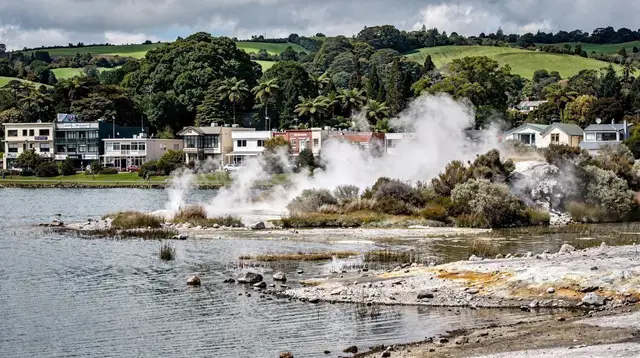
Further along, Sulphur Point Reserve is where the lakefront stops pretending to be an ordinary park. Boardwalks cross bare, steaming ground pocked with small vents and discoloured mineral deposits, right next to open water where black swans paddle past as if nothing unusual is happening. It’s one of the few places in the world where an urban lakefront walk and an active geothermal field share the same stretch of path, and it costs nothing to visit. For a longer look at geothermal ground with named features — mud pools, coloured pools, a reliably timed geyser — the thermal parks south and east of town go further than the lakefront can, and pairing a lakefront walk with an afternoon at one of them is a common, sensible way to spend a day:
an afternoon tour through Rotorua’s geothermal terraces and thermal springscovers that ground without requiring a rental car.
Ōhinemutu, Ngongotahā and the Villages on the Shore
Two settlements on the lake’s edge are worth knowing by name. Ōhinemutu, a Ngāti Whakaue village barely a ten-minute walk from the town centre, sits directly on the shore with geothermal steam rising between houses that are still lived in. Its meeting house and St Faith’s Anglican Church — the latter famous for an etched-glass window depicting Christ in a Māori cloak, positioned so he appears to be walking on the lake beyond it — make it one of the more striking places to slow down for half an hour. Visiting respectfully matters here more than almost anywhere else in the region; a short read of Māori cultural etiquette in Rotorua before wandering through is worthwhile, since this is a living community, not an exhibit.
On the lake’s western shore, Ngongotahā is a smaller township with its own boat ramp and a more residential, unhurried feel — a reasonable base if the central lakefront feels busy, and close to Mount Ngongotahā behind it. Between the two, the western and southern shorelines are mostly given over to reserves, sports fields and residential streets rather than tourist infrastructure, which is part of why the lakefront proper concentrates almost everything visitors come for into one compact stretch.
Where the Swimming Works — and Where It Doesn’t
This is the practical heart of visiting Lake Rotorua, and it deserves a straight answer rather than a vague one. The lake itself is not thermally heated overall — it behaves like any large lake in the region, warming through summer and cooling in winter — but it sits inside an active geothermal field, and a small number of specific bays receive warm or mineral-laden groundwater seepage close to shore. Around Sulphur Point and parts of the town-side shoreline, that seepage is enough to affect both water clarity and the smell in the air, and these spots are not places people swim.
Move away from those specific points — toward the northern beaches near Hamurana Springs, or the lake’s open eastern and northern reaches — and the water is ordinary, cool, and swimmable through the summer months. Signage and local advice at any given beach reflect current conditions better than a guidebook can, since water quality on any lake shifts with rainfall and season; treating posted signs as the final word, rather than assuming from a map, is the right approach. If the appeal is heated water rather than lake swimming as such, the safer and more comfortable route is a purpose-built geothermal pool rather than the lake edge — Rotorua has several, from the well-known Polynesian Spa to smaller free and low-cost hot pools around town. A lakefront-adjacent option that combines both settings is:
a lakefront hot springs spa experience with a Māori wellness element, right on the water’s edgewhich lets you look at the lake while sitting in water that’s actually meant to be hot.
On the Water: Cruises, Kayaking and Floatplanes
Lake Rotorua’s real draw for most visitors is being on it rather than in it. Scheduled and chartered lake cruises run past Mokoia Island and along the shoreline, usually the easiest way to see the island’s shape and scale without arranging a landing permit yourself. For a self-directed pace, kayaking on the Rotorua lakes is well established, with calm mornings generally the most comfortable window before any afternoon wind picks up across the open water.
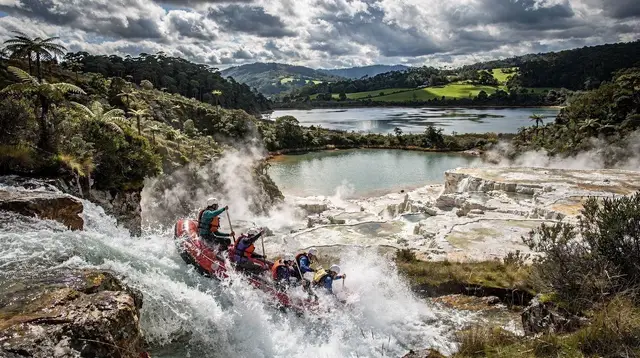
Rotorua is also one of the handful of New Zealand towns where floatplanes and helicopters operate directly off the lake surface, based at jetties along the lakefront. A scenic flight is the fastest way to grasp the caldera shape that’s difficult to read from ground level — the lake’s roughly circular outline, Mount Tarawera’s shattered profile beyond it, and the patchwork of other crater lakes scattered across the district all resolve into an obvious pattern from a few hundred metres up. Details on which operators fly which routes are covered in the comparison of Rotorua’s scenic flights. For visitors interested in the wider volcanic story that produced this landscape — including the lake that didn’t survive the 1886 eruption in its original form — a cruise across neighbouring Lake Rotomahana pairs naturally with a lakefront day:
a walk through Waimangu Volcanic Valley followed by a cruise on Lake Rotomahanawhich puts Lake Rotorua’s own crater origins into context against a much younger one nearby.
Beyond the Shoreline: Hamurana Springs and Day Trips
At the lake’s northern end, Hamurana Springs is worth the short drive on its own terms: cold, extremely clear spring water rises from the lakebed and flows out through a stand of tall redwoods before reaching the lake, and the walk along it is one of the calmer, less geothermal experiences in the district — no smell, no steam, just clear water and shade. It makes a good counterpoint if a day has otherwise been spent around thermal ground.
For those with more time, Lake Rotorua sits at the centre of a cluster of other lakes worth knowing about even if they’re not the subject here: Lake Rotoiti connects to Rotorua at its eastern end and has hot springs of its own reachable only by water; Lake Tarawera, on the far side of the mountain, sits beneath the volcano that reshaped this whole area in 1886; and the Blue and Green Lakes further along offer a striking colour contrast between two lakes fed by different sources. None of this needs to happen in one visit — a two-day Rotorua itinerary comfortably splits lakefront time from a side trip to one of the others.
Lake Rotorua at a Glance
| Aspect | What to know |
|---|---|
| Formation | Flooded volcanic caldera, roughly 11 x 9 km |
| Central feature | Mokoia Island, a predator-free wildlife and cultural sanctuary |
| Swimming | Fine in most open water and northern beaches in summer; avoided near Sulphur Point and some town-side bays |
| Getting on the water | Scheduled lake cruises, kayak hire, floatplane and helicopter flights from lakefront jetties |
| Villages on the shore | Ōhinemutu (walking distance from town), Ngongotahā (west shore) |
| Free lakefront sights | Government Gardens, Sulphur Point Reserve, the lakefront walkway |
| Nearby spring water | Hamurana Springs, at the lake’s northern end |
Lake Rotorua: Common Questions
Is Lake Rotorua the same as the geothermal parks like Wai-O-Tapu?
No. Wai-O-Tapu, Waimangu and Hell’s Gate are dedicated geothermal parks south and east of town with mud pools, coloured pools and geysers; Lake Rotorua is the large lake the town itself is built around. They sit within the same volcanic zone and some lakeshore spots do show geothermal activity, but the lake and the thermal parks are separate places and usually separate outings.
Can you swim in Lake Rotorua?
Yes, in most of the open lake and its northern beaches, particularly in summer. A small number of shoreline spots, notably around Sulphur Point, carry geothermal warmth or sulphur seepage and are avoided for swimming — check local signage on the day rather than assuming any specific spot is fine.
How do you get to Mokoia Island?
Only by licensed boat operator, as part of a cruise or a guided landing — there’s no independent public ferry. The island is a protected wildlife sanctuary and a culturally significant site for Te Arawa, and access is managed accordingly.
Is the lake water safe given all the geothermal activity nearby?
The open lake itself is not thermally heated and behaves like a normal large lake. The geothermal influence is localised to specific bays and shoreline points rather than spread across the whole lake, which is why some spots are avoided while most of the lake is treated as ordinary swimmable water.
What’s the best way to see the lake if you only have a couple of hours?
Walk the lakefront from the Government Gardens to Sulphur Point, which takes well under an hour and passes most of the free highlights. Adding a short lake cruise past Mokoia Island turns that into a fuller half-day without needing a car.
Why does part of the lakefront smell like sulphur?
Hydrogen sulphide gas escapes from geothermal vents along parts of the shoreline, particularly around Sulphur Point, which is also where the mineral-stained ground and steam are most visible. It’s the same gas responsible for the smell across much of central Rotorua.
Is Ōhinemutu open to visitors?
Yes, it’s a public village and visitors are welcome to walk through, view the meeting house exterior and St Faith’s Church, and see the geothermal steam among the houses. It remains a lived-in community, so quiet, respectful visiting is expected rather than treating it as a sightseeing stop.
What other lakes are near Lake Rotorua worth visiting?
Lake Rotoiti, Lake Tarawera, and the Blue and Green Lakes are all within a short drive and each has a different character — hot springs reachable by boat, a volcano’s shoreline, and a sharp colour contrast between two adjacent lakes, respectively.