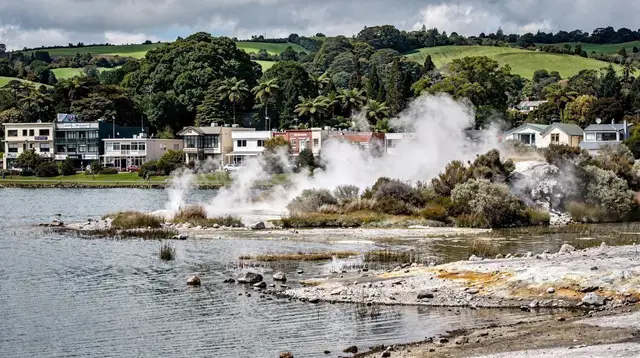
Ōhinemutu sits on a low point of land pushing into Lake Rotorua, a few streets back from the city’s main strip. It looks, at first glance, like any small New Zealand neighbourhood: weatherboard houses, a war memorial, a bowling green. Then a drain by the roadside starts hissing, a front lawn has a patch of bare, steaming ground fenced off with a low rail, and a carved meeting house appears between two ordinary homes. This is one of the oldest continuously occupied settlements in Rotorua, the home base of Ngāti Whakaue, and it sits inside the city rather than beside it — a working village, not a re-creation of one.
A Village Inside the City
Most of what visitors come to Rotorua for — geysers, mud pools, cultural performances — has been set up for people to look at. Ōhinemutu is different: it is a place people live, not a venue built to be visited. Houses, a marae (the communal meeting complex with its carved wharenui, or meeting house), a church, and a graveyard sit within a few hundred metres of each other on land that has been settled since long before Europeans arrived on the lake.
The name itself carries a story tied to the wider region: Ngāti Whakaue and the broader Te Arawa confederation trace their presence here back many generations, arriving overland from the Bay of Plenty coast and settling around the geothermal lakes precisely because the ground offered something no other part of the country did — heat for cooking and warmth without firewood, in a landscape otherwise cold and wet for much of the year.
Because Ōhinemutu is residential, there is no ticket booth, no gate, and no set route. A visit means walking a short loop of public streets, looking at what is visible from those streets and from the church grounds, and leaving the rest — the marae, private homes, the cemetery paths that aren’t clearly public — alone. That restraint is the whole point of visiting well here, and it is covered in more detail in the etiquette guide for Rotorua’s Māori sites.
St Faith’s and the Christ in the Window
The building most visitors come to see is St Faith’s Anglican Church, a timber church on the lake edge built in the early twentieth century to replace an earlier mission church on the same site. Its exterior is fairly plain Gothic Revival timber construction; the interior is where it becomes distinctive. The walls and ceiling carry Māori carving and tukutuku panelling (woven lattice work) alongside conventional Christian imagery — a direct visual statement that the two traditions share the space rather than one replacing the other.
The single detail that draws people specifically to St Faith’s is a window on the lake side of the church, sandblasted with the figure of a Māori Christ, dressed in a traditional cloak. Because the window is clear rather than stained, the figure appears to be standing just outside on the water of Lake Rotorua, an effect that depends entirely on where the viewer stands and how the light falls — it reads very differently at midday than in early morning or late afternoon. It is one of the more photographed single images in the Rotorua region, and one of the few places where a compact, self-contained visit (five to ten minutes, if the church is open) delivers something genuinely specific to this one spot.
St Faith’s remains an active parish church with a Sunday congregation, and its opening hours to visitors can vary — sometimes it is open through the day, sometimes locked outside of services. There is no admission fee, but a koha (a voluntary donation) toward the church’s upkeep is customary if the door is open and a box is out. Photography inside is generally tolerated but should be quiet and brief; this is not treated as a photo backdrop by the community that uses it weekly.
Where the Steam Comes From
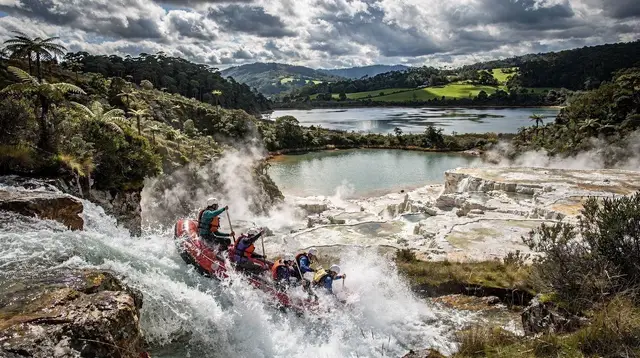
Ōhinemutu is one of the plainest illustrations in the whole city of why Rotorua smells the way it does and why the ground behaves the way it does. The village sits directly on the edge of the same geothermal field that feeds Kuirau Park a short walk away and, more distantly, the thermal valleys around Te Puia and Whakarewarewa Village. Steam vents, low-temperature pools, and warm patches of ground turn up unpredictably between properties, sometimes fenced with nothing more than a low rail and a sign.
Historically, that heat was put to direct use rather than treated as scenery. Communal steam boxes (hāngī-style cooking pits using geothermal heat rather than buried coals) and bathing pools were, and in places still are, part of daily life here — cooking dinner over a steam vent rather than a stove is a practical use of the land, not a demonstration staged for tourists. The guide to hāngī explains the wider tradition of geothermally and earth-cooked food across the region, of which this is a living, domestic version rather than the commercial one most visitors encounter at an evening cultural show.
The same heat brings real hazards. Ground that looks solid can be thin-crusted and scalding beneath, and this is precisely why visitors should stay on marked paths and public roads and never step onto unfenced ground, however dry it looks. For the mechanics of the wider geothermal field and why it behaves this way, see why Rotorua is geothermal and the general safety guide to Rotorua’s geothermal areas.
A Living Marae, Not a Museum
At the centre of the village stands Tama-te-kapua, the carved meeting house of Ngāti Whakaue, fronted by a marae ātea (the open ceremonial ground in front of a wharenui). This is a functioning marae: it hosts hui (gatherings), tangihanga (funerals), and other community events exactly as marae elsewhere in New Zealand do, and it is not open for visitors to walk into or photograph up close without an invitation.
That distinction matters for how a visit should feel. Whakarewarewa Village, a short drive away, is set up to welcome paying visitors onto its geothermal terraces and into its meeting house as part of a structured cultural experience; Te Puia frames its geothermal and cultural offering as a national institute built for public visits. Ōhinemutu offers neither of those — it is simply where people live, and the correct way to experience it is from the public street, at a respectful distance from the marae itself, unless someone from the community explicitly invites closer access. A comparison of what each of the three villages actually offers, and which one suits a given traveller’s interest, is laid out in the guide to Te Puia versus Whakarewarewa Village and the broader comparison of Rotorua’s Māori cultural experiences.
The graveyard beside St Faith’s is also worth noting for the same reason it draws attention: because the ground is geothermally active and prone to subsidence and heat, many graves here sit above ground level in raised, sometimes elaborately built tombs rather than buried in the conventional way. It is a practical adaptation to the same volcanic geology that shapes everything else in the area, and it is treated by the community as a resting place for ancestors, not as a curiosity to walk through for its own sake.
Visiting With Respect
Ōhinemutu asks more restraint of a visitor than almost anywhere else covered in this guide, precisely because it carries none of the usual signals — fences, ticket desks, staff — that tell a tourist where they’re welcome. A short, practical way to think about it:
- Stay on public roads and the church grounds; don’t walk onto private lawns, verandas, or the marae ātea.
- Treat the cemetery as a place of mourning, not a photo opportunity — walk quietly, and be selective about photographing individual graves.
- If St Faith’s is open, keep voices low and phones silent; a small koha is appropriate if you go inside.
- Don’t approach or photograph people going about daily life as though they were performers; a friendly greeting is welcome, a raised camera generally is not.
- Visit in daylight. There’s little to see after dark, and it’s a residential street, not a lit attraction.
This is broadly the same standard set out in the Tiaki Promise, New Zealand’s visitor commitment to care for the land and people as well as the place, explained in full in what the Tiaki Promise actually asks of visitors. Ōhinemutu is one of the clearest tests of whether a traveller has taken that commitment on board, because almost nothing here physically stops poor behaviour — the boundary is social, not built.
Getting There and What’s Nearby
Ōhinemutu is close enough to the centre of Rotorua to reach on foot from most central accommodation — allow roughly ten to fifteen minutes walking, or five minutes by car, along the lakefront from the Government Gardens area. There’s no dedicated visitor car park; on-street parking near the church is limited and shared with residents, so arriving on foot or by a short taxi or rideshare trip is usually easier than driving in. For visitors without a rental car, the general options for moving around the city are covered in getting around Rotorua without a car.
The village sits directly on the lakeside path that continues around toward the Government Gardens and Rotorua’s museum building, so a stop at Ōhinemutu combines naturally with a longer lakefront walk rather than standing alone as a destination for a whole trip. It also pairs well, later in the same day or the next, with a paid cultural experience that goes further than a public street can — a guided walk through Te Puia’s geothermal valley and arts institute, for instance, gives the deeper context (carving, weaving, the geyser field) that a fifteen-minute walk through Ōhinemutu can only gesture at:
a guided day visit to Te Puia, covering its geothermal valley and Māori arts programmeFor visitors who want geothermal scenery and cultural context combined into a single afternoon without arranging transport themselves, an escorted option covering several of Rotorua’s thermal sites is also available:
an afternoon tour taking in Rotorua’s geothermal landscape with transport includedCombining Ōhinemutu With the Rest of Rotorua
Because a visit to Ōhinemutu itself is short, most travellers fold it into a broader day rather than building a schedule around it. A common pattern is a morning at St Faith’s and the lakefront, followed by an afternoon at one of the region’s larger geothermal parks, several of which sit further out of town — Wai-O-Tapu and Waimangu Volcanic Valley are the two most commonly paired together, and a single guided trip can cover both:
a combined tour of Wai-O-Tapu’s coloured pools and the Waimangu Volcanic ValleyCruise ship passengers arriving via Tauranga for a single day in Rotorua tend to have the least flexible schedules, and a short stop at Ōhinemutu is sometimes included as part of a wider shore excursion that also covers Te Puia’s geyser field:
a shore excursion from Tauranga covering Rotorua and Te Puia in a single dayFor anyone planning more time around Rotorua’s Māori heritage specifically, rather than a single stop, the two-day Māori culture itinerary sets out a fuller sequence — Ōhinemutu, one of the geothermal cultural villages, and a hāngī meal — and the general question of how many days to allow in Rotorua covers how a short stop like this fits into a one-day versus multi-day visit.
Practical Information
| Detail | Note |
|---|---|
| Cost | Free to walk through; koha appreciated at St Faith’s |
| Opening | Public streets always accessible; St Faith’s hours vary, check locally |
| Time needed | 30-60 minutes on its own |
| Access | On foot from central Rotorua (10-15 min) or a short drive/taxi |
| Facilities | None dedicated to visitors — no cafe, shop, or visitor centre on site |
| Photography | Church exterior and street views fine; ask before photographing people or graves closely |
Ōhinemutu: Common Questions
Is Ōhinemutu free to visit?
Yes. There is no entry fee or ticket for the village itself, since it is a residential neighbourhood and not a paid attraction. A voluntary koha is customary if you go inside St Faith’s church while it is open.
Can I go inside St Faith’s church?
Usually, but not guaranteed. St Faith’s is an active parish church rather than a museum, so its opening hours to visitors vary and it may be locked outside of services. If the door is open, you’re welcome to look inside quietly, including at the etched Christ window, and a small koha is appropriate.
Why does steam come up between the houses?
Ōhinemutu sits directly on Rotorua’s geothermal field, the same system that feeds Kuirau Park and the thermal valleys around Te Puia. Vents and warm patches of ground occur naturally across the village, sometimes right beside a driveway or lawn, and are fenced off rather than removed.
Is it disrespectful to visit Ōhinemutu as a tourist?
Not if you keep to public streets, stay off the marae ātea and private property, and treat the graveyard and church with the same quiet you would show any place of worship or mourning. Ngāti Whakaue welcome visitors on those terms; the issue is treating the village as a photo backdrop or performance rather than a place people live.
How long does a visit take?
Most visitors spend thirty to sixty minutes walking the church grounds and the streets around the marae. It works best as one stop on a longer lakefront walk or a half-day covering central Rotorua, rather than a destination in its own right.
Is Ōhinemutu the same as Whakarewarewa Village?
No. Whakarewarewa Village is a separate, ticketed cultural experience a short drive south of the city centre, built around its own geothermal terraces and a structured visitor programme. Ōhinemutu is an unticketed, residential village on the lake in the city centre with no set visitor route.
Can I take photos of the marae or the graves?
Photograph the exterior of the meeting house and church from the public street freely, but avoid close-up photography of the marae ātea, individual graves, or residents without asking first. This isn’t enforced by any barrier — it’s a matter of the same courtesy you’d extend to any private home or cemetery.
Do I need a guide to visit Ōhinemutu?
No guide is required for the public streets and St Faith’s. A guide adds value at the larger paid sites nearby, such as Te Puia, where trained guides explain carving, weaving, and the geyser field in a way a self-guided walk through Ōhinemutu doesn’t offer.