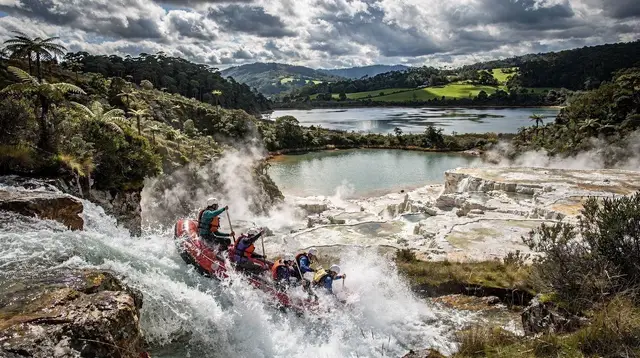
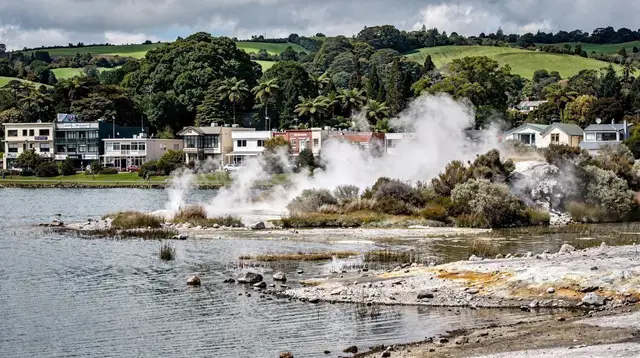
Wai-O-Tapu is the geothermal park that shows up on most postcards and Instagram grids of this part of New Zealand: an orange-and-green pool that looks almost artificial, a milky-white crater the size of a small lake, and a geyser that goes off on cue every morning. All of it is real geothermal activity sitting in the same Taupō Volcanic Zone that produces Rotorua’s sulphur smell and street-level steam - but Wai-O-Tapu is also the most visited and most managed site of its kind in the region, and that combination is worth understanding before you drive down.
What makes Wai-O-Tapu different from Rotorua’s other geothermal parks
Wai-O-Tapu sits about 27 km south of Rotorua off SH5, on privately managed land rather than inside a living village like Whakarewarewa or a Te Arawa cultural site like Te Puia. It’s purely a geological attraction - there’s no marae, no hāngī, no cultural performance built into the visit. What it does have is unusual concentration: a single walking loop passes an active crater field, a boiling mud pool, a series of coloured pools, and Champagne Pool, all within a couple of kilometres of trail.
The colours are the main draw, and they’re genuinely mineral, not enhanced. Champagne Pool gets its bright orange rim from antimony and arsenic sulphides that precipitate out where the near-boiling water meets cooler air; the pool itself is a deep turquoise-green from suspended silica. Devil’s Bath, a short walk further on, is a similarly vivid pool coloured by sulphur and ferrous salts, and on an overcast day the colour reads even more strongly against the grey sky - one of the genuine cases in this region where cloud cover helps rather than hurts the visit.
Because the whole loop is on marked paths with signage, Wai-O-Tapu reads more like a managed geological exhibit than a wild landscape. That’s a fair trade for most people: the paths mean you can get close to genuinely dangerous features (near-boiling pools, thin crusts over mud) without the risk that comes with unmarked geothermal ground, and the walk is manageable in ordinary shoes. It also means the park feels less remote than Waimangu Volcanic Valley or Hell’s Gate, both of which sit closer to the “wilder valley” end of the spectrum.
The walking loop: Champagne Pool, Devil’s Bath, and the craters between them
The full loop typically takes 2 to 3 hours at an unhurried pace, though it can be walked faster if you’re doing it as part of a longer day. From the entrance, the path climbs gently past a series of collapsed craters and steaming vents before reaching Champagne Pool itself - by far the most-photographed single feature in the park, and usually the busiest stretch of path as a result. Expect to share the viewing platforms with other visitors, particularly around mid-morning when tour buses tend to arrive.
Past Champagne Pool, the trail continues to Devil’s Bath, then loops through a mix of mud pools, sulphur crystal formations, and dead trees whose roots have been calcified by mineral-rich water - a detail that photographs almost as well as the pools themselves. The ground temperature varies noticeably across short distances, and steam rises differently depending on air temperature, so the same pool can look quite different on a cold winter morning versus a warm summer afternoon. Paths are clearly marked and fenced at hazard points; staying on them isn’t optional given how hot the ground and water genuinely are.
Unlike Rotorua’s free hot pools or the public geothermal ground at Kuirau Park, nothing at Wai-O-Tapu is for entering. This is a look-don’t-touch park from entrance to exit, which disappoints some visitors expecting a soak - if that’s what you’re after, plan it as a separate stop rather than assuming the geothermal park itself will double as one.
Lady Knox Geyser: what the 10:15 am show actually is
Lady Knox Geyser is the park’s other headline feature, and it runs on a fixed daily schedule: at 10:15 am, a ranger adds a small amount of surfactant - historically soap, now typically a biodegradable equivalent - into the geyser’s vent. The surfactant lowers the surface tension of the water column, which triggers an eruption that can send water 10 to 20 metres into the air and continue for roughly half an hour to an hour afterward.
It’s worth being direct about what this means: the geyser is a genuine geothermal feature with real underground heat and pressure behind it, but the reliable 10:15 timing is induced, not a natural cycle like Pōhutu Geyser at Te Puia, which erupts on its own schedule without any assistance. Some visitors find this disappointing once they learn it; others don’t mind, since the eruption itself is still impressive and the mechanism has been used at the site for decades. Either way, it’s better to know going in than to feel misled afterward.
Because the show happens early and at a fixed time, most visitors plan to see Lady Knox first, then walk the main Champagne Pool and Devil’s Bath loop afterward. The geyser sits a short drive or walk from the main entrance, and current gate times, ticketing, and whether the geyser viewing is included in your ticket type can all vary - check directly with the operator or the DOC for the current arrangement rather than assuming last season’s schedule still applies.
Is it worth it? An honest read
For a first geothermal park in the Rotorua area, Wai-O-Tapu is a reasonable choice specifically because it concentrates several high-impact features into one walkable loop. If you’re only doing one geothermal site on this trip, Champagne Pool alone makes a strong case for this being it.
Where it’s worth tempering expectations: this is the most heavily visited geothermal park in the region, and it feels that way, especially around Champagne Pool and around 10:15 am when the geyser crowd disperses back into the main loop. If you’ve come across photos that look like you’d have the pool to yourself, plan for a busier reality, particularly in the middle of the day and during New Zealand’s summer school holidays.
Compared to the alternatives: Waimangu Volcanic Valley trades some of Wai-O-Tapu’s colour concentration for a longer, quieter valley walk through the world’s youngest geothermal system, born in the 1886 Tarawera eruption. Hell’s Gate is smaller and more active underfoot, and it’s the only one of the three where you can actually get into a mud bath. None of these is objectively better - they answer different questions about how much crowd, colour, and hands-on activity you want from a geothermal stop. Reading a fuller comparison of Rotorua’s geothermal parks before booking is a reasonable ten minutes spent.
Getting there and when to go
Wai-O-Tapu sits directly on SH5, the same road that continues on to Taupō, which makes it a natural stop if you’re driving that direction rather than a dedicated round trip from Rotorua. Self-driving takes about 30 minutes each way from central Rotorua; there’s no public transport option directly to the park, so it’s either a rental car, a tour, or a private transfer.
Weather doesn’t really dictate the visit the way it would for a hike or a beach day - the geothermal features are active regardless of rain, and an overcast sky can actually improve the colour contrast at Champagne Pool and Devil’s Bath. What does matter is timing relative to the Lady Knox show and to tour bus groups: arriving right at opening tends to give the quietest first hour on the main loop, before the geyser crowd rejoins it.
If you’re building this into a wider day, pairing Wai-O-Tapu with Waimangu Volcanic Valley is straightforward given how close the two sites are along the same road, and it’s worth checking a Rotorua day trip plan or a dedicated two-day geothermal itinerary if you want to fit in more than one park without rushing either. Travelers coming from Taupō rather than Rotorua can also work Wai-O-Tapu into a Rotorua-Taupō day trip run in the other direction.
Tours and tickets
Independent entry is the most flexible option if you want to set your own pace on the main loop and decide on the spot whether to catch the 10:15 am Lady Knox show. A straightforward Wai-O-Tapu entry ticket covers exactly that, without transport or a guide attached.
For visitors without a rental car, or who’d rather not navigate ticketing and timing themselves, a guided option that bundles transport from Rotorua with a full day covering Wai-O-Tapu, Waimangu, and Te Puia packs three geothermal and cultural stops into one organised day - a reasonable choice if this is your only day with a vehicle. Travelers who specifically want to pair the two roadside parks without the extra Te Puia stop can look at a combined Wai-O-Tapu and Waimangu tour that includes the Waimangu boat leg, which covers both valleys with transport included and no need to self-drive between them.
Whichever option you pick, none of it needs to be booked far in advance outside peak summer weeks - but if you specifically want the 10:15 am geyser show as part of a guided day, check that your chosen tour’s timing actually lines up with it, since not every itinerary is built around that fixed schedule.
Wai-O-Tapu FAQ: Lady Knox, Champagne Pool, and visiting times
What time does Lady Knox Geyser erupt at Wai-O-Tapu?
At 10:15 am daily, a ranger drops a small amount of surfactant into the vent, which lowers the surface tension of the water and triggers an eruption that can reach around 10-20 metres. The geyser is real and geothermally active, but the exact timing is induced, not natural - without the surfactant it would erupt far less predictably.
Is Wai-O-Tapu worth visiting?
For most visitors doing one geothermal park near Rotorua, yes - Champagne Pool’s colours and the scale of Devil’s Bath are hard to match elsewhere in the area. It is also the busiest and most commercialised of the region’s geothermal sites, so anyone who prefers a quieter or wilder-feeling park should compare it against Waimangu or Hell’s Gate before booking.
How long do you need at Wai-O-Tapu?
Budget 2 to 3 hours for the main walking loop, which covers Champagne Pool, Devil’s Bath, and the craters and mud features along the way. Add 20-30 minutes if you’re starting the day with the Lady Knox Geyser show, since it’s a short walk from the geyser back to the main entrance.
Can you swim in Champagne Pool?
No. Champagne Pool sits at a temperature well above what a person can tolerate, and it is fenced off - viewing is from marked walkways only. Swimming at Wai-O-Tapu happens nowhere in the park; if you want a soak, that’s a separate stop at one of Rotorua’s hot pools.
Is Wai-O-Tapu better than Waimangu or Hell’s Gate?
They’re different experiences rather than a strict ranking. Wai-O-Tapu has the single most striking colour feature (Champagne Pool) and the scheduled Lady Knox show; Waimangu is a valley walk through the world’s youngest geothermal system with fewer crowds; Hell’s Gate is the most active and the only one where you can get into a mud bath yourself.
What should I bring to Wai-O-Tapu?
Comfortable closed shoes for the walking trails, sun protection given how strong New Zealand’s UV can be, and a jacket if you’re visiting in winter for the cold morning air. There’s no need to bring swimwear, since none of the park’s pools are for entering.
Is Wai-O-Tapu accessible for wheelchairs or strollers?
Parts of the main loop are on formed paths, but the terrain includes boardwalks, slopes, and steps in places, and conditions can change with maintenance or weather. Anyone with mobility needs should check current accessibility directly with the park before visiting rather than assume full-loop access.
Can I combine Wai-O-Tapu with other geothermal parks in one day?
Yes - Wai-O-Tapu and Waimangu Volcanic Valley are close enough together on SH5 that pairing them in a single day is common, and several tours already bundle the two. Adding a third stop, such as Te Puia, is possible but makes for a long day once travel time and each park’s walking loop are added up.