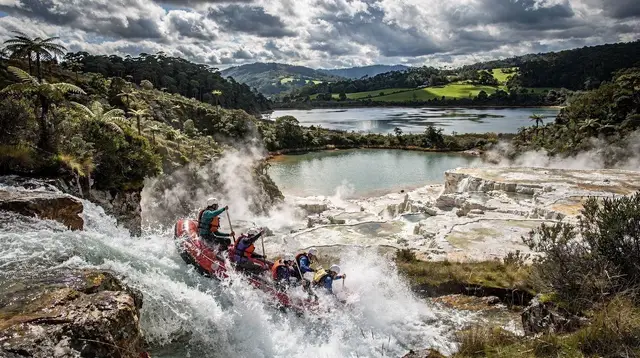
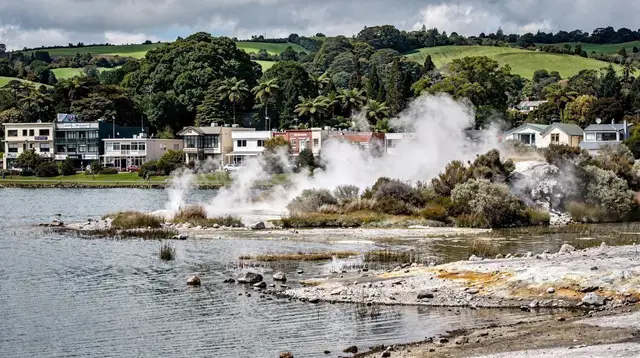
A village first, an attraction second
Most of what visitors see steaming in Rotorua is unoccupied ground: mineral terraces, empty craters, mud that nobody lives beside. Whakarewarewa is the exception. Behind the ticket gate on the southern edge of town is a residential street where people still live, in houses connected to a working geothermal field that heats their water, steams their food, and occasionally lets off a burst of pressure a few metres from someone’s front door. The community is Tūhourangi Ngāti Wāhiao, and the arrangement is not staged for tourists — it predates the tourist trade by decades and continues alongside it.
That distinction matters for how you plan a visit. A geothermal park like Wai-O-Tapu or Waimangu is a managed reserve: paths, viewing platforms, no one at home. Whakarewarewa is a suburb with a marae, a school, and families whose grandparents and great-grandparents also lived on this same ground. Walking through it with someone who grew up there is a different kind of visit from reading interpretation panels alone, and it’s the reason a guided walk is worth booking here even if you’d rather explore other sites independently.
How the village came to be here
The people of Tūhourangi did not originally live at Whakarewarewa. Before 1886 their home was Te Wairoa, a village near Lake Tarawera that also served as the staging point for boat trips to the Pink and White Terraces. On 10 June 1886, Mount Tarawera erupted, killing more than a hundred people and burying Te Wairoa under ash and mud. The terraces themselves — then among the most famous natural attractions in the world — were destroyed or submerged; their exact fate is still debated by geologists. You can read the fuller account in our piece on the 1886 eruption.
Survivors from Te Wairoa and the wider Tūhourangi hapū resettled at Whakarewarewa, joining Ngāti Wāhiao, who already lived on the geothermal field there. The combined community, Tūhourangi Ngāti Wāhiao, has occupied the village since. That history is why the guides here often talk about the 1886 eruption as living memory passed down through their own whānau, not as a museum exhibit about someone else’s past — and it’s also why the deeper background on Te Arawa history, the wider iwi confederation both hapū belong to, is worth reading before or after your visit.
What’s actually inside the gate
Whakarewarewa sits on the same geothermal system that feeds Te Puia next door, and the two are commonly confused because they share a name, a car park approach, and the same active geyser field. They are not the same visit. Te Puia is the New Zealand Māori Arts and Crafts Institute — a cultural and educational centre with a carving school, a kiwi conservation enclosure, and views of the geyser terrace from a distance. Whakarewarewa Village is the residential side: streets you actually walk down, past houses, steam vents, and communal cooking pools that are in daily use. If you’re trying to decide between the two, or whether to do both, our side-by-side comparison breaks down what each one covers.
Inside the village, a typical guided walk takes in:
- Communal steam boxes and cooking pools — geothermally heated pits and pools used to cook food by steam, much as they have been for generations. Guides explain which pools are for cooking, which for bathing, and why the two are never mixed.
- The marae and meeting house — viewed respectfully from outside; this remains a living community space, not a stage set.
- Historic photographs and family stories — many guides are descendants of people photographed at the village in the early 1900s, when Whakarewarewa was already New Zealand’s most visited tourist site.
- The geyser terrace — a viewing point over the same thermal field that includes Pōhutu, described below.
- A carving or weaving demonstration, depending on the day, showing skills still taught within the community.
None of this is presented as folklore from a vanished way of life. Guides are generally direct that people still live exactly this way, with steam heating and geothermal cooking as an everyday convenience rather than a re-enactment. If cultural etiquette in these settings is new to you, it’s worth a quick read of our guide to Māori cultural etiquette in Rotorua before you go — most of it comes down to asking before photographing people and following the guide’s lead on where you can and can’t walk.
Pōhutu, viewed from the village side
Whakarewarewa and Te Puia share the same active geyser field, and Pōhutu — the most reliable geyser in the Southern Hemisphere, erupting once or twice an hour to heights of around 30 metres — is visible from viewing points on both sides. From the village, you typically see it across the valley rather than from directly beneath it, which some visitors prefer because it puts the eruption in context against the whole steaming landscape rather than isolating it as a single spectacle. Eruptions aren’t scheduled and timing varies through the day; see our guide to when Pōhutu erupts for what affects the timing and how long to expect to wait.
The wider smell that hangs over the whole area — often the first thing visitors notice — is hydrogen sulphide, a natural by-product of the geothermal system, not pollution. If it’s your first geothermal stop in Rotorua, our explainer on why Rotorua smells of sulphur covers it in more detail than most tour guides have time for.
Why the guided version changes the visit
Whakarewarewa can be visited independently, following marked paths past the same steam vents, pools and geyser viewpoints. What changes with a guide is context: a local Tūhourangi Ngāti Wāhiao guide walks the same route while explaining which family lives in which house, why a particular pool is used for cooking crayfish and another for corn, how the 1886 eruption reshaped where their own ancestors settled, and what daily life on an active geothermal field actually involves — from managing sulphur gas safely to what happens when a new steam vent opens up in someone’s backyard.
That’s the difference between reading a plaque and having a conversation. A independent walk-through, using the self-guided trails ticket, works well if you’re short on time or have already done a guided cultural experience elsewhere in Rotorua and want a quieter, self-paced look at the geothermal side. But for a first visit, most people find the guided option is where the “living village” idea actually lands — it’s harder to grasp from a path map than from someone telling you, standing outside their own front door, that they were cooking breakfast there that morning.
a guided walk through the village led by a Tūhourangi Ngāti Wāhiao host covers the geyser terrace, the cooking pools and the history in one session, typically with a kapa haka performance included. If you’d rather set your own pace and skip the group format, the self-guided trails ticket gives access to the same paths and viewpoints without a scheduled group.
Hāngī and what to expect at a meal here
A hāngī is food cooked in an earth oven — traditionally meat and vegetables layered over heated stones and buried to steam for several hours. At Whakarewarewa, some operators use the geothermal steam boxes seen on the walk instead of buried stones, which is a genuinely local adaptation rather than a shortcut: it’s the same steam-cooking principle the village has used for generations, applied to a meal. Not every visit includes a hāngī meal, and timing depends on which tour or package you book, so check what’s included before assuming it’s part of a walk-through ticket. For the fuller picture of what a hāngī is and where else in Rotorua to eat one, see our dedicated guide.
If a kapa haka (performance) is included, it’s worth knowing that haka is not only the war dance most visitors picture — it’s a broader performance art covering welcome, celebration and storytelling as well as challenge. Our explainer on what haka actually means is useful context before you watch one.
Village vs the other cultural and geothermal options
Rotorua has several places that overlap on either culture or geothermal features, and it’s easy to double up without realising it. This is roughly how Whakarewarewa compares to its closest alternatives:
| Site | What it is | Live residents? | Best for |
|---|---|---|---|
| Whakarewarewa Village | Residential village on a geothermal field | Yes — Tūhourangi Ngāti Wāhiao | Culture-first visitors, family history, geyser views from the village side |
| Te Puia | Māori arts and crafts institute, geyser field | No | Carving and weaving demonstrations, kiwi conservation, geyser viewing platforms |
| Wai-O-Tapu | Geothermal reserve (Champagne Pool, Lady Knox Geyser) | No | Colour and scale of geothermal features, the 10:15am geyser show |
| Waimangu Volcanic Valley | Geothermal valley born in the 1886 eruption | No | Walking a valley with a documented birth date, Frying Pan Lake |
| Hell’s Gate / Tikitere | Most active geothermal area, mud bath option | No | The only site where you can enter a mud bath yourself |
If you’re weighing several of these against each other rather than just this one, our full comparison of Rotorua’s geothermal parks and our roundup of Māori cultural experiences both go deeper than this table.
Whakarewarewa’s own geothermal field also produces mud pools alongside the steam vents and cooking pools; if that side of things interests you specifically, our guide to Rotorua’s mud baths and mud pools covers where mud is for looking versus where it’s for bathing.
Practical details
Getting there. Whakarewarewa is close enough to central Rotorua to reach by taxi, rideshare or local bus in well under fifteen minutes; it’s not a day-trip destination, it’s a same-morning or same-afternoon stop. If you’re building out a full day of geothermal and cultural sites, our one-day Rotorua itinerary and our dedicated two-day Māori culture itinerary both slot Whakarewarewa in with sensible pairings.
Timing your visit. Guided walks run on a schedule through the day; the self-guided trails are open longer. Because eruption timing for Pōhutu isn’t fixed, allow enough time on-site that you’re not rushing away right before or right after a viewing. Hours and guided-walk timetables change with the season, so check the current schedule directly with the operator rather than relying on a printed itinerary.
Photography and etiquette. Photographing the geothermal features is uncomplicated. Photographing residents, their homes, or the marae without asking is not — this is someone’s home, not a photo backdrop, and guides will tell you clearly where cameras are welcome and where they’re not.
What to wear. Flat, closed shoes for uneven ground near thermal features; layers, since steam areas can feel warmer than the surrounding air, especially in winter when the contrast with the cold is part of what makes the steam so visible in the first place.
Combining it with other stops. Because Whakarewarewa and Te Puia sit side by side, some visitors do both in a single day. Others prefer to keep the village visit standalone and unrushed, then see Te Puia, Wai-O-Tapu or Hell’s Gate on a separate day. If you want a broader look at the geothermal and volcanic valleys on one outing, a combined day tour of Wai-O-Tapu and Waimangu covers ground that Whakarewarewa doesn’t. For an unguided but broader afternoon that touches several geothermal features around town, an eco-thermal afternoon tour is a lighter-touch alternative to a full village walk.
Whakarewarewa Village FAQ
Do people really still live in Whakarewarewa Village?
Yes. It’s a residential community of Tūhourangi Ngāti Wāhiao, with houses connected to the geothermal field for heating and cooking. It is not a reconstruction or a set built for visitors.
What’s the difference between Whakarewarewa Village and Te Puia?
Whakarewarewa Village is the residential side of the same geothermal field, run by the community that lives there, with a focus on daily life and family history. Te Puia, next door, is the national Māori arts and crafts institute, with a carving school, a kiwi conservation area and geyser viewing platforms, but no resident population. Many visitors choose one rather than both; see our detailed comparison for which suits your interests.
Can I see Pōhutu geyser from Whakarewarewa Village?
Yes, the village has its own viewing points over the same geyser field that includes Pōhutu, generally seen across the valley rather than close up. Eruptions happen roughly once or twice an hour but aren’t on a fixed schedule.
Is a guided tour necessary, or can I walk through on my own?
Both options exist. A guided walk led by a village resident adds context — family history, explanations of which pools are used for what, and the 1886 eruption’s connection to the community — that’s hard to get from a self-guided path map alone. The self-guided trails ticket suits visitors who prefer their own pace or have already done a guided cultural experience elsewhere.
Is there a hāngī meal included in the visit?
Not automatically — it depends on which ticket or tour you book. Some packages include a steam-cooked hāngī meal; others cover only the walk and geyser viewing. Check what’s included before you book if a meal is the priority.
How long should I plan for Whakarewarewa Village?
Two to three hours covers a guided walk, the geyser terrace and time to look around at your own pace. It works well as half a day, paired with Te Puia, the Redwoods forest, or a geothermal park on the other half.
Is Whakarewarewa Village suitable for children?
Generally yes, particularly for children old enough to walk the paths comfortably and follow basic safety guidance around thermal features. The historical and cultural content is more engaging for older children and teenagers than very young ones, though the geysers and steam vents hold interest across ages.
Do I need to book in advance?
Booking ahead is recommended, particularly for guided walks with set start times or for periods when cruise ships are in port at nearby Tauranga and day-tour numbers rise. Independent self-guided access is more flexible but still worth checking for opening hours before you go, since these can shift seasonally.