Rotorua Geothermal Parks: Which One to Choose
Which Rotorua geothermal park should I visit if I only have time for one?
Wai-O-Tapu packs the widest range of colour and scale into one self-guided walk and sits on the way south to Taupō, which makes it the default pick for a single visit. Te Puia is the better choice if you want a living Māori cultural experience alongside the geothermal scenery, since it also holds the reliable Pōhutu geyser.
Rotorua sits inside the Taupō Volcanic Zone, and the geothermal parks scattered around it are not interchangeable versions of the same walk. Each one formed differently, is run by a different operator, and shows a different slice of what the ground underneath the city is doing. The practical question most visitors actually have is narrower than “what is geothermal tourism” — it is “which of these do I have time and budget for, and which can I skip.” This guide answers that directly for the six most visited parks: Wai-O-Tapu, Te Puia and the Whakarewarewa Living Village, Waimangu Volcanic Valley, Hell’s Gate, and Orakei Korako.
Six parks, one real trade-off
The trade-off underneath every comparison here is the same: colour and scale versus culture, and convenience versus crowds. Wai-O-Tapu wins on colour. Te Puia and the Whakarewarewa village win on living Māori culture, because Te Arawa history and daily life run through both sites rather than sitting alongside the geology. Waimangu wins on scientific interest, since it is the only geothermal system anywhere with a documented birth date. Hell’s Gate wins on raw activity and is the only one where you get into a mud bath yourself. Orakei Korako wins on quiet, precisely because getting there takes more effort than the others.
None of these six is a bad choice on its own terms. The question is which trade-off matches the day you actually have.
The parks compared at a glance
| Park | Distance from Rotorua | Typical visit length | Smell intensity | Crowd level | What it does that the others don’t |
|---|---|---|---|---|---|
| Wai-O-Tapu | ~27 km south, SH5 | Half a morning | Strong | High, especially around the 10:15am Lady Knox eruption | Widest range of colour (Champagne Pool, Devil’s Bath) in one self-guided loop |
| Te Puia | In Rotorua (Whakarewarewa) | A couple of hours | Moderate to strong | High, tour groups and cruise-ship transfers | Pōhutu, the most reliable geyser in the southern hemisphere, plus a working carving and weaving school |
| Whakarewarewa Village | In Rotorua, adjoining Te Puia | An hour or so | Moderate | Moderate | The only one that is a lived-in village, not an attraction site |
| Waimangu | South of Rotorua, near Wai-O-Tapu | Half a day if walking the full valley | Moderate | Lower than Wai-O-Tapu | One-way downhill walk through a valley born in a single 1886 eruption |
| Hell’s Gate | ~16 km northeast, SH30 | A couple of hours | Strongest of the six | Lower | The only park with a mud bath you get into yourself |
| Orakei Korako | Furthest out, boat access only | Half a day with the crossing | Moderate | Lowest | Reached only by boat; the quietest of the six |
Treat the smell and crowd columns as relative to each other, not as absolute measurements — every one of these sites carries the hydrogen sulphide smell that gives Rotorua its nickname, and none of them is silent in peak summer.
Wai-O-Tapu
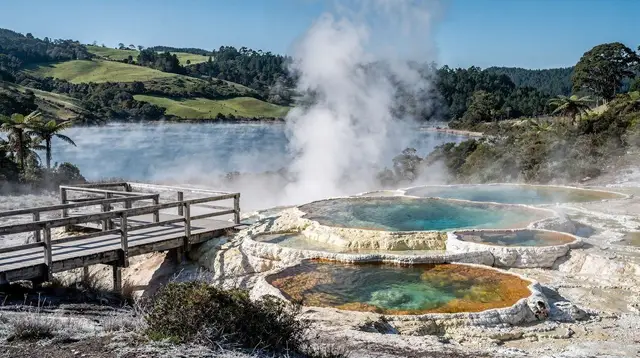
Wai-O-Tapu is the default first answer for a reason. It sits about 27 km south of Rotorua on SH5, on the way towards Taupō, so visiting it costs almost no extra driving if that road is already part of your plan. Inside, a network of marked loop walks passes the Champagne Pool — an orange-rimmed pool that gets its colour from mineral deposits — the Devil’s Bath, and a series of craters and steaming terraces in close succession. It is the single site that shows the widest colour range of any park in the region within one visit.
The one scheduling constraint worth knowing about is the Lady Knox geyser, a short walk from the main car park, which is triggered every morning at 10:15am with a surfactant rather than erupting on its own schedule. Because of that fixed time, Wai-O-Tapu sees its heaviest crowds mid-morning; arriving right at opening or well after the Lady Knox show has thinned the car park makes for a much quieter walk through the rest of the site. For a fuller walk-by-walk breakdown, see the dedicated Wai-O-Tapu visiting guide.
Rotorua: Wai-O-Tapu Geothermal Park entry ticket covers self-guided access to the full walking network, which suits visitors who want to set their own pace rather than follow a guide.
Te Puia and Whakarewarewa Village
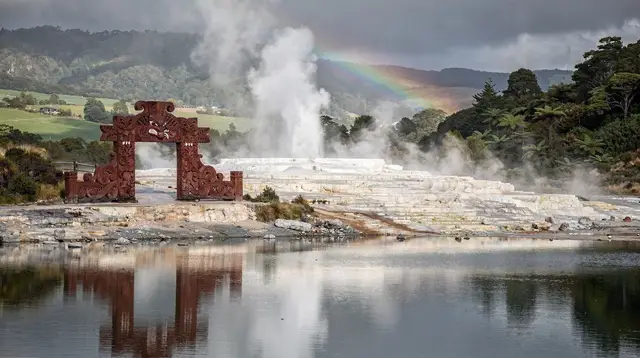
Te Puia and the Whakarewarewa Living Village share the same Whakarewarewa thermal valley in Rotorua but are run separately, and the distinction matters more than most first-time visitors expect. Te Puia is the national institute of Māori arts and crafts: it holds a working carving school and weaving school, and its grounds contain Pōhutu, the most reliable geyser in the southern hemisphere, which erupts once or twice an hour up to around thirty metres. The Whakarewarewa Village next door is a place people actually live — homes of Tūhourangi Ngāti Wāhiao residents who still cook using geothermal steam boxes sunk into the ground.
Both sites can be visited in the same half-day, and the Te Puia vs Whakarewarewa Village guide covers how to sequence the two if you have time for both, and which one to pick if you only have time for one. If timing Pōhutu’s eruptions matters to your schedule, see when Pōhutu actually erupts before you plan around it.
Rotorua: Te Puia Māori village and rejuvenation tour bundles entry with a guided walk through the geothermal valley and the carving school, which suits visitors who want context rather than a self-guided wander.
Cruise passengers arriving through the Bay of Plenty often base a shore day here rather than in central Rotorua — Tauranga: Rotorua shore excursion with Te Puia is built specifically around that transfer time.
Waimangu Volcanic Valley
Waimangu is the odd one out on this list because its origin story is precisely dated: the entire valley was created by a single eruption on 10 June 1886, which makes it the only geothermal system in the world with a known birth date. Unlike the other parks, the main walk runs one way, downhill, past Frying Pan Lake and Inferno Crater, with a shuttle bus bringing walkers back up from the far end. That layout makes Waimangu feel less like a loop of individual attractions and more like a single continuous landscape still visibly settling into its post-eruption shape.
It sits a short drive south of Rotorua, close enough to Wai-O-Tapu that combining both in one day is realistic for visitors who want the fuller geothermal picture. The 1886 eruption is also connected to Mount Tarawera and the buried village of Te Wairoa, both worth reading about if Waimangu’s history draws you in.
Hell’s Gate
Hell’s Gate, also known by its Māori name Tikitere, sits about 16 km northeast of Rotorua on SH30 and is generally described as the most geothermally active site in the area. It is also the only one of the six where visitors get into a mud pool themselves rather than only viewing one from a boardwalk. That single feature makes it the most physically involved of the six parks, and the one most often chosen specifically for the mud bath rather than for scenery. For more on what a geothermal mud bath actually involves, see the mud baths and mud pools guide.
Because Hell’s Gate does not sit directly on the route to anywhere else — it is its own short detour off SH30 — it tends to draw fewer casual add-on visitors than Wai-O-Tapu or Te Puia, which keeps its crowds noticeably lighter for most of the day.
Orakei Korako
Orakei Korako, known as the hidden valley, is the least convenient of the six by design: there is no direct road access to the geothermal terraces, and visitors reach them by a short boat crossing from the car park. That extra step filters out casual stops and makes Orakei Korako consistently the quietest of the six parks, even in peak summer. In exchange for the extra logistics, visitors get silica terraces and geothermal colour comparable to Wai-O-Tapu, without the tour-bus volume.
Because it sits furthest from central Rotorua of the sites covered here, Orakei Korako suits visitors who are also heading towards Taupō or who have already done one geothermal park in Rotorua and specifically want a quieter second one rather than a repeat of the same experience.
Which one to skip if you only have time for one
If the day only has room for a single geothermal stop, the honest shortlist is Wai-O-Tapu or Te Puia — everything distinctive about the other four overlaps with one of those two somewhere. Waimangu’s colour and craters resemble Wai-O-Tapu’s, just spread across a longer one-way walk. Hell’s Gate’s mud is a more hands-on version of features you can already see at Wai-O-Tapu and Hell’s Gate’s own mud pools. Orakei Korako’s silica terraces echo Wai-O-Tapu’s Champagne Pool without the crowds, but at the cost of a boat crossing most first-time visitors don’t need to bother with. Whakarewarewa Village is the one exception worth carving out separately, since it is the only lived-in option and isn’t really a geothermal park in the same sense as the other five — it’s a place people call home.
Practically:
- Choose Wai-O-Tapu if colour and scale matter most and you’re driving towards Taupō anyway.
- Choose Te Puia if you want Pōhutu geyser and a living Māori cultural institute in the same visit.
- Add Hell’s Gate only if getting into a mud bath yourself is a priority, not an afterthought.
- Add Waimangu or Orakei Korako on a second Rotorua trip, or if the first park already felt crowded and you want the quieter version.
- Skip nothing entirely if you’re staying three days or more — see how many days to spend in Rotorua for how the parks fit around everything else in the region.
For a broader look at how these sites compare to Rotorua’s other geothermal features — the free public ones included — the Rotorua geothermal parks overview and the hot pools guide cover ground this comparison doesn’t. Families deciding between sites should also check the Rotorua with kids guide, and anyone building a tight budget can see how entry costs stack up in the Rotorua on a budget guide. If you’d rather have someone else handle the driving and sequencing between two parks in one day, Rotorua: off the beaten track geothermal tour with a local is built around exactly that kind of multi-site day.
A two-day geothermal-focused itinerary is laid out step by step in Rotorua geothermal in two days, and a single tight day is covered in Rotorua in one day.
Rotorua geothermal parks: frequently asked questions
Which Rotorua geothermal park should I visit if I only have time for one?
Wai-O-Tapu is the usual answer: it has the broadest range of colour and scale on a single self-guided walk, and it sits directly on the route south towards Taupō, so it costs no extra driving. Choose Te Puia instead if a living Māori cultural experience matters as much to you as the landscape.
Is Wai-O-Tapu better than Te Puia?
They are not really competing for the same thing. Wai-O-Tapu is a self-guided walk through the most colourful geothermal terrain in the area, with no cultural component. Te Puia combines a smaller geothermal walk, the reliable Pōhutu geyser, and a working Māori arts and crafts institute. Visiting one does not replace the other.
Which geothermal park smells the least of sulphur?
None of them are odour-free — hydrogen sulphide is what makes the whole region smell of rotten egg, and it is strongest right at boiling pools and mud. Orakei Korako and the Whakarewarewa valley tend to feel less concentrated than Wai-O-Tapu or Hell’s Gate simply because more of the walk runs through open bush between features.
Can I visit more than one geothermal park in a day?
Two is realistic if you start early, for example Wai-O-Tapu in the morning and Te Puia or Whakarewarewa in the afternoon, since both are close to the same stretch of SH5. Fitting in a third turns the day into driving and queueing rather than walking, and geothermal walks are more rewarding at a slower pace.
Which park is best for families with young children?
Te Puia and the Whakarewarewa Village suit families well because the walks are short, some sections have kapa haka or hāngī demonstrations to break up the walking, and there is shelter and food on site. Hell’s Gate’s mud bath is a novelty older children tend to enjoy more than toddlers.
Is Hell’s Gate worth it if I’ve already seen Wai-O-Tapu?
Yes if you specifically want the mud bath experience or the most visibly active mud and steam in the region — Hell’s Gate is the only one of the six where you get into a mud pool yourself. If you are only after scenery and colour, Wai-O-Tapu already covers that ground.
How do I get to Orakei Korako, and is it worth the extra effort?
Orakei Korako is reached by a short boat crossing rather than walking straight in from a car park, which makes it the least convenient of the six and also the least crowded. It is worth the detour for visitors who want silica terraces and geothermal colour without the tour-bus traffic of Wai-O-Tapu.
Which geothermal park should I skip if I’m short on time or money?
If you can only justify one stop, most of what makes the others distinctive — colour, geysers, mud, silica terraces — overlaps somewhere with Wai-O-Tapu and Te Puia. Waimangu and Orakei Korako are the two easiest to leave for a return trip, since both require more driving time relative to what they add over the first two.
Geothermal park tours on GetYourGuide
Verified deep-linked GetYourGuide tours. Book through these links and we earn a small commission at no cost to you.
Photos show the destination, not the operator's own images.