Te Puia sits on the edge of Rotorua, on the same geothermal reserve as Whakarewarewa village, and combines two things that do not usually share a gate: an active volcanic valley and a national training institute for Māori carving and weaving. Most visitors come for one geyser in particular, but Te Puia is built around more than a single eruption — it is a working site where craft, conservation and geology sit next to each other on the same afternoon.
What Te Puia Is: Geyser Valley and Arts Institute
Te Puia is both a geothermal park and the home of the New Zealand Māori Arts and Crafts Institute, founded to keep whakairo (carving) and raranga (weaving) alive as practised skills rather than museum pieces. The grounds cover a stretch of the same thermal field shared with the neighbouring village of Tūhourangi Ngāti Wāhiao, which means the geysers, mud pools and silica terraces you walk past are part of the wider Whakarewarewa system that has drawn visitors to Rotorua since the 1880s.
Inside the grounds, a boardwalk network loops past the main geyser terrace, a carved wharenui (meeting house), open-air carving and weaving workshops where students train, and a bush walk down to the kiwi conservation area. It is a compact site to walk, but there is enough to see that rushing through in under an hour means missing most of it. For context on how Te Puia compares with its neighbour, see Te Puia vs Whakarewarewa Village.
Pōhutu Geyser: When It Erupts and What to Expect
Pōhutu is the reason most people first hear of Te Puia. It is generally described as the most reliable geyser in the Southern Hemisphere, erupting roughly once or twice an hour and sending water up to around 30 metres into the air on a strong eruption. Unlike Lady Knox at Wai-O-Tapu, which is triggered on a fixed schedule with a surfactant, Pōhutu erupts on its own, which means there is no guaranteed minute to plan around — only a reasonable expectation that it will go off at least once during a two-to-three-hour visit.
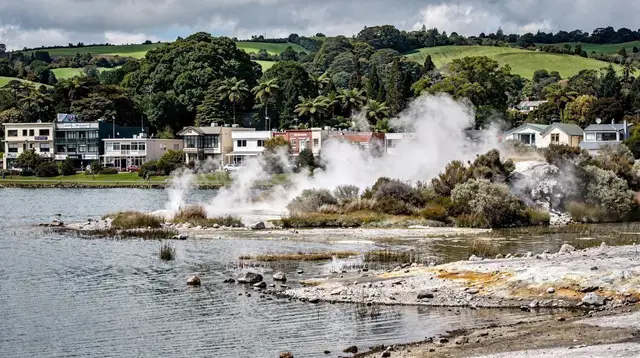
The terrace around Pōhutu also includes the Prince of Wales Feathers geyser, which frequently erupts just before Pōhutu and can act as an early signal that a bigger eruption is coming. Steam from the field is visible well before you reach the terrace, and on cold mornings the whole valley can be wreathed in it, which is one reason a Te Puia visit works just as well in winter as in summer. For a closer look at eruption patterns and timing, see Pōhutu Geyser: When Does It Erupt? and the wider context in Why Rotorua Smells of Sulphur, since Pōhutu and its hydrogen sulphide are part of the same system.
A guided walk through the geyser terrace, timed around eruption activity, is built into the standard day visit.
Te Puia’s guided day tour walks the geyser terrace, carving school and kiwi house with a local guideTe Rā vs Te Pō: Day Visit or Evening with Hāngī
Te Puia runs two distinct visitor experiences, and mixing them up is a common source of confusion when booking.
| Te Rā (day) | Te Pō (evening) | |
|---|---|---|
| Focus | Geyser valley, carving and weaving schools, kiwi house | Cultural performance and hāngī meal |
| Typical length | 2-3 hours, self-paced or guided | Set-length evening program |
| Food | Not included by default | Hāngī meal included |
| Atmosphere | Daylight, active workshops in session | Evening, performance-led, valley lit after dark |
| Best for | First-time overview of the geothermal grounds | Visitors wanting a structured cultural evening |
Te Rā is the standard daytime visit: it covers the geyser terraces, the meeting house, the working carving and weaving studios, and the kiwi conservation area, either at your own pace or as part of a guided walk. Te Pō is built for the evening — a cultural performance in the wharenui, followed by a hāngī meal cooked using geothermal steam rather than the buried earth-oven method used elsewhere. For background on what that cooking method actually involves, see Hāngī: What It Is and Where to Eat One, and for what the performance itself includes, Haka: What It Means explains that a haka is one part of a wider performance, not a stand-alone war display.
Some visitors treat Te Rā and Te Pō as two separate trips on different days; others combine a daytime walk with the same evening’s performance and hāngī. Either works, but check which ticket type covers which experience before assuming a single ticket includes both.
The New Zealand Māori Arts and Crafts Institute
The institute at the centre of Te Puia trains carvers and weavers in a formal, multi-year program, and visitors walk past open studios where students work on commissions for marae (meeting grounds) around the country. This is a working school, not a static display case: the carvings on view in the wharenui and around the grounds were made by people who trained, or are still training, on the same site.
For visitors trying to understand what they are looking at rather than just photographing it, a short primer on carving symbolism and correct behaviour around a meeting house is worth reading before arrival — see Māori Cultural Etiquette in Rotorua. Te Puia sits within the wider story of Te Arawa, the iwi confederation whose rohe (tribal area) covers the Rotorua lakes district; for the longer history behind the carvings and the geothermal valley itself, Te Arawa History: Rotorua covers how the district’s Māori history and its geology are tied together.
Visitors weighing up Te Puia against other cultural options in the district — a hāngī dinner elsewhere, a marae visit, or the village experience next door — may find Rotorua Māori Cultural Experiences Compared useful for deciding which one, or which combination, fits a given trip.
Kiwi Conservation at Te Puia
Down a short bush path from the main terrace, Te Puia runs a kiwi conservation area with a nocturnal house built to reverse the birds’ day-night cycle for viewing, since kiwi are nocturnal and are almost never seen in the wild during the day. The enclosure keeps low light levels during opening hours so the birds behave as they would at night, which means a sighting is possible but not guaranteed on any given visit — patience near the glass matters more than timing.
This is the practical answer to a question a lot of first-time visitors have about seeing a kiwi at all: it will not happen on a daytime forest walk. For more on where and how kiwi can realistically be seen around the district, see Rotorua Wildlife and Kiwi.
Getting There and Practical Info
Te Puia is close to central Rotorua — about 3 km, a five-to-ten-minute drive, or a short taxi or rideshare trip from most accommodation in town. It sits just off State Highway 30 on the way toward Whakatāne, in the same pocket of the city as Whakarewarewa Village and the Redwoods forest, so it is easy to pair with either in a single outing.
Because the site is entirely outdoors along boardwalks, footwear that handles uneven surfaces and occasional wet ground is more useful than anything else you might pack. Rain does not close the geothermal terraces — if anything, a wet, overcast morning tends to make the steam plumes over the valley more visible, not less, which is one reason Te Puia is a reasonable choice on a day when other outdoor plans are rained out. See Rotorua Rainy-Day Activities for how it fits alongside other wet-weather options.
For travellers building a wider culture-focused stop in Rotorua, Rotorua Māori Culture in 2 Days sets out how Te Puia, the village and a hāngī evening can be spread across two days rather than crammed into one, while Rotorua in 1 Day shows how it fits into a tighter single-day visit alongside the geothermal parks further out of town.
Nearby: Whakarewarewa Village and Other Geothermal Parks
Te Puia is one of several geothermal sites in the district, and it is worth being clear about how it differs from the others before deciding where to spend a limited amount of time. Whakarewarewa Village, sharing the same thermal field, is a residential Tūhourangi Ngāti Wāhiao community where people still live and cook using geothermal steam — a different kind of visit from the institute grounds at Te Puia. Further south, Wai-O-Tapu and Waimangu Volcanic Valley offer larger-scale, more colourful thermal landscapes without the cultural institute component, while Hell’s Gate to the north-east is the most active field and the only one with a mud bath.
None of these sites duplicates another closely enough to make choosing between them arbitrary; Rotorua’s Geothermal Parks: Which One to Choose breaks down what each one actually adds. For a full day that pairs the two most photographed thermal valleys south of the city, an operator-run option covers both in a single outing.
a combined day tour covers Wai-O-Tapu’s coloured pools and Waimangu’s Frying Pan Lake in one trip, useful if you want to see beyond Te Puia’s valleyBooking Te Puia: Tours and Combos
Te Puia can be visited independently with a standalone Te Rā or Te Pō ticket, or as part of a wider tour that bundles it with another North Island stop. Visitors flying in and out through Auckland sometimes combine Te Puia with the Hobbiton film set on the same day, since both sit on a workable route through the central North Island.
a private day tour pairs the Hobbiton film set with Te Puia’s geothermal valley for travellers short on daysCruise passengers docking in Tauranga are another group for whom Te Puia is a common single stop, since it packs geysers, culture and a hāngī-style meal into a shore excursion window without needing a rental car.
a Tauranga shore excursion transfers cruise passengers to Rotorua with Te Puia built into the dayWhichever route you take, book the Te Rā or Te Pō ticket that matches what you actually want from the visit — a daytime walk through the geyser field and carving schools, or an evening built around performance and food — rather than assuming one covers the other.
Te Puia FAQ: Pōhutu, Te Rā and Te Pō
How often does Pōhutu geyser erupt at Te Puia?
Pōhutu is described as the most reliable geyser in the Southern Hemisphere, typically erupting once or twice an hour and reaching up to around 30 metres. Eruptions are not on a fixed clock, so allow time in the valley rather than timing a visit to a single minute.
What is the difference between Te Rā and Te Pō at Te Puia?
Te Rā is the daytime visit: the geothermal valley, the carving and weaving schools, and the kiwi conservation area, seen at your own pace or with a guide. Te Pō is the evening experience, built around a cultural performance, a hāngī meal cooked with geothermal steam, and the valley lit after dark.
Can I see Pōhutu erupt without paying for Te Puia?
Pōhutu sits on the shared thermal reserve between Te Puia and the neighbouring Whakarewarewa village, and it can also be viewed from a public lookout point outside the paid grounds, though the closest views and the rest of the institute’s grounds require an entry ticket.
Is Te Puia worth it if I am already visiting Whakarewarewa village?
The two sites share the same geyser field but offer different experiences: the village is a lived-in Tūhourangi Ngāti Wāhiao community, while Te Puia is the national institute for Māori arts, with carving and weaving schools and a dedicated kiwi facility. Many visitors choose one rather than both.
Will I see a live kiwi at Te Puia?
Te Puia runs a kiwi conservation area with a nocturnal house, since kiwi are active at night. Sightings are not guaranteed on any single visit, but the dim, controlled environment is built to give the birds their natural night-time conditions during opening hours.
How much time should I set aside for Te Puia?
A self-paced or guided daytime visit generally takes two to three hours to cover the geyser terraces, the arts institute and the kiwi house without rushing. Te Pō, the evening option, runs as a set-length program built around the performance and the hāngī meal.
Does Te Puia work for a rainy day in Rotorua?
Yes. Geothermal features are not weather-dependent, and light rain can make the steam and mud pools more visible rather than less. Bring a rain jacket rather than expecting the visit to be indoors.
Can Te Puia be combined with Hobbiton in one day?
Some tours run Hobbiton and Te Puia together as a single day, pairing Matamata’s film set with Rotorua’s geothermal valley, since the two sites are roughly on the same route. Check the specific itinerary’s timing before booking, as it is a full day either way.