Te Puia vs Whakarewarewa Village: Which One Should You Visit
What is the difference between Te Puia and Whakarewarewa Village?
Te Puia is a national institute for Māori arts and crafts built around the same geothermal valley as Pōhutu geyser, run as a cultural and educational attraction. Whakarewarewa Village, next door, is a residential Māori community where Tūhourangi Ngāti Wāhiao families still live and cook using geothermal steam, and visitors are guided through it by residents.
Two gates, two ticket booths, one geothermal valley. On the southern edge of Rotorua, the Whakarewarewa thermal area splits into two separate visitor experiences that get confused constantly, partly because they share a name, a neighbourhood, and the same underground plumbing. Te Puia is a national institute built around arts, crafts, and the geyser field. Whakarewarewa Village, a few minutes’ walk away, is a residential community where people actually live among the steam. They are not competing versions of the same thing. They answer different questions, and most visitors are better served by understanding the difference before they buy a ticket than by picking whichever one shows up first in a search.
One valley, two very different institutions
The geology does not care about property lines. The same fault-fed geothermal field that pushes steam through Rotorua’s streets runs beneath both sites, and the boundary between them is administrative rather than volcanic. Pōhutu geyser, the largest regularly erupting geyser in the southern hemisphere, sits inside Te Puia’s grounds. Whakarewarewa Village has its own cluster of hot pools, mud, and steam vents woven directly into the streets where families live, plus a public terrace with a clear view across to the same geyser field.
Te Puia was established as a national institute for Māori arts and crafts. Its role is training and preserving carving and weaving skills at a national level, alongside running the geothermal reserve and a kiwi conservation enclosure. It functions like a cross between a working school, a cultural centre, and a geothermal park, with paid guides leading visitors through a set route.
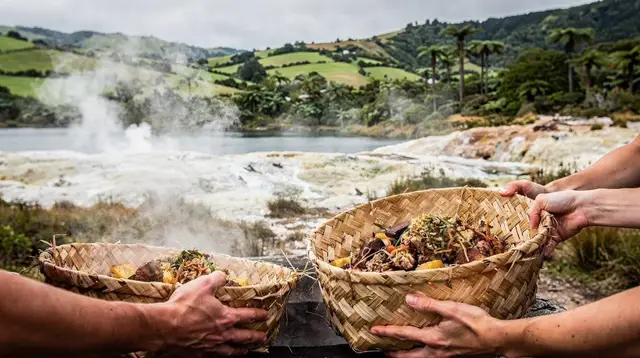
Whakarewarewa Village is a place people call home. Tūhourangi Ngāti Wāhiao families have lived on this land for generations, cooking with geothermal steam boxes instead of ovens, and bathing in naturally heated pools instead of running hot water to the door. Visits are guided by residents, walking you through a functioning neighbourhood rather than a curated exhibit, which is the single biggest thing separating it from Te Puia.
What Te Puia actually is
Te Puia sits on land that has held cultural and geothermal significance long before it became a formal institute, and it now combines several things under one entry ticket. The National Carving School and National Weaving School operate on site, and it is common to walk past students working on pieces that will end up in meeting houses around the country. The geyser field, including Pōhutu, sits within a marked geothermal valley threaded with boardwalks. A nocturnal kiwi house lets visitors see New Zealand’s national bird up close, since kiwi are nocturnal and impossible to spot in the wild during the day.
a combined visit pairing the geothermal valley with a cultural welcome and guided walk through the grounds covers the standard daytime experience. For a longer format built around a full guided day rather than a set slot, Te Puia’s full-day guided experience adds more time with a dedicated guide across the carving school, weaving school, and geyser field. Evenings run differently: an evening programme combining a hāngī dinner with a cultural performance is the option to look at if a meal and a haka are part of what you want from the visit, since the standard daytime ticket does not include either.
Te Puia suits visitors whose main interest is craft, geothermal features, and a structured overview delivered by trained guides who are not necessarily residents of the immediate area, though many carvers and weavers on site are of local descent. See what the haka actually means and what a hāngī is and where to eat one before deciding whether the evening combo adds enough to be worth it for your trip.
What Whakarewarewa Village actually is
Whakarewarewa Village is smaller in footprint and entirely different in feel. There is no institute structure here, no national school, no separate kiwi house. What there is instead is a walk through streets where people are washing dishes in a steaming stream, where a communal hot pool sits metres from someone’s front door, and where a guide who grew up in the village explains, in their own words, what daily life among active geothermal features actually involves.
a guided walk through the living village led by a resident of Tūhourangi Ngāti Wāhiao descent is the core way to experience it, and it typically includes a stop at a geothermal cooking demonstration and a viewing point over the geyser field shared with Te Puia. For visitors who prefer to move at their own pace rather than follow a fixed guided group, a self-guided walk through the village’s geothermal trails covers the same ground with printed or signposted information instead of a live narrator.
The difference in atmosphere is the whole point. Whakarewarewa Village is not staged for the visit; the visit is fitted around an existing, ongoing community. That distinction matters for anyone weighing how touristy Rotorua feels compared to how it is often described — this is one of the few Rotorua attractions where the answer leans clearly toward lived-in rather than performed. For background on the wider people and history behind both sites, Te Arawa’s history in Rotorua covers the iwi context that both Te Puia and the village draw from.
Side-by-side comparison
| Te Puia | Whakarewarewa Village | |
|---|---|---|
| What it is | National arts and crafts institute plus geothermal reserve | Inhabited residential Māori village |
| Guides | Trained institute staff | Residents of the village |
| Geyser access | Pōhutu geyser is within the grounds | Viewing point over the same geyser field |
| Craft schools | National Carving School, National Weaving School | Not on site |
| Kiwi enclosure | Yes, nocturnal house | No |
| Typical visit length | Roughly 1.5 to 2 hours for the standard visit | Roughly 1 to 1.5 hours for the guided walk |
| Evening option | Hāngī dinner and performance combo available | Standard visit is daytime only |
| Best fit | Craft, geology, structured overview | Real community, lived experience, shorter visit |
Treat the visit-length figures as general orientation rather than a fixed schedule; both operators adjust guided walk timings and geyser-viewing stops depending on the day, so confirm current timing with the operator when booking.
Pōhutu geyser: who sees it, and when
Pōhutu erupts on its own schedule, driven by underground pressure rather than any timetable set by either attraction, typically firing one or two jets an hour and reaching heights of around 20 to 30 metres when active. Because the geyser sits physically within Te Puia’s boundary, visitors there get the closest vantage point, walking along boardwalks that bring you near the base of the geyser field. Whakarewarewa Village visitors see the same eruptions from a viewing terrace across the valley, further away but still a clear, unobstructed view, since the geyser is tall enough to be visible from a distance.
Neither site can guarantee an eruption during your specific visit window, since geyser activity follows geological pressure rather than a fixed clock, and both operators are candid about this rather than promising a timed show. If seeing Pōhutu up close is your priority, Te Puia’s proximity gives you the better vantage point; if it is a secondary interest alongside the cultural walk, the distant view from Whakarewarewa Village is generally enough.
Choosing between them
If your main interest is Māori arts, craft, and geothermal geology as a structured overview, Te Puia is the stronger fit. The presence of the national carving and weaving schools, the closer geyser access, and the kiwi enclosure give it more to cover in a single visit, and the guiding is delivered by trained staff working from a consistent script across sessions.
If your main interest is experiencing a living Māori community rather than an institution, Whakarewarewa Village is the stronger fit. The shorter walk, the fact that residents themselves are your guides, and the everyday geothermal cooking and bathing you see along the way make it feel less like an attraction and more like being shown around someone’s neighbourhood, because that is exactly what it is.
If you are short on time and can only do one, decide based on which of those two descriptions matters more to you personally, since there is no objectively “better” choice between an institute and a village — they are different categories of experience that happen to share a valley.
If you have half a day, doing both is straightforward given how close together they sit. A common pattern is Whakarewarewa Village first, since the shorter guided walk sets useful context on the people and the geothermal setting, followed by Te Puia for the geyser field, craft schools, and kiwi house at a slower pace. Either order works; there is no dependency between the two visits.
If you are travelling with young children, Whakarewarewa Village’s shorter loop and more relaxed pace tend to hold attention better, though Te Puia’s live carving, weaving, and kiwi house also appeal to kids who enjoy watching people work with their hands. For more on the wider question of which Rotorua activities suit families, see the Rotorua with kids guide and the things to do for families category for more Māori cultural options at a family pace.
If an evening hāngī and performance matter to your plans, Te Puia’s evening combo is the more established option between the two, pairing the cultural grounds with a full dinner and haka performance after dark. For a broader comparison of hāngī and cultural evening options across Rotorua rather than just these two sites, Māori cultural experiences in Rotorua compared lays out the alternatives side by side.
Getting there and combining with other stops
Both sites sit within the same Whakarewarewa area a short drive south of central Rotorua, with clear signage from the main routes into town. Neither requires a full day on its own, which makes this area easy to pair with other nearby attractions on the same outing. Te Wairoa, the buried village destroyed in the 1886 Tarawera eruption sits a short drive further out and offers a very different, historical counterpoint if you want to extend the day; a guided visit to the buried village site covers that separately.
For visitors weighing this area against Rotorua’s other geothermal parks before deciding where to spend limited time, which geothermal park to choose and the Wai-O-Tapu visiting guide both help place Whakarewarewa in context against the drive-out options further south.
If your Rotorua time is built around cultural experiences specifically rather than geothermal sightseeing broadly, a dedicated two-day plan such as Rotorua Māori culture in two days sequences Te Puia, Whakarewarewa Village, and other cultural stops without the scheduling guesswork. Before visiting either site, it is worth reading a short primer on Māori cultural etiquette in Rotorua, since both places are genuine cultural spaces rather than neutral tourist stops, and small courtesies around photography and behaviour matter more here than at a standard sightseeing attraction. For travellers deciding how many days to allocate to Rotorua overall before working out which specific sites fit, how many days in Rotorua is the place to start that planning.
Combined and alternative tour options
A handful of operators package Te Puia alongside other Rotorua and regional stops rather than selling it as a standalone half day. a private combination covering Hobbiton and Te Puia’s geothermal valley in one day suits visitors basing themselves in Rotorua who want both the film-set stop and the geothermal valley without arranging separate transport. These combined itineraries move at a faster pace than visiting either site independently, so they suit travellers prioritising coverage over lingering at any one stop.
Whakarewarewa Village, Te Puia: which one to book
There is no single correct answer, because the two sites are not really substitutes for each other. Te Puia is the fuller, more structured option: craft schools, closer geyser views, and a kiwi enclosure under one roof, best suited to visitors who want a comprehensive overview delivered by trained guides. Whakarewarewa Village is the shorter, more personal option: a real neighbourhood where residents show you their own daily life among the steam, best suited to visitors who want authenticity and human connection over breadth of content. Given how close together they sit, and how little time each requires, the honest recommendation for most visitors with half a day free is to do both rather than choose.
Māori culture & heritage tours on GetYourGuide
Verified deep-linked GetYourGuide tours. Book through these links and we earn a small commission at no cost to you.
Photos show the destination, not the operator's own images.