Rafting in Rotorua: Which River Should You Choose?
Which river should I raft near Rotorua?
The Kaituna is grade 5 and famous for a 7-metre waterfall drop, best for confident first-timers in good health. The Rangitāiki is grade 4, a calmer step down with a longer gorge run. The Wairoa is grade 5 but only runs on scheduled dam-release days, aimed at experienced paddlers. The Tongariro is grade 3, glacier-fed and the most family-friendly of the four.
Four Rivers, One Region, Very Different Days on the Water
Rotorua sits within reach of four commercially rafted rivers, and they are not interchangeable. The Kaituna and the Wairoa are both graded 5, but one runs every day of the season and the other only when a dam upstream releases water. The Rangitāiki sits a notch down at grade 4, a longer and steadier run rather than a single defining drop. The Tongariro, over near Tūrangi, is graded 3 and is the river most families and nervous first-timers end up on. None of these grades are marketing language — they follow the same International Scale of River Difficulty used worldwide, and the difference between a 3 and a 5 is the difference between a splashy, manageable day and a trip that includes a genuine waterfall drop.
This guide compares the four on grade, age suitability, distance from Rotorua, and the kind of day each one actually delivers, so the choice comes down to who is going, not which name sounds most exciting.
At a Glance
| River | Grade | Defining feature | Best suited to |
|---|---|---|---|
| Kaituna | 5 | Tutea Falls, a roughly 7 m waterfall drop | Fit adults and confident teens wanting one big adrenaline hit |
| Rangitāiki | 4 | Long, steady gorge run, dam-regulated flow | Reasonably fit paddlers who want sustained white water without a waterfall |
| Wairoa | 5 (release days only) | Bigger volume water on scheduled dam-release days | Experienced rafters chasing the biggest water in the region |
| Tongariro | 3 (grade 2 option available) | Glacier-fed, clear water near Tongariro National Park | Families, first-timers, and anyone wanting scenery over adrenaline |
Kaituna River — Grade 5, and the Waterfall Everyone Talks About
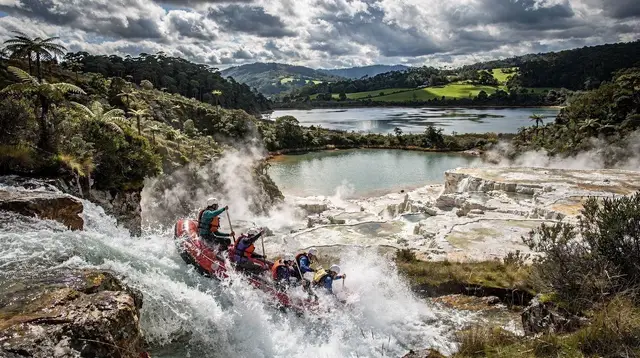
The Kaituna flows out of Lake Rotoiti and past Okere Falls, a short stretch of gorge that has become one of the most rafted grade 5 rivers anywhere, largely because of Tutea Falls: a drop of around 7 metres that operators and guidebooks alike describe as the highest commercially rafted waterfall in the world. The run itself is short — most trips are on the water for well under an hour — but it packs in several rapids on either side of the falls, through a narrow bush-lined gorge that stays green and shaded even in summer.
Because the trip is short and the operators run it year-round, the Kaituna is the river most visitors default to, and for a fit, willing adult it is a reasonable choice even as a first rafting experience — guides brief every group thoroughly and the falls are run the same way, hundreds of times a season. It is not, however, a gentle introduction: the waterfall is unavoidable if you book the full run, and it is genuinely a grade 5 feature, not a grade 5 on paper. Anyone with back or neck issues, anyone pregnant, and younger children are generally excluded by the operators themselves rather than by choice.
the Kaituna River white-water rafting trip through Okere Falls is the standard version of this run, and it is worth reading the operator’s own minimum age and health requirements before booking, since these are set by the operator and do vary.
If the waterfall itself is the appeal but rafting as a format is not, the same stretch of river is also run as white-water sledging, where paddlers go down individually on a body board rather than as a crew in a raft — a genuinely different way to experience the same water.
Rangitāiki River — Grade 4, the Longer, Steadier Alternative
The Rangitāiki sits inland, in the hill country between Rotorua and the Bay of Plenty, and its character is almost the opposite of the Kaituna’s. Instead of one short run built around a single dramatic drop, the Rangitāiki offers a longer stretch of continuous grade 4 white water through a forested gorge, with its flow regulated by an upstream dam, so it delivers a consistent volume of water on any given trip rather than depending on recent rain. There is no waterfall to run, which for many paddlers makes it feel like the more approachable of the two higher grades even though grade 4 is still serious white water requiring a raft crew that can follow instructions under pressure.
This is the river operators tend to point toward when a group includes a strong teenager who is not quite ready for the Kaituna’s waterfall, or when a group of adults wants a longer day on the water rather than a short, intense one. Because the gorge is more remote than the Kaituna’s, trips typically involve more travel time from Rotorua, and days on the water are less frequent than the Kaituna’s daily departures — it is worth checking current availability rather than assuming a same-day booking.
Wairoa River — Grade 5, But Only on Dam-Release Days
The Wairoa, over toward Tauranga, is graded similarly to the Kaituna but plays by different rules entirely. Its flow is controlled by a hydro dam upstream, and outside of scheduled release days the river simply does not carry enough water to raft commercially. On release days, the dam sends a larger volume of water down the valley for a set window, and operators run trips specifically timed to that release — which means Wairoa trips are booked around a fixed calendar of dates rather than offered daily like the Kaituna.
What that scheduling buys paddlers is genuinely bigger water: more volume, longer continuous rapids, and a different feel from the Kaituna’s short, punchy run built around one obstacle. This is the river experienced rafters and repeat visitors tend to seek out specifically, often after having already done the Kaituna on an earlier trip. Because dates are limited and set in advance, anyone wanting to raft the Wairoa on a Rotorua trip should check the release schedule with an operator early rather than leaving it for a spontaneous decision once in town.
Tongariro River — Grade 3, and the Family Option
The Tongariro flows down from Tongariro National Park past Tūrangi, roughly two hours south of Rotorua beyond Taupō, and it is a different kind of river again: fed by mountain catchments rather than geothermal or dammed sources, its water runs clear rather than tea-coloured or silty. Graded 3, it delivers genuine rapids and a proper rafting experience without the waterfall drop or continuous grade 4-5 water of the other three rivers, and the scenery — native forest opening onto volcanic country toward Ngauruhoe and Ruapehu — is part of the appeal in its own right.
Operators here typically offer two versions: a grade 3 run for anyone wanting real white water with the safety margin of a lower grade, and a gentler grade 2 stretch aimed specifically at younger children, older travellers, or anyone who wants to be on the river without the adrenaline. This split makes the Tongariro the most flexible of the four rivers for a mixed group — a family with both teenagers wanting excitement and younger children wanting a splash can sometimes be accommodated on the same day with two different trip levels, though this depends on the operator’s age and weight policies, which should always be confirmed directly.
a grade 3 rafting trip on the Tongariro River covers the standard family-friendly run, while the gentler grade 2 Tongariro Explorer trip is built for younger paddlers or anyone who wants scenery over white water.
Because the Tongariro sits close to Tongariro National Park, a rafting morning here pairs naturally with a wider day out — see the Tongariro Alpine Crossing from Rotorua guide for anyone wanting to combine river time with the crossing itself, though the two are not usually done on the same day given the crossing’s own length.
By Age: Who Actually Fits Where
Age limits on all four rivers are set by individual operators, not by a single national rule, and they do get reviewed and changed, so treat anything below as a general pattern rather than a guaranteed number — always confirm current limits directly with the operator before booking, especially for teenagers or anyone booking a family group.
- Younger children are generally not accepted on the Kaituna, Rangitāiki or Wairoa because of the grade of white water involved. The gentlest options — a grade 2 stretch on the Tongariro, or a flat-water float such as a river float trip near Taupō — are where operators set their lowest minimum ages.
- Teenagers are the group most likely to be turned away from one river and welcomed on another. Many operators set a higher minimum age for the Kaituna specifically because of the waterfall drop, while the same teenager may be accepted on the Rangitāiki or the Tongariro’s grade 3 run.
- Adults in reasonable fitness are the target market for all four rivers, with health questionnaires — back and neck issues, pregnancy, recent surgery — applied consistently across operators regardless of age.
- Older travellers are not excluded by age alone on any of the four rivers, but fitness and mobility (getting in and out of a raft, holding a paddling position) matter more than the number on a passport, and the Tongariro’s grade 3 or grade 2 runs are the more forgiving choice if in doubt.
By Experience: What Each Level Should Choose
First-time rafters who are fit and willing generally do well on the Kaituna, since operators there run beginners through the same waterfall drop daily and have the safety routine down to a science; those who would rather ease in first tend to choose the Tongariro’s grade 3 run instead.
Confident but not expert paddlers looking for more sustained white water without a single defining obstacle tend to prefer the Rangitāiki’s longer gorge run.
Experienced rafters who have already done a grade 5 river and want bigger volume specifically go looking for a Wairoa release date, planning around the schedule rather than turning up and hoping.
Families with a wide age range, or anyone travelling with children too young for grade 4-5 water, are best served by the Tongariro’s dual grade 3 and grade 2 offering, or by a gentler alternative such as a scenic river float on the Waikato near Taupō for a rafting-adjacent day without white water at all.
Distance and Logistics from Rotorua
The Kaituna’s put-in at Okere Falls is the closest of the four to central Rotorua, which is part of why it runs daily and books up fastest in peak season. The Rangitāiki and Wairoa both involve more driving into the Bay of Plenty hinterland, and operators for both typically include transport in the trip price rather than expecting self-drive to a remote put-in. The Tongariro is the furthest at around two hours south, beyond Taupō, which makes it a natural half-day or full-day trip rather than an easy add-on to a Rotorua morning — see getting to Rotorua and driving in New Zealand for visitors for general orientation if self-driving between the two towns.
Anyone building a longer stay around adventure activities rather than a single rafting trip should look at the three-day adventure itinerary, which sequences a river day against ziplining, mountain biking and other activities without repeating the same kind of adrenaline twice in one trip. The wider ranking of Rotorua’s adventure activities is also useful context for deciding how a rafting day fits against options like the Redwoods mountain biking network or a scenic flight.
Combining Rafting with a Wider Trip
None of these four rivers need to be the only activity of the day. The Kaituna sits close enough to central Rotorua that a morning on the water leaves the afternoon free for Lake Tarawera or one of the geothermal parks. The Tongariro run pairs naturally with time in and around Tongariro National Park itself, whether that means the alpine crossing on a separate day or simply driving the loop road through volcanic country afterward. Families weighing up a rafting day against other options for kids should also check Rotorua with kids, which covers age-appropriate alternatives across the wider region, not just on the water.
For a first visit trying to decide how many rafting days — if any — fit into a limited schedule, how many days in Rotorua sets out a general framework for balancing adventure activities like these against the geothermal parks and Māori cultural experiences the region is equally known for. A single grade 5 river is usually enough adrenaline for one trip; doing two in the same visit is a deliberate choice for repeat visitors rather than something most first-timers plan for.
Choosing Between Rotorua’s Rafting Rivers: Common Questions
Which river is best for a first-time rafter?
Most first-timers who are reasonably fit and comfortable in water choose the Kaituna, since operators run it daily and guide large numbers of beginners down it every year. Anyone nervous about a waterfall drop, or travelling with younger teenagers, is usually steered toward the Rangitāiki or the Tongariro instead.
What grade is the Kaituna River and why is it famous?
The Kaituna is rated grade 5 and is best known for Tutea Falls, a roughly 7-metre drop near Okere Falls that is regularly described as the highest commercially rafted waterfall in the world. The rest of the run adds several more rapids through a bush-lined gorge.
Is the Rangitāiki River rafting trip suitable for teenagers?
The Rangitāiki, graded around 4, is generally the more approachable of the two grade 4-5 rivers, with a longer, steadier gorge run rather than one dominant waterfall drop. Age limits are set by the operator, so check the current minimum before booking for a teenager.
Why does the Wairoa River only run on certain days?
The Wairoa is controlled by an upstream hydro dam, so commercial rafting only happens on scheduled release days when the operator arranges enough water in the river. Outside those windows the river is too low to raft, so trip dates are fixed well in advance rather than available on demand.
Can young children go rafting near Rotorua?
Not on the grade 4 and grade 5 rivers. The gentlest options are float-style trips on calmer water, such as a grade 2 run on the Tongariro or a scenic river float near Taupō, where operators set lower minimum ages. Always confirm the current age and weight limits directly with the operator before booking for a child.
Do I need to be a strong swimmer to raft the Kaituna?
You do not need to be a strong swimmer, but you do need to be comfortable being briefly underwater and able to follow safety instructions under pressure, since the Kaituna includes an unavoidable waterfall drop. Guides fit every paddler with a helmet, wetsuit and buoyancy aid and run a safety briefing before launch.
Is the Tongariro River rafting trip a good option for families?
Yes, within limits. The Tongariro’s grade 3 run is graded well below the Kaituna and Wairoa, its water is glacier-fed and clear rather than churned with silt, and it runs on a regular schedule rather than dam releases, which makes it easier to plan a family day around. A gentler grade 2 stretch is also offered for younger or more cautious paddlers.
What should I wear rafting in Rotorua?
Operators provide a wetsuit, splash jacket, helmet and buoyancy vest, so swimwear or quick-dry layers underneath are enough. Bring a towel, dry clothes and closed-toe shoes that can get wet, since sandals and jandals are usually not allowed in the raft.
Whitewater rafting tours on the Kaituna River on GetYourGuide
Verified deep-linked GetYourGuide tours. Book through these links and we earn a small commission at no cost to you.
Photos show the destination, not the operator's own images.