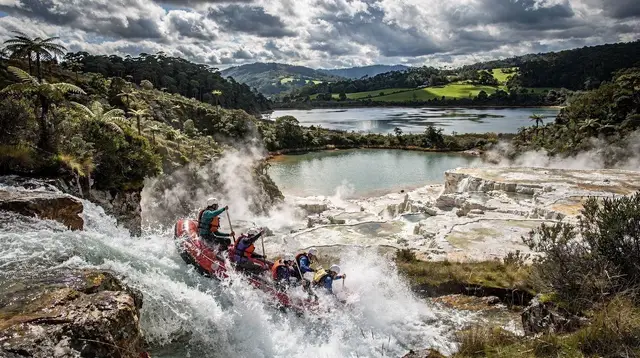
Okere Falls is not one waterfall but a short, steep stretch of the Kaituna River where the water drops through a series of rapids and ledges on its way out of Lake Rotoiti. The best-known of those drops is Tutea Falls, a 7-metre vertical fall that commercial rafting trips run several times a day. It is generally described as the highest waterfall commercially rafted anywhere in the world — not the highest waterfall people have ever rafted as a stunt, but the highest one a paying customer can book a seat on, in a raft, with a guide, on a regular schedule.
That single fact draws two very different kinds of visitor. One group turns up in a wetsuit to go over the edge. The other parks for free at the Okere Falls reserve, walks five minutes down a track, and watches the first group go over the edge instead. Both are legitimate ways to spend an hour or two here, and neither costs very much by Rotorua standards — one costs nothing at all.
The Kaituna River and Its Waterfall
The Kaituna begins at Lake Rotoiti, a few kilometres northeast of Rotorua, and runs north to the coast near the Bay of Plenty. For most of its length it is a manageable, scenic river. At Okere Falls, it changes character abruptly: the riverbed narrows and steps down through a gorge cut into old volcanic rock, producing a run of named rapids in quick succession before the water settles again downstream.
Tutea Falls sits partway through that gorge. At 7 metres it is not a tall waterfall by world standards — plenty of waterfalls are taller — but almost none of the taller ones are runnable by raft, and fewer still are run commercially as a routine, guided, multiple-times-a-day activity. That combination of height and repeatability is what the “highest commercially rafted waterfall” claim actually refers to. The rest of the Kaituna run adds several more rapids above and below the falls, so a rafting trip here is not just one drop — it’s a short, continuous sequence of white water with Tutea Falls as its centrepiece.
The volcanic geology of the gorge is part of the same story as the rest of the Rotorua area: this is still the Taupō Volcanic Zone, and the hard, layered rock the river has cut through is what gives the falls their sharp, stepped shape rather than a gentler slope.
Rafting Tutea Falls: What It’s Actually Like
A Kaituna rafting trip is short compared with a full-day river expedition elsewhere — this is a compact, intense run rather than a long float. Guides brief the group on the bank, fit helmets and wetsuits, and the raft is in white water within minutes of setting off. The run works through a sequence of named rapids before the group approaches Tutea Falls itself, where the raft goes over the ledge nose-first and drops the full 7 metres into the pool below. Guides paddle it correctly hundreds of times a season; the moment itself is fast, wet, and over in a couple of seconds, followed immediately by more rapids downstream.
What surprises most first-timers is less the height of the fall and more how continuous the trip is — there is very little flat, calm water between rapids, so the intensity does not really let up between the start and the takeout point. Trips run in most weather; light-to-moderate rain does not usually stop a rafting company operating, since everyone is getting wet regardless, though very high river flow after heavy rain can see operators adjust or pause trips for safety.
Several Rotorua operators combine the Kaituna raft trip with other adventure activities from the same base, which suits visitors trying to fit more than one thing into a single day.
a Rotorua ziplines and Kaituna rafting combo that finishes with a free sauna pairs the river with a treetop zipline circuit, while a similar combo that swaps the sauna for a soak in a hot pool is a reasonable way to warm back up afterwards — worth considering given how cold the Kaituna can feel outside summer.
Grading, Safety, and Who Can Go
Kaituna rafting is commonly described as one of the more demanding commercial white-water trips run in New Zealand, with the falls and several of the surrounding rapids rated toward the top of the standard international white-water scale. In practice this means operators set minimum age limits, require a basic level of fitness and swimming ability, and brief participants on what to do if they end up in the water rather than in the raft — which does happen occasionally on a drop this size.
None of that makes it an extreme or reckless activity as it’s commercially run: guides paddle the falls constantly, safety kayakers typically shadow the group through the harder sections, and the trip is short enough that fatigue is rarely the issue. It is simply a genuinely wet, genuinely fast white-water run, not a gentle scenic float — book it expecting that, and check the specific age and health restrictions with the operator when you book, since these can change.
Pregnant travellers, people with certain heart or back conditions, and young children are typically excluded by most operators; if in doubt, ask before paying rather than after arriving at the put-in.
The Free Viewpoint: Kaituna River Walkway
Everything above costs money and requires a booking. The alternative costs nothing: a walking track through the Okere Falls Scenic Reserve follows the top of the gorge past several of the same rapids, including a formed viewpoint close to Tutea Falls itself. It’s an easy, mostly flat walk of well under an hour return, on a track that’s well maintained and clearly signposted from the small car park off State Highway 33.
Along the way the track passes Tutea’s Caves, a set of small caves in the gorge wall that were historically used by Te Arawa as a refuge during conflict — a reminder that this gorge has been part of local life for a long time before it became a rafting destination. Information panels along the walkway explain the history and the geology in more depth than a quick visit can cover.
Timing a visit to coincide with a rafting company’s departure window means a reasonable chance of watching a raft actually go over the falls from above — worth checking rough departure times with an operator if that’s the goal, since trips run on their own schedule rather than a fixed public timetable. Either way, the walk works as a standalone outing: the rapids and the gorge itself are worth seeing even without a raft in view, and it’s one of the more satisfying free things to do within a short drive of Rotorua.
The path is unsealed in places and has sections close to a steep drop into the gorge, so it’s not the best choice for a stroller, and care is needed with young children near the unfenced viewpoints.
Other Ways to Experience the Gorge
Rafting and walking aren’t the only two options. White-water sledging — lying on a reinforced, buoyant board and going through the rapids feet-first, at water level, without a raft around you — is offered on the same stretch of river by specialist operators, and gives a noticeably different, more exposed sensation of the same water. It is generally not run over Tutea Falls itself, since sledging that particular drop is a different proposition to rafting it, so check exactly which rapids a sledging trip covers before booking if the falls themselves are the draw.
Kayaking is another way onto the Kaituna, either self-guided for experienced paddlers who know the river or as part of a guided trip, though the falls and hardest rapids are typically the preserve of dedicated white-water kayakers rather than casual guided outings.
| Activity | Typical cost profile | Physical intensity | Goes over Tutea Falls |
|---|---|---|---|
| Commercial rafting | Paid, mid-range | High | Yes |
| White-water sledging | Paid, mid-range | High, more exposed | Usually not |
| Guided or independent kayaking | Paid or free (own gear) | Varies, expert-level for the falls | Only for experienced white-water kayakers |
| Gorge walkway | Free | Low, easy walk | Viewing only |
Getting to Okere Falls and When to Go
Okere Falls sits northeast of central Rotorua, roughly 20 to 25 minutes by car via State Highway 33 toward Lake Rotoiti — closer to Rotorua than most of the region’s other big attractions. There’s no public transport running directly to the reserve, so this is a destination for a rental car, a rafting company’s own shuttle, or a booked tour that includes transfers; anyone getting around Rotorua without a car will generally need to join a tour rather than turn up independently.
Because the region’s seasons run opposite to the northern hemisphere, summer (December to February) is the warmest and most comfortable time to raft, with longer daylight hours and the least need for extra layers under a wetsuit. Winter (June to August) is noticeably colder, and the water temperature drops with it, though operators supply wetsuits year-round and trips still run. Rain falls in every season here, so a wet day is not a reason to cancel a rafting trip already booked — if anything, the falls look the same or better in the rain, since the river itself is the point.
The walkway, being free, easy, and short, is worth doing in any season and in most weather, and makes a sensible half-day add-on to a longer stay rather than a destination that needs its own dedicated day.
Combining Okere Falls with the Rest of Rotorua
Okere Falls’ short drive time and short on-site duration make it easy to pair with something else on the same day. A morning rafting trip leaves the rest of the day free for a geothermal park or a cultural experience back in town; the walkway alone takes well under an hour, so it slots in easily around lunch or on the way to or from Lake Rotoiti itself.
For visitors weighing up whether an adventure day should include the Kaituna at all, Rotorua’s adventure activities ranked puts rafting in context against ziplines, luge, and the region’s other adrenaline options, while a dedicated Kaituna River rafting guide and a broader which river to raft in Rotorua comparison go into more detail on operators, trip lengths, and what to bring than fits here. Anyone considering the board-based alternative should read the separate guide to white-water sledging in Rotorua before choosing between the two.
If the goal for the day is simply to stay dry and spend nothing, the free things to do in Rotorua guide lists the walkway alongside other no-cost options, and the walking tracks guide covers it next to other short, easy trails including the nearby Redwoods forest. Travellers building a longer stay around adventure activities may find the 3-day Rotorua adventure itinerary useful for sequencing Okere Falls against ziplines, mountain biking, and other physical days out, and rainy-day planning is covered separately in the Rotorua rainy day activities guide, given how well the falls handle wet weather either way.
Anyone travelling with children too young for rafting or sledging can still do the walkway together, and the Rotorua with kids guide has more on which of the region’s adventure activities have workable minimum ages. Those wanting to make a full adventure day of it, with a warm-up option on the calmer side, might also look at an afternoon eco and thermal tour as a gentler counterpart booked for the same trip.
Okere Falls and Kaituna Rafting: Frequently Asked Questions
Is Okere Falls the same as Tutea Falls?
Not quite. Okere Falls refers to the broader gorge and reserve on the Kaituna River, which includes several rapids. Tutea Falls is the specific 7-metre waterfall within that gorge — the one that gives the area its reputation as the highest commercially rafted waterfall in the world.
Can I see the falls without rafting them?
Yes. A free walking track through the Okere Falls Scenic Reserve follows the top of the gorge past several rapids, including a viewpoint close to Tutea Falls, and takes well under an hour to walk return.
How difficult is rafting the Kaituna?
It is generally considered one of the more demanding commercial rafting trips in New Zealand, given the height of Tutea Falls and the number of continuous rapids in a short stretch of river. Operators set minimum age and fitness requirements, so check these when booking.
Is there a minimum age for rafting Tutea Falls?
Most operators set a minimum age, which varies by company and can be higher for the falls run than for gentler rafting elsewhere. Confirm the current age and health requirements directly with the operator before booking, since restrictions do change.
Does rafting still run in the rain?
Yes, in most cases. Light to moderate rain doesn’t usually stop trips, since participants get wet regardless. Very high river flow after heavy rain can occasionally lead an operator to adjust or postpone a trip for safety.
How do I get to Okere Falls without a rental car?
There is no direct public transport to the reserve. Most visitors arrive by rental car, by an operator’s own shuttle as part of a booked rafting or sledging trip, or on a guided tour that includes transfers from Rotorua.
What’s the difference between rafting and white-water sledging here?
Rafting takes a group down the river together in an inflatable raft, including over Tutea Falls itself. White-water sledging uses an individual buoyant board at water level for a more exposed, solo-feeling ride, and is generally not run over the falls itself — check with the specific operator which rapids a sledging trip covers.
How long should I plan for a visit to Okere Falls?
The free walkway alone takes under an hour. A rafting or sledging trip, including briefing, transfers, and changing, typically takes a few hours out of the day. Either way, it fits comfortably as a half-day activity alongside something else nearby.