Kaituna River Rafting and Tutea Falls
What makes Tutea Falls on the Kaituna River different from a normal grade 5 rapid?
Tutea Falls is a single, near-vertical 7-metre ledge drop into a deep plunge pool, not a chaotic multi-stage rapid full of rocks. That shape, combined with dam-regulated flow, trained guides and a fixed technique for punching through the drop, is why it carries a grade 5 rating but a low injury rate.
The Kaituna, Rotorua’s Whitewater River
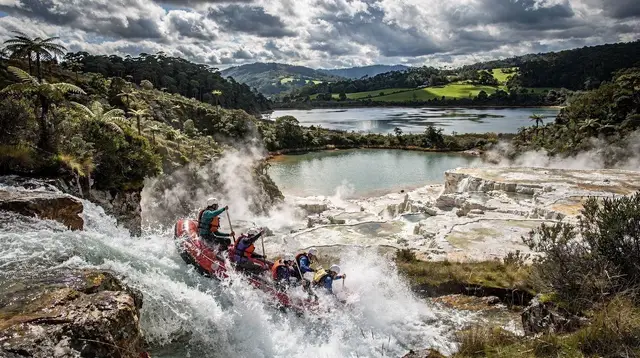
The Kaituna River drains Lake Rotoiti and runs north through native bush before it eventually reaches the Bay of Plenty coast. The stretch that matters to visitors is a short, dense run near Okere Falls, about 20 minutes from central Rotorua. In that short section the river drops fast through a series of grade 3 rapids and one outlier: Tutea Falls, a 7-metre ledge that is widely described as the highest waterfall commercially rafted anywhere in the world.
That single feature is why the Kaituna appears on lists of the best whitewater in New Zealand, and why it draws people who have never picked up a paddle before. It is also why this guide exists: a grade 5 rating sounds alarming next to a grade 3 river, and most first-timers want to know, specifically, what happens in that drop before they book it.
Because the river is fed and moderated by control gates at the outlet of Lake Rotoiti, flow on the Kaituna is more consistent than on a river that depends purely on rainfall. That does not mean conditions never change — releases are managed and can be adjusted — but it is one reason operators can run trips through most of the year rather than only after a good flood.
What “Grade 5” Actually Describes
Whitewater is graded on a scale from 1 (flat, moving water) to 6 (unraftable). Grade 3 means moderate rapids with some manoeuvring required; grade 4 adds more powerful, more technical water with a real chance of a swim; grade 5 means long, obstructed, or very steep rapids with a significant risk of injury if things go wrong, requiring precise technique and reliable rescue capability nearby.
Tutea Falls earns grade 5 because of its height and steepness, not because it is technically complicated to navigate. A grade 5 rapid on a mountain river might be a chaotic run of car-sized boulders, undercut rocks and multiple hazards stacked one after another, where a mistake compounds before anyone can react. Tutea Falls is a single, clean, near-vertical drop into open water. It is a different kind of grade 5 problem: short, predictable, and repeatable in exactly the same way, trip after trip.
That distinction matters for how you should think about the risk. A long, obstructed grade 5 rapid is dangerous because there are many places to go wrong and few places to recover. A single clean drop is dangerous mainly in the instant of the fall itself — and that instant is short enough, and consistent enough, that guides can train a specific technique for it and repeat it reliably.
What Happens in the Drop
Approaching Tutea Falls, the guide lines the raft up so it goes over the ledge nose-first, square to the current rather than angled or sideways. Speed matters: paddlers are told to keep paddling right up to the lip, because a raft with forward momentum tends to punch cleanly through the falling water and re-surface, while a raft that stalls at the edge is more likely to be thrown off line or flipped by the falling water hitting it unevenly.
At the guide’s command, everyone tucks down into the raft, holds the perimeter safety line, and braces. The raft goes over the ledge, the bow drops, and for roughly a second the boat and everyone in it is airborne or driving through several feet of falling, aerated water before the front re-enters the pool below. The impact pushes the nose underwater momentarily; the raft’s buoyancy and the paddlers’ weight distribution bring it back up within a second or two, and the boat rides the boil at the base of the falls before the guide steers it clear.
The landing zone is the other half of why this works. Below Tutea Falls is a deep plunge pool, scoured out by exactly this kind of impact over a long period, with no rocks in the immediate fall line. A drop of the same height onto a shallow, rocky landing would be an entirely different — and unraftable — proposition. The height gets the grade 5 rating; the pool underneath is what makes that height survivable at commercial scale.
Being briefly underwater, upside down for a moment, or drenched by the wave off the falls is normal and expected, not a sign that something has gone wrong. Rafts do occasionally flip at Tutea Falls, and guides are trained specifically for that outcome: life jackets keep swimmers at the surface, the pool is clear and deep enough to work in, and a safety kayaker is stationed below the falls to reach anyone who ends up separated from the raft.
Why the Injury Record Is What It Is
A handful of factors compound to keep a genuinely grade 5 feature safer in practice than the number suggests:
- A single, short hazard rather than a sustained one. The danger window is the drop itself, not a long boulder garden where multiple things can go wrong in sequence.
- A known, unchanging line. Guides run the same drop on every commercial trip and know exactly where the raft needs to be positioned and how much speed it needs, rather than reading a new hazard each time.
- A deep, clear landing pool. The consequence of the drop — hitting the water below — happens somewhere without rocks or shallow ledges to land on.
- Regulated flow. Water released from the Lake Rotoiti control gates keeps the falls in a workable, familiar state rather than swinging wildly with rainfall, the way an unregulated river would.
- Equipment built for the job. High-sided rafts, perimeter grab lines, wetsuits, helmets and properly fitted life jackets are standard, not optional extras.
- Guide training focused on this specific drop. Technique for Tutea Falls — paddle hard to the lip, tuck down, hold on — is taught and drilled as a specific skill, not general rafting instruction applied to a new obstacle.
None of this makes the drop risk-free, and no operator will claim it is. What it explains is the apparent contradiction between a grade 5 rating and a trip regularly sold to first-time rafters, families with teenagers, and people with no whitewater background at all: the rating reflects the height and force of the drop, and the safety record reflects everything built around managing that one specific, well-understood hazard.
Who Can Actually Go
Age and weight limits are set by each operator and tend to be stricter for the Tutea Falls trip than for an easier river, because the falls put more force on a body than a standard grade 3 rapid does. A typical minimum age sits in the young-teens range, but treat that as a starting point rather than a fact to book against — confirm the exact age, weight range, and any health exclusions on the specific tour listing before you commit, especially if you’re booking for a mixed group with children or older travellers.
Beyond the operator’s formal limits, three practical things matter more than fitness in the gym sense:
- Swimming ability. You should be a confident swimmer, comfortable being briefly submerged while wearing a life jacket. You are not expected to swim the rapid — the equipment and guide do that work — but panicking underwater is the thing operators are screening for.
- Following instructions under stress. Commands are shouted in English over the noise of the water, and they need to be followed immediately: paddle, stop, get down. If a language barrier or a health condition would make that hard, say so before the trip starts.
- Basic joint and cardiac health. The impact at the base of the falls is a real jolt. Pregnancy, recent surgery, significant back or neck issues, and uncontrolled heart conditions are the kinds of things operators ask about and will decline a booking for.
If you don’t meet the requirements for Tutea Falls, or would simply rather not do a 7-metre drop, that’s a legitimate reason to choose a different river rather than push a limit. The Tongariro River, further south, runs grade 3 and grade 2 sections without anything close to Tutea Falls in scale, and both are built for a gentler introduction to whitewater.
Booking the Kaituna Trip
Two of the tours covering this stretch put the falls at the centre of the trip in slightly different ways.
a half-day Kaituna rafting trip that runs the full grade 3 to grade 5 stretch, including Tutea Falls is the standard way most visitors do this run, with gear, guiding and the safety briefing included.
a Kaituna trip built specifically around the Tutea Falls descent covers the same river with the falls positioned as the trip’s main feature, useful if that single drop is the reason you’re booking.
If Tutea Falls itself is the deterrent rather than whitewater in general, a grade 3 rafting trip on the Tongariro River gives a comparable whitewater experience without a grade 5 waterfall in the run.
How It Compares to the Rest of the Trip
The falls are the headline, but they are one feature in a run that also includes several grade 3 rapids before and after the drop. The table below gives a rough sense of how the main Rotorua-area whitewater options compare.
| Trip | River | Top grade | Best suited to |
|---|---|---|---|
| Kaituna full run (with Tutea Falls) | Kaituna | Grade 5 | Confident swimmers, no experience needed, meeting age/weight limits |
| Tongariro grade 3 | Tongariro | Grade 3 | First-time rafters wanting real whitewater without a major drop |
| Tongariro grade 2 (Explorer) | Tongariro | Grade 2 | Younger children, older travellers, scenic float with mild rapids |
| River sledging | Kaituna (lower sections) | Grade 3 | Rafters wanting a more physical, one-on-one whitewater style |
For a closer look at how the sledging option differs from sitting in a raft, see white-water sledging on the Kaituna. For a broader comparison of which river suits which traveller, our guide to choosing a rafting river around Rotorua covers the Kaituna and Tongariro side by side, and our ranking of Rotorua’s adventure activities places rafting against the region’s other adrenaline options.
Practical Notes
Trips run out of a base near Okere Falls, a short drive from central Rotorua; most tours include return transport from town, so getting around Rotorua without a car is not a barrier to booking this one. Wetsuits, splash jackets, helmets and life jackets are provided — bring a swimsuit to wear underneath, a towel, and dry clothes for the drive back. Wear footwear that stays on your feet in fast water; open sandals are a poor choice and bare feet are not accepted.
Trips run in most weather, including light rain — the water is the point, and being wet is the default state for the whole trip. Genuinely severe weather, high or turbid flow after heavy rain, or scheduled maintenance on the control gates can see a trip postponed or cancelled by the operator; if that happens you’ll be rebooked or refunded rather than sent out onto water an operator has judged unsafe that day. If you’re travelling with a family and weighing this against calmer options, our guide to Rotorua with kids and our accessibility guide cover which activities suit which ages and mobility levels in more detail. For where to base yourself while you fit this and other activities into a visit, see where to stay in Rotorua and our guide to a 3-day adventure itinerary.
Because flow is regulated rather than rainfall-dependent, the Kaituna is one of the more weather-resilient activities in the region — a genuine advantage given how often it rains here. See the best time to visit Rotorua for how that fits into planning a trip across the seasons.
Kaituna Rafting and Tutea Falls: Common Questions
How high is Tutea Falls?
About 7 metres. It is generally described as the highest waterfall commercially rafted anywhere in the world, on the Kaituna River near Okere Falls, a short drive from Rotorua.
What grade is the Kaituna River overall?
The commercial run is mostly grade 3, punctuated by a handful of bigger drops. Tutea Falls is the outlier at grade 5, which is why the whole trip is marketed and rated by that single feature.
Is rafting Tutea Falls actually safe?
No whitewater is risk-free, but the drop’s geometry helps: a straight vertical ledge, a deep landing pool, no rocks in the fall line, and rafts that go over nose-first at speed rather than sideways. Guides run the same line on every trip and safety kayakers sit below the falls.
What is the minimum age for Kaituna rafting?
Operators set their own age and weight limits for the Tutea Falls trip, and they are stricter than on an easier river. Check the specific age, weight range and swimming requirement listed on the tour you book before assuming you or your children qualify.
Do I need rafting experience or strong swimming ability?
No prior rafting experience is required. You do need to be a reasonably confident swimmer, comfortable being briefly underwater in a life jacket, and able to follow shouted commands in English at speed.
What happens if the raft flips at the falls?
It can happen, and guides train specifically for it. Life jackets keep paddlers at the surface, the plunge pool below the falls is deep and clear of obstructions, and a safety kayaker is positioned to help anyone separated from the raft.
Can I raft the Kaituna without going over Tutea Falls?
The falls are the point of this particular river and most commercial trips include them by default. If you specifically want white water without a grade 5 drop, a different river or a sledging trip is a better fit.
What should I wear or bring?
Operators supply wetsuits, splash jackets, helmets and life jackets. Bring a swimsuit to wear underneath, a towel and dry clothes for afterwards, and secure footwear you don’t mind getting wet — sandals that can come off are a poor choice.
Whitewater rafting tours on the Kaituna River on GetYourGuide
Verified deep-linked GetYourGuide tours. Book through these links and we earn a small commission at no cost to you.
Photos show the destination, not the operator's own images.