Tauranga Cruise Stopover: Rotorua in Nine Hours
Cruise ships calling at Tauranga dock at the port of Mount Maunganui, not in Rotorua itself. Rotorua is roughly an hour’s drive away, which puts it within reach of a single day ashore — but a nine-hour call is not a nine-hour Rotorua day. Drive time, one stop instead of three, and a fixed all-aboard time all cut into what looks, on a map, like an easy trip. This plan works backward from the ship’s departure rather than forward from what there is to see, because missing the ship costs far more than missing a second attraction.
The core decision is simple: pick one substantial Rotorua experience, not two. A geothermal park and a cultural site both reward slow visits, and stacking them on top of a return drive is the single most common way cruise passengers cut it close. This itinerary builds around Te Puia, which combines geothermal features with Māori cultural context in one site — efficient for a stopover — with an alternative built around Mount Maunganui for passengers who would rather stay near the port.
Why nine hours is tighter than it looks
A “9am to 6pm” call sounds generous. In practice, the ship needs passengers back on board 60 to 90 minutes before its stated departure time, and the gangway itself takes time to clear at both ends of the day. Subtract disembarkation, walking to transport, and the return buffer, and the usable window for Rotorua is closer to six to seven hours — of which up to two hours can be driving. For a full breakdown of how cruise timing plays out specifically for Rotorua, see the dedicated guide on spending a cruise day in Rotorua from Tauranga.
Rule of thumb: if the ship’s all-aboard time is earlier than usual, or if the itinerary shows an early evening departure, stay closer to the port and build the day around Mount Maunganui and Ōhope Beach rather than Rotorua.
| Call length ashore | Recommended plan |
|---|---|
| 10+ hours | Rotorua (one major site) + short stop back near the port |
| 8–9 hours | Rotorua (one major site) only, direct there and back |
| 6–7 hours | Mount Maunganui and Tauranga’s port area; skip Rotorua |
| Under 6 hours | Port area only — Rotorua is not realistic |
Independent travel (rental car, shuttle, or taxi) is possible for this stopover, but it removes the safety net a scheduled shore excursion provides: operators know the ship’s schedule and build return buffer in as standard practice, and if traffic runs long, the tour company — not the passenger alone — carries the risk. That is the main reason most cruise lines and independent guides alike recommend a shore excursion for a Rotorua day rather than a self-drive one, covered in more detail in the comparison of guided tours versus self-drive around Rotorua.
Day 1: Nine hours, one Rotorua stop, margin for the ship
Morning: disembark and transfer (roughly 60–75 minutes)
Passengers on a booked shore excursion are usually met at or near the gangway, which removes the need to arrange transport independently. A tour built around Te Puia — such as a shore excursion from the port to Rotorua and Te Puia — collects passengers early and drives directly to Rotorua, using the first window of the day when traffic is lightest.
Independent travelers renting a car should check basics before setting off — driving on the left, one-lane bridges, and speed limits differ from what many visitors are used to. See driving in New Zealand for visitors before taking this route unguided.
Midday: Rotorua — one geothermal and cultural stop
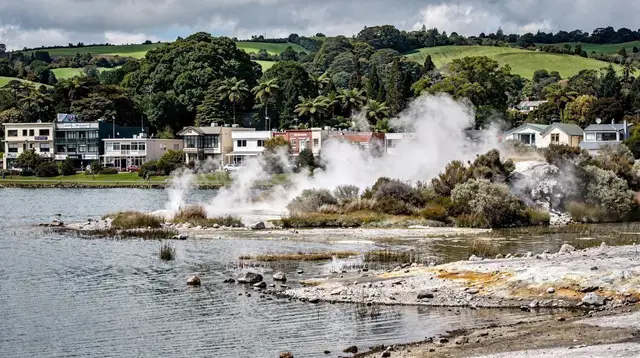
At Te Puia, the drawcard is Pōhutu, the most reliable geyser in the southern hemisphere, erupting once or twice an hour to heights of around 30 metres — there’s a reasonable chance of catching it during a two-to-three-hour visit, though timing is never guaranteed. Te Puia also houses the national school of Māori arts and carving, giving context to craftwork seen throughout the region. For how Te Puia compares to the neighbouring living village, see Te Puia versus Whakarewarewa Village — both sit in the same Whakarewarewa valley, but Te Puia’s format (timed visit, geyser terrace, cultural performance) suits a fixed-return stopover better than the village’s slower, residential pace.
Travellers who prefer a forest setting over a thermal one can substitute a Redwoods forest tour combined with a Māori village visit, which walks through the towering Californian redwoods of Whakarewarewa Forest before a cultural stop — a good option if the geothermal smell (hydrogen sulphide, harmless but distinctive) isn’t for everyone in the group.
If there’s a short gap before the return drive, a quick look at Lake Rotorua from the lakefront takes only a few minutes and needs no separate booking.
Early afternoon: the return drive begins on schedule, not by feel
This is the point in the day that determines whether the stopover works. The return leg to Tauranga should start at a fixed time decided that morning — not “whenever we’re done” — because Rotorua’s geothermal parks are the kind of place that absorbs an extra 30 minutes without anyone noticing. A tour operator running a shore excursion builds this fixed departure into the itinerary; independent drivers need to set an alarm for it.
Anyone feeling steam, warmth, or ground softness they weren’t expecting near an unmarked area should stay on formed paths — geothermal ground can be unstable outside marked walkways. Details are in Rotorua’s geothermal safety guide.
Late afternoon: back at the port — Mount Maunganui or Tauranga itself
Arriving back at the port with an hour or two in hand, Mount Maunganui is a five-to-ten-minute walk or short drive from the cruise terminal. The base loop around Mauao, the volcanic cone that gives the suburb its name, is about 3.4 km flat and takes roughly 45 minutes to an hour — a reasonable way to stretch legs before boarding without any driving risk. Climbing to the summit (also about 45 minutes one-way) is possible but cuts further into the buffer; it’s worth doing only if the return from Rotorua came in ahead of schedule.
For a lower-effort option in the same window, a stand-up paddleboarding session at Mount Maunganui uses the calm harbour side of the beach and can be timed to a fixed end point, which suits a schedule with a hard deadline. See the Mount Maunganui guide for the wider lay of the base area, cafés, and beach access.
Passengers who decided against Rotorua altogether, or whose call is on the shorter end, can spend the whole day around the port instead: Mount Maunganui’s beach and base walk, plus a guided cruise to Ōhope with an oyster farm visit and lunch, keeps everything within a short radius of the ship and removes drive-time risk entirely.
Evening: reboarding
Being back at the gangway ahead of the all-aboard time, rather than exactly at it, is the one non-negotiable part of this itinerary. Ships do leave without passengers who miss the cutoff, and Tauranga’s port has no scheduled evening sailing to Auckland or elsewhere that could substitute for a missed connection. Build the day around this fact rather than around fitting in one more stop.
Costs for this stopover
| Item | Approximate cost (NZD, per person) |
|---|---|
| Shore excursion to Rotorua (half-day, Te Puia or Redwoods) | Varies by operator — check current pricing |
| Independent return transfer (shuttle or taxi) | Higher than a group excursion, no built-in schedule buffer |
| Mount Maunganui activities (paddleboarding, café stop) | Budget to mid-range |
| Whole day, mid-range estimate per person | Roughly in line with a standard mid-range day, around 350 NZD |
NZD prices already include New Zealand’s 15% goods and services tax — the price shown is the price paid, and tipping isn’t expected. See tipping and costs in New Zealand for more on how this works day to day.
Alternatives if the call is longer or shorter
A call of ten hours or more gives enough margin to add a short stop back near the port after Rotorua, such as the Mount Maunganui base walk described above. A call under six hours makes Rotorua unrealistic without cutting the return buffer to an uncomfortable margin — the Tauranga day trip guide covers the reverse direction (Rotorua-based visitors heading to Tauranga) and is useful for sense-checking drive times either way. For cruise passengers weighing whether Rotorua is worth the risk at all on a short call, the cruise day in Rotorua from Tauranga guide sets out the calculation in more detail, and getting to Rotorua covers the road and transport options beyond a cruise-specific transfer.
FAQ: Tauranga cruise stopovers to Rotorua
How long does it take to get from the Tauranga cruise port to Rotorua?
By road, the drive is roughly one hour each way, traffic and weather permitting. That means a round trip alone can take up two hours of a nine-hour day ashore.
Is a nine-hour call enough time for Rotorua from Tauranga?
Generally yes, but only for one substantial stop, not several. After subtracting drive time and a return buffer of 60 to 90 minutes before all-aboard, the realistic window in Rotorua itself is closer to two to three hours.
Should I book a shore excursion or arrange my own transport?
A shore excursion removes scheduling risk: operators know the ship’s departure time and build return margin into the itinerary. Independent transport (rental car, taxi, shuttle) is workable but puts the return-time responsibility entirely on the traveller.
What happens if I’m not back at the ship on time?
Cruise ships do depart without passengers who miss the stated all-aboard time, and there is typically no scheduled alternative sailing from Tauranga to rejoin the ship at its next port. This is the main reason to build in a firm return buffer rather than optimise for seeing more.
Is it better to stay near the port instead of going to Rotorua?
If the call is on the shorter side, or the ship’s departure time is earlier than usual, yes. Mount Maunganui and the immediate port area offer a full day’s worth of activity with no drive-time risk.
Can I fit in both a geothermal site and a Māori cultural experience in one stopover?
It’s tight. Sites like Te Puia combine both in a single visit, which is more time-efficient than visiting a geothermal park and a separate cultural village on the same nine-hour call.
Do I need to worry about geothermal safety on a short visit?
The same rules apply regardless of visit length: stay on marked paths and boardwalks, and treat any unmarked steam or soft ground as off-limits. A short visit doesn’t reduce the need for care.
Is Whakaari / White Island reachable on a Tauranga stopover?
Boat access and landings on Whakaari have not operated since the 2019 eruption. Some operators offer a scenic flight or a boat approach without landing from the Bay of Plenty, but this is a separate booking from a Rotorua-focused day and isn’t compatible with the itinerary above.
Lake cruises on GetYourGuide
Verified deep-linked GetYourGuide tours. Book through these links and we earn a small commission at no cost to you.
Photos show the destination, not the operator's own images.