Rotorua Geothermal Safety: Boardwalks, Mud Pools and Gas Risks
Is it safe to visit Rotorua's geothermal parks?
Yes, when you stay on marked boardwalks and follow posted guidance: managed parks like Wai-O-Tapu, Waimangu and Te Puia are built around real hazards, including mud pools that can reach around 95 degrees Celsius and pockets of hydrogen sulphide gas. Almost all incidents involve leaving the path, entering unmanaged bush pools, or ignoring gas warnings in low, poorly ventilated ground.
Why Geothermal Ground Is Not Ordinary Ground
Rotorua sits inside the Taupō volcanic zone, a roughly 250-kilometre tear in the earth’s crust running from Whakaari / White Island in the Bay of Plenty down to Mount Ruapehu in the central North Island. The city itself sits on an active caldera, which is why steam drifts out of drains and roadside cracks, why the air carries a sulphur smell, and why Rotorua has geysers and mud pools that most cities simply do not have. None of that is decorative. It means the ground under a thin crust of soil can be a few centimetres away from water or mud sitting near boiling point, and it means gas is constantly moving up through the soil from below.
This guide is not meant to make you nervous about visiting. Millions of visitors have walked through Rotorua’s geothermal parks since organised tourism here began in the 1880s, and the injury record at managed sites is good, for a simple reason: every hazard described below has already been mapped, fenced or boardwalked by people who understand this ground far better than any visitor can in a single afternoon. The job of this page is to explain what those precautions are actually protecting you from, so the rules make sense rather than feeling arbitrary, and so you know what to do in the small number of situations, mostly involving unmanaged or free sites, where you are the one making the safety call.
For an overview of which parks show which features, see our guide to Rotorua’s geothermal parks and how to choose between them.
Stay on the Boardwalk: What It’s Actually Protecting You From
The single most important rule in any geothermal area, ticketed or free, is to stay on the marked path. It sounds obvious, but it is worth understanding why it matters so much here specifically. Geothermal ground often has a crust of mineral deposits or dried mud that can look completely solid, sometimes solid enough to walk on for a step or two, while the material underneath is soft, hot and unstable. Stepping through that crust is how serious burns happen, and it is very hard to judge from the surface which patches of ground are safe and which are not, even for someone who visits regularly.
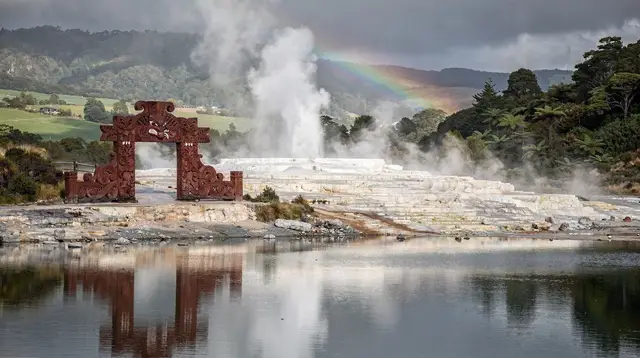
Boardwalks and fenced viewing platforms at parks like Wai-O-Tapu, Waimangu Volcanic Valley, Hell’s Gate and Te Puia exist because staff who work with this ground daily have identified where it is stable and where it is not. Leaving the path does not just risk your own safety; it can also damage the geothermal features themselves, some of which are geologically rare and slow to reform. The rule is the same everywhere in the region: if there is a rail, a rope or a marked track, it is there because someone assessed the ground on both sides of it and made a decision.
This applies just as much at informal or free sites as at ticketed parks. Our guide to free hot springs and geothermal spots around Rotorua covers where these exist, but the absence of a boardwalk at an unmanaged site is not a sign that the ground is safer. It usually means the opposite: nobody has mapped it for you.
Mud Pools and Boiling Water: The Numbers Behind the Danger
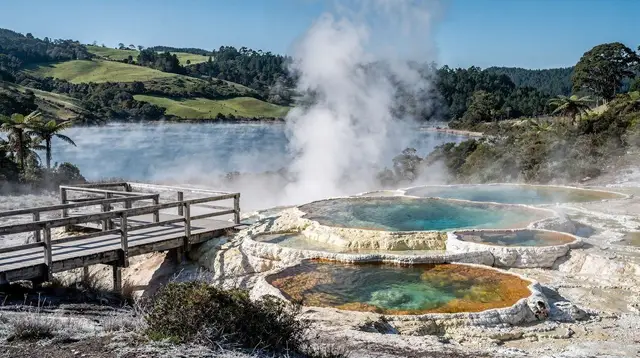
Rotorua’s bubbling mud pools are one of its most photographed features, and also one of the more misunderstood. The mud itself is heated by steam rising from deep geothermal reservoirs, and surface temperatures in active pools commonly sit close to boiling point, which at Rotorua’s altitude is around 95 to 100 degrees Celsius. A splash from an actively bubbling pool at that temperature causes a serious burn in a fraction of a second, and mud clings to skin rather than running off the way water does, which makes the contact time, and the injury, worse than a splash of boiling water alone.
This is why every managed mud pool you will see, from the roadside pools at Whakarewarewa Village to the larger fields at Wai-O-Tapu and Hell’s Gate, is set back from viewing areas by a safe margin, sometimes with a low wall or rail as an extra barrier as much as a formality. It is also why the advice to keep children close and to avoid leaning over railings for a better photo is not overcaution. A pool that looks placid can erupt in a small burst with no warning, since gas pressure builds and releases unevenly underground.
Our dedicated guide to Rotorua’s mud baths and mud pools explains the difference between these natural, scalding mud pools you view from a distance and the cooled, treated mud used in spa treatments, which is a completely different, deliberately prepared product.
Hydrogen Sulphide: The Smell, and When It’s More Than a Smell
The rotten-egg smell that greets most first-time visitors to Rotorua is hydrogen sulphide gas, released continuously as geothermal water and steam reach the surface across the region. At the concentrations most visitors encounter outdoors, walking through a park or across a car park, it is unpleasant but not dangerous, and most people stop noticing it within a day. Our explainer on why Rotorua smells of sulphur goes into the chemistry in more detail.
The gas becomes a genuine hazard in a specific circumstance: hydrogen sulphide is heavier than air, so it can settle and concentrate in low-lying hollows, drains, or poorly ventilated dips in the ground, particularly on still days with no breeze to disperse it. At higher concentrations it is toxic, and one of its more dangerous properties is that it can dull the sense of smell at exactly the levels where it starts to matter, so a spot that smelled strong on arrival will not necessarily continue to warn you as concentration rises. This is why marked tracks and viewing areas in geothermal parks avoid routing people through natural depressions, and why any posted gas warning at a park, a backyard geothermal feature, or a roadside dip should be taken at face value rather than treated as routine caution.
If you or anyone in your group ever feels sudden dizziness, a headache, or shortness of breath near a thermal area, the right response is immediate: move to higher, open ground away from any vent, pool or hollow, and seek fresh air. Symptoms usually resolve quickly once you are clear of the area. If they do not, or if anyone loses consciousness, call 111.
People with existing respiratory conditions, and dogs, are generally more sensitive to lower gas concentrations than a healthy adult, which is worth factoring in before spending long periods in low-lying geothermal terrain, particularly off formal park grounds.
Naegleria and the Real Rule About Warm Water
Naegleria fowleri is a microscopic amoeba that occurs naturally in warm fresh water worldwide, including some warm, slow-moving or stagnant water in geothermally active regions. It causes a very rare but serious brain infection, and the only way it can cause harm is if contaminated water is forced up the nose in enough volume to reach the nasal passages, typically through jumping, diving, or vigorous splashing in untreated water. It is not a risk from drinking water, from skin contact, or from swallowing water, and it cannot spread from person to person.
This matters for how you think about Rotorua’s various warm-water experiences, because they are not all the same kind of water. Commercial hot pool complexes and spas, including well-known ones around Rotorua, are supplied from geothermal bores but are then filtered, treated and monitored the way any public pool is, which is a different water safety category from a natural, untreated pool or slow warm stream. Our Rotorua hot pools guide and our page on the Polynesian Spa explain how these facilities are managed.
The precaution that actually reduces Naegleria risk, in natural warm water anywhere in the world, is straightforward: avoid submerging your head, diving, or vigorous splashing in warm, untreated, slow-moving natural water, and keep young children, who are more likely to submerge without meaning to, closely supervised around any natural warm pool or stream.
Managed Parks vs Free, Unmanaged Geothermal Spots
There is a meaningful safety difference between Rotorua’s ticketed geothermal parks and the free geothermal spots scattered around the wider area, and it is worth being explicit about it. At Wai-O-Tapu, Waimangu, Hell’s Gate, Te Puia and similar sites, the boardwalks, fencing, staff presence and signage are the product of ongoing hazard assessment by people who monitor the ground continuously. That infrastructure is doing real safety work, not just guiding foot traffic.
Free and informal sites, including some roadside features and undeveloped geothermal ground around the wider Rotorua area, generally have none of that. There may be no fence between a footpath and an actively boiling pool, no sign warning of unstable crust, and no one nearby if something goes wrong. This does not mean these places should be avoided, but it does mean the responsibility for staying safe shifts entirely onto the visitor: keep well back from any pool or steaming ground, never let children or pets range ahead unsupervised, wear closed shoes rather than sandals, and treat any patch of discoloured, steaming or bare ground as a warning sign rather than a photo opportunity.
If you would rather see this landscape with someone who reads the ground for a living, a guided visit puts local knowledge between you and the terrain. A trip like the
off-the-beaten-track geothermal walk with a local guidecovers less-visited thermal ground with someone who can point out what is and is not safe underfoot, which is a genuine advantage over exploring an unmarked site alone.
Hot Pools and Spas: Where the Rules Are Different
It is worth separating two very different Rotorua experiences that both involve warm water: viewing a natural geothermal feature, and bathing in a commercial hot pool. Bathing pools at recognised spa facilities draw on geothermal water but treat and monitor it before anyone gets in, which addresses both water quality and temperature control, since raw geothermal water can arrive far too hot to enter safely without cooling and mixing. These facilities post safe temperature ranges and staff them accordingly.
Natural pools you might encounter in the wider landscape, including some spots covered in our guide to free hot springs around Rotorua, are a different situation entirely: nobody is testing or adjusting the water, temperatures can vary sharply within the same pool, and some pools that look inviting are, in fact, part of the same volcanic plumbing that produces the boiling mud pools described above. A pool that is pleasantly warm at the edge can be scalding a short distance further in. Test any natural pool cautiously at the edge before committing to it, and never assume a natural feature is safe simply because other people are in it.
Mount Tarawera, Guided Access and Volcanic Ground
Mount Tarawera is the clearest reminder in this region that geothermal and volcanic hazards are not only about heat you can see steaming in front of you. The mountain erupted on 10 June 1886, in one of the deadliest eruptions in New Zealand’s recorded history, killing more than a hundred people and destroying the Pink and White Terraces along with several villages, including Te Wairoa. Our account of the 1886 eruption covers what happened in more detail.
Today, access to Mount Tarawera is guided only, and the mountain itself is owned by local iwi, which is a cultural as well as a practical safety arrangement: guides know current ground conditions, and access is controlled deliberately rather than left open to casual hikers. If you want to visit, book through one of the operators covered in our guide to guided walks on Mount Tarawera rather than attempting independent access to unmarked slopes.
For a broader sense of how seriously the region as a whole treats these hazards, and how that shapes what is and is not offered to visitors, see our explainer on how safe geothermal tourism actually is, including how the industry changed after the 2019 Whakaari / White Island eruption.
Practical Precautions for a Geothermal Day
A geothermal day in and around Rotorua is straightforward to do safely if a handful of habits become automatic:
| Situation | What to do |
|---|---|
| Any boardwalk or marked path | Stay on it, even for photos; never step onto surrounding ground |
| A mud pool or hot spring, managed or free | View from a safe distance; never touch or reach toward the surface |
| A natural, untreated warm pool or stream | Avoid submerging your head, diving, or letting children jump in |
| A low hollow, dip or unventilated gully near thermal ground | Do not linger; move through to open ground |
| Sudden dizziness, headache or breathlessness near thermal ground | Move immediately to higher, open air; call 111 if symptoms persist |
| Children and pets at any thermal site | Keep them within arm’s reach, not running ahead |
| Footwear | Closed, sturdy shoes rather than sandals or jandals |
| Independent access to Mount Tarawera or unmarked bush thermal areas | Don’t; use a licensed guide |
A few additional points worth carrying with you rather than in a table: Rotorua’s UV index climbs to extreme levels in summer, and a day spent outdoors in geothermal parks, which offer little shade, is exactly the kind of exposure that catches visitors out, so sun protection belongs in the same mental checklist as gas and heat awareness. The Tiaki Promise, the visitor behaviour commitment asked of everyone travelling in New Zealand, also covers staying on formed tracks, which lines up directly with the geothermal safety rules in this guide. And Rotokākahi, the Green Lake near Tarawera, is tapu, sacred, and closed to public access entirely; that restriction is a cultural one, not a hazard warning, but it is absolute either way.
If you would like a first geothermal visit that combines safety, cultural context and a well-marked route in one outing, the
entry ticket to Wai-O-Tapu’s geothermal parkgives you one of the region’s most extensive boardwalk networks, or for a cultural grounding alongside the geology, the
guided visit to Te Puia’s Māori village and geothermal valleypairs Pōhutu geyser viewing with a hosted introduction to the site. Travelling up from Tauranga on a cruise stop, the
shore excursion to Rotorua with a Te Puia visitcovers the same managed ground within a single day trip.
Who Should Be Extra Careful
Some visitors should weigh these hazards a little more carefully than others. Anyone with a respiratory condition such as asthma may be more sensitive to hydrogen sulphide at lower concentrations than a healthy adult, and should avoid lingering in low, poorly ventilated pockets of geothermal ground. Families travelling with young children should treat every mud pool, hot spring and unfenced viewing point as a hand-holding zone rather than a place for children to explore ahead; our guide to Rotorua with kids covers which sites are easiest to manage with a family group. Anyone considering an unmarked or free geothermal spot without local knowledge should default to viewing from further back than feels strictly necessary, since the visual cues that make a hazard obvious are not always present.
None of this is a reason to skip Rotorua’s geothermal landscape, which is genuinely one of the more remarkable things to see in New Zealand and is central to why the region has drawn visitors since the nineteenth century. It is a reason to treat the ground the way locals and park operators already do: as active, not scenic.
Rotorua Geothermal Safety FAQ
Can I touch the mud pools or hot springs at Rotorua’s parks?
No. Surface mud and water in geothermal parks can sit at or near boiling point, and the crust around a pool can look solid while the ground underneath is soft and scalding. Every managed park fences or boardwalks its features precisely so visitors never need to get close enough to touch them.
What is the amoeba risk in Rotorua’s hot springs?
Naegleria fowleri is a naturally occurring amoeba that can live in warm, untreated fresh water, including some natural hot springs and slow rivers, and it can cause a rare but serious brain infection if water is forced up the nose. It does not spread through drinking water or skin contact, and treated, chlorinated pools such as commercial spa complexes are managed to prevent it. The precaution is simple: avoid jumping, diving or submerging your head in natural, untreated warm water.
Why do some areas smell strongly of sulphur, and is the gas dangerous?
The smell is hydrogen sulphide, a gas that rises constantly through the Taupō volcanic zone and gives Rotorua its rotten-egg reputation. At normal open-air concentrations it is unpleasant rather than dangerous, but the gas is heavier than air and can build up to harmful levels in enclosed dips, hollows or unventilated low ground, which is why parks and footpaths avoid routing visitors through those spots.
Is it safe to walk off the marked boardwalks?
No, and this is the single rule that matters most in any geothermal park. The ground away from boardwalks can be a thin crust over near-boiling water or mud with no visible warning, and burns from stepping through crust are the most common serious injury in geothermal areas worldwide, not only in Rotorua.
What should I do if I feel dizzy or short of breath near a thermal area?
Move immediately to higher, open ground away from steam vents, mud pools or low hollows, since that is consistent with gas exposure. Most people recover quickly once they are back in fresh air, but if symptoms continue, or if anyone loses consciousness, call 111 for emergency help.
Are the free, unmanaged geothermal spots around Rotorua safe to visit?
They carry more risk than ticketed parks precisely because there is no fencing, no boardwalk and no on-site staff. If you visit an informal geothermal spot, treat every steaming patch of ground as potentially unstable, keep well back from any pool, and supervise children and pets closely.
Is geothermal tourism in Rotorua safe overall?
Yes, for the great majority of visitors who follow signage and stay on marked routes. Rotorua has hosted geothermal tourism since the 1880s, and the parks operating today are designed around the same volcanic hazards this guide describes, which is why the safety record at managed sites is good.
What happened at Whakaari / White Island, and does it affect Rotorua park visits?
Whakaari / White Island, an active volcano off the Bay of Plenty coast, erupted on 9 December 2019 while a tour group was on the crater floor, killing 22 people. Landings on the island have not been offered since. This is a separate offshore volcano, not one of the land-based geothermal parks around Rotorua, but it is the clearest reminder that volcanic ground anywhere in this region deserves to be taken seriously.
Geothermal park tours on GetYourGuide
Verified deep-linked GetYourGuide tours. Book through these links and we earn a small commission at no cost to you.
Photos show the destination, not the operator's own images.