Is New Zealand Expensive? What I Actually Spent
I’ve now paid for coffee in Melbourne, Lisbon, Berlin, and Rotorua within the same twelve months, which is a strange way to end up thinking about currency conversion, but it’s given me a clearer answer than any single price list could. New Zealand isn’t the most expensive country I’ve travelled through, and it isn’t the cheapest. It sits in a specific, slightly awkward bracket: close to Australia, above most of continental Europe, and shaped by geography in ways that a price comparison table doesn’t capture on its own.
Where the money actually goes
The first thing I noticed here wasn’t the big-ticket items, it was the small daily ones. A takeaway coffee in Rotorua costs roughly what I’d pay in a Melbourne suburb, and noticeably more than the same cup in most of Spain, Portugal, or inland France. Casual food, a pie from a bakery, fish and chips by the lake, sits in the same bracket. None of it feels like being overcharged, it just adds up faster than a Southern European trip would.
Fuel is where the gap widened the most for me. New Zealand has no rail network worth planning a Rotorua trip around, so almost everyone drives, and the distances between towns are longer than the map suggests once you factor in winding roads through hills. A full tank on a self-drive loop through the Waikato and back cost more than it would in the US, and landed close to what I’d expect in Western Europe. If you’re weighing up driving in New Zealand as a visitor against relying on tours and shuttles, fuel and rental car costs are the number to model first, not the last thing you check.
Accommodation is the category with the widest spread, because the choice you make changes the number more than the country does. A holiday park cabin or a campervan pitch runs closer to what I’d budget in regional Australia, while a mid-range motel near Rotorua sits comfortably in the same bracket as a chain hotel in an Australian regional town. If you want the low end, holiday parks and camping around the lake are genuinely worth comparing before booking anything else, and the wider question of where to stay is worth answering before you commit to a whole trip’s accommodation budget.
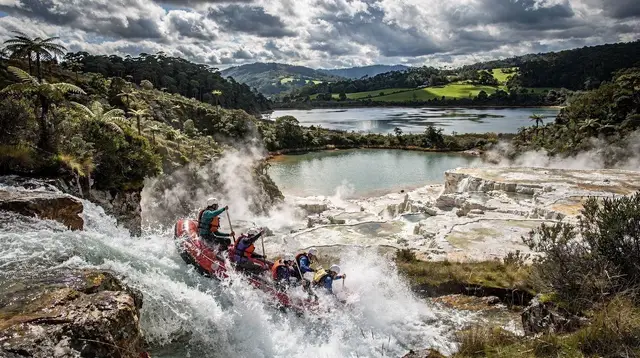
Activities are the category people ask me about most, probably because a geothermal park or a cultural evening reads as a “big” spend on a day’s itinerary. Compared to national park or reserve entry fees in Australia, or ticket prices at a major European attraction, most of what’s on offer here sits in a similar range rather than standing out as unusually steep. An eco thermal afternoon tour around the geothermal valleys, for instance, isn’t priced wildly differently from a half-day national park visit elsewhere, and if you’d rather have someone else handle the driving and the entry logistics, an eco thermal afternoon tour around Rotorua’s geothermal sites bundles several stops into one paid ticket instead of several separate ones.
What actually offsets the cost
Two things quietly work in the visitor’s favour here, and neither shows up on a printed price. The 15 percent GST is already built into every price you see, from a coffee to a museum ticket, so there’s no surprise addition at the till the way there is with tax-exclusive pricing elsewhere. And tipping isn’t expected anywhere, not in cafes, not in restaurants, not on tours, which softens the total more than people expect once they’ve stopped mentally adding 15 to 20 percent to every bill out of habit. For a fuller picture of both, tipping and everyday costs in New Zealand is worth a read before you budget a whole trip.
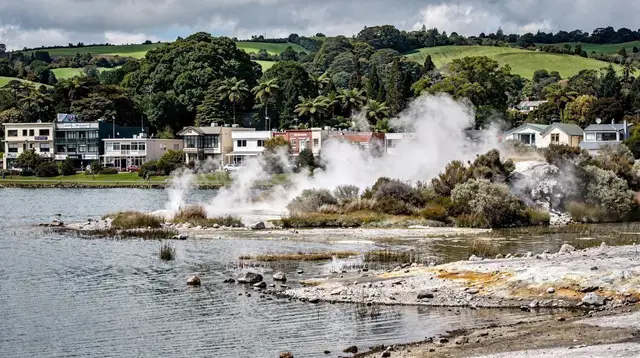
Free and low-cost options also exist alongside every paid one, and I lean on them more than I expected to. Kuirau Park is a free geothermal park in the middle of town. Walking tracks through the Redwoods forest cost nothing beyond getting there. A proper rundown of free things to do around Rotorua changed how I planned my own days here, mixing one paid highlight with several free ones rather than paying for everything on the list.
Putting a number on it
Rough per-person, per-day figures, converted at roughly 1.85 NZD to the euro and 1.70 NZD to the US dollar, give a usable sense of scale:
| Travel style | Per day (NZD) | Roughly in EUR | Roughly in USD |
|---|---|---|---|
| Budget | ~150 | ~80 | ~90 |
| Mid-range | ~350 | ~190 | ~205 |
| Higher-end | ~700 | ~380 | ~410 |
These bands cover accommodation, food, local transport, and one activity a day, not flights in or out of the country. Where you land inside them depends far more on your accommodation choice and how many guided experiences you book than on the destination itself.
What I’d tell someone planning around this
If you’re deciding how many days to spend in Rotorua, the daily cost matters more than the total, since a longer trip at the budget end can still cost less overall than a short one spent entirely at the higher end. I’d also plan the big-ticket days deliberately rather than let them stack up by accident. A Wai-O-Tapu and Waimangu volcanic valley tour covering two geothermal sites in one paid outing works out better value than two separate half-day trips, and booking a combined Wai-O-Tapu and Waimangu volcanic valley tour is one way to do that without doubling up on transport costs.
The same logic applies to a day trip out to Hobbiton near Matamata, which is easy to treat as one paid day rather than several smaller ones once you add up fuel, parking, and entry separately. A Hobbiton Movie Set tour from Rotorua folds the return drive and the ticket into a single line item, which made my own budgeting for that day a lot simpler to track. If cultural experiences and a heritage site both interest you, the same principle held when I visited the buried village of Te Wairoa: pairing it with a visit to the Buried Village of Te Wairoa as part of a planned day cost less, in time and money, than treating it as an add-on afterthought.
None of this makes New Zealand cheap, and I wouldn’t tell anyone it is. But it isn’t the outlier some price comparisons suggest either. If you’ve budgeted for a trip to Australia, you’ve more or less budgeted for this one too, with fuel and accommodation choice doing more to move the final number than the exchange rate ever did. For working out your own numbers before you land, the budget planning tool and rotorua on a budget guide are the two things I’d point a first-time visitor to before anything else.
Good-value Rotorua tours on GetYourGuide
Verified deep-linked GetYourGuide tours. Book through these links and we earn a small commission at no cost to you.
Photos show the destination, not the operator's own images.