A supervolcano you can swim in
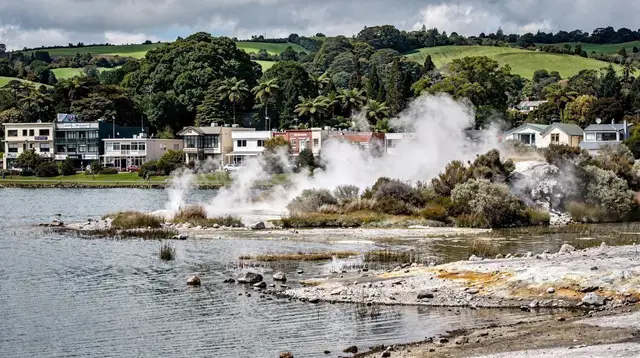
Lake Taupō doesn’t look like a crater from the shore, which is part of what makes it strange. It reads as an enormous, ordinary lake — 616 square kilometres of it, the largest body of fresh water in New Zealand — with hills around the edges and boats crossing the middle. What you’re actually looking at is the caldera left by one of the most powerful eruptions in the geological record, part of the same Taupō Volcanic Zone that runs north through Rotorua and on toward the Bay of Plenty coast. The lake filled the crater afterwards. It’s still an active system: geothermal streams feed into it at several points, hot springs sit near its edges, and the Craters of the Moon thermal area steams away just outside Taupō town.
For visitors coming from Rotorua, Lake Taupō is usually framed as a day trip, and it works well as one. But it also rewards more time than a single afternoon: the rock carvings that give this stretch of shoreline its reputation are only reachable by water, the trout fishing here is considered among the best in the country, and the town itself sits at the northern gateway to Tongariro National Park, one of the few double World Heritage sites on the planet.
Mine Bay: the Māori rock carvings
The single most photographed feature of Lake Taupō is a carving that didn’t exist before the late 1970s. Cut into a sheer rock face at Mine Bay, on the lake’s western shore, the largest figure stands roughly ten metres tall and represents Ngātoroirangi, the navigator credited in Te Arawa and local tradition with guiding early ancestors to this part of the country. Smaller carvings and a cave sit alongside it. The site has no road, no car park, and no path down a cliff — it was designed from the outset to be seen from the water, which keeps it separate from ordinary tourist infrastructure and gives it a genuinely remote feel despite being a short trip from town.
There are two practical ways to reach it:
| Option | Typical experience | Best for |
|---|---|---|
| Scenic cruise from Taupō | A guided boat trip out to the cliff face and back, usually with commentary on the carvings and lake history | Travellers short on time, or who’d rather not paddle |
| Kayak or canoe | A self-paced paddle out to the site, getting close to water level | Paddlers who want a slower, quieter approach and some exercise |
Both approaches are weather-dependent, since the carvings sit in open water and conditions on Lake Taupō can change through the day. A cruise gets you there and back with minimal effort:
a lakefront cruise out to the rock carvingscovers the round trip with commentary included, while a shorter option —
a 1.5-hour scenic cruise to the carvings— suits a tighter schedule. Either way, this is one of the few sights in the wider Rotorua region that simply cannot be reached by car, which is worth planning around rather than discovering on arrival.
Getting there and getting around
Taupō town sits at the lake’s northern tip, about an hour south of Rotorua on State Highway 5 — one of the most straightforward drives in the region, without the winding sections that slow down some other day trips. Self-driving gives the most flexibility, particularly if you want to combine the lake with Huka Falls or Craters of the Moon on the same day, both of which sit just outside town. For visitors without a car, guided day tours from Rotorua typically bundle the rock carvings cruise with one or two of these nearby stops, which is a reasonable way to see the highlights without arranging transport yourself; see driving in New Zealand for visitors if you’re deciding between the two.
Boat cruises to Mine Bay depart from the Taupō town waterfront, so there’s no need to drive further once you’ve arrived. Kayak trips generally launch from the same general area. Once in town, most of what matters for a first visit — the lakefront, cafés, and cruise departure points — is walkable.
Hot-water beaches and warm shoreline
Because Lake Taupō sits inside an active geothermal system, several streams that feed into it carry geothermally heated water, and where they meet the lake the shoreline runs noticeably warmer than the open water a short distance away. These spots aren’t marked attractions in the way Wai-O-Tapu or Hell’s Gate are back near Rotorua — they’re simply a feature of swimming here that catches first-time visitors off guard, especially in a country most people don’t associate with warm lakes. Conditions and exact temperature vary with rainfall and season, so treat any specific spot as something to check locally rather than something guaranteed on a given day.
The lake overall is large and clear enough for straightforward swimming through summer, when air temperatures make it comfortable rather than bracing. If hot water specifically is the draw, it’s worth knowing that Rotorua itself has its own concentrated cluster of geothermal bathing options — see Rotorua hot pools guide and free hot springs around Rotorua — which some visitors prefer to fold into the same trip as a soak after a day on Lake Taupō.
Trout fishing on Lake Taupō
Lake Taupō and its tributary rivers make up one of the best-known trout fisheries in the Southern Hemisphere, stocked originally with brown and rainbow trout that have thrived in the cold, clear, spring-fed water. Fishing here sits inside its own separate licensing district — a Taupō-specific fishing licence is required, distinct from general New Zealand freshwater licences, because the district funds its own fishery management. Guided trips, whether by boat on the open lake or wading rivers like the Tongariro, typically arrange licensing as part of the booking.
One fact surprises almost everyone who didn’t grow up here: trout cannot legally be sold anywhere in New Zealand. No restaurant, however good, is allowed to put trout on a menu unless a customer caught it themselves and asked for it to be cooked. It’s a rule that dates back to how trout were introduced as a recreational fish rather than a commercial one, and it means the only way to eat trout in this country is to catch it — which is part of why fishing tourism around Taupō is taken seriously rather than treated as a novelty. See trout fishing Rotorua and Taupō for how guided trips are typically structured.
Around the lake: Huka Falls, Craters of the Moon and Tongariro
Taupō town works as a base for several sights that sit outside the lake itself but close enough to combine easily.
| Nearby sight | What it is | Distance from Taupō town |
|---|---|---|
| Huka Falls | The Waikato River, the lake’s outflow, forced through a gorge roughly 15 metres wide | Short drive |
| Craters of the Moon | A geothermal field of steaming vents and craters, walkable on boardwalks | Short drive |
| Tūrangi | A small town at the lake’s southern end, close to the Tongariro River | About 45 minutes |
| Tongariro National Park | New Zealand’s first national park, and a dual UNESCO World Heritage site for both natural and cultural values | Roughly an hour |
Tongariro deserves its own planning rather than a rushed add-on. The Tongariro Alpine Crossing, a 19.4-kilometre one-way track through volcanic terrain beneath the peaks of Ngāuruhoe and Ruapehu, takes most walkers six to eight hours and needs to be arranged around shuttle transport, weather, and daylight — it’s a serious day hike, not a stroll. Ruapehu, at 2,797 metres, is also where skiing happens in this part of the North Island through winter; there is no snowfield anywhere near Rotorua itself. For a different angle on the same volcanic peaks, a scenic flight is the option that needs no hiking at all:
a scenic helicopter flight over the volcanic peaks near Tongarirogives an aerial view of terrain that would otherwise take a full day on foot to reach.
When to go
Lake Taupō follows the same inverted, Southern Hemisphere calendar as the rest of the North Island: summer runs December to February, winter June to August. Summer brings the warmest water and the longest days, making it the obvious choice if swimming is the priority — daytime maximums sit in the low-to-mid twenties Celsius, similar to Rotorua. Winter is colder, with maximums closer to the low teens and cold mornings, but the lake and its cruises don’t shut down; conditions on the water are often calmer, and this is also when Ruapehu opens for skiing to the south. Rain falls throughout the year across this whole region, so there’s no dry season to plan around — see best time to visit Rotorua and Rotorua weather month by month for how the wider region’s climate behaves across the calendar, since Taupō tracks it closely.
Where Lake Taupō fits in a Rotorua trip
For most visitors based in Rotorua, Lake Taupō works as a single well-planned day: drive down in the morning, take a cruise or paddle out to the Mine Bay carvings, stop at Huka Falls or Craters of the Moon on the way back, and be home by evening. That’s enough to see the lake’s headline sight without needing to change accommodation. See Rotorua to Taupō day trip for how that itinerary typically breaks down.
An overnight stay opens up more — a guided fishing trip, more time on the water, or a push south toward Tūrangi and Tongariro without the return drive hanging over the day. If you’re weighing up whether to base yourself here at all rather than in Rotorua, Rotorua vs Taupō: where to base covers the trade-offs directly. Either way, pair a lake day with something geothermal back in Rotorua — a soak is a reasonable way to end a day that started on a boat:
a lakefront hot springs and spa experience back in Rotoruarounds out a Taupō day trip without adding a second full excursion. For those building a longer route, see Rotorua day trips and how many days in Rotorua for where a Taupō stop fits against everything else in the region.
Lake Taupō FAQ: rock carvings, swimming and fishing
How do you see the Mine Bay Māori rock carvings?
The carvings are cut into a cliff face on the western shore of Lake Taupō and have no road access at all. The only ways to see them are by scenic boat cruise from Taupō town or by kayak or canoe, which gets you closer to the water level and lets you set your own pace.
How far is Lake Taupō from Rotorua?
Taupō town, at the northern end of the lake, is about an hour’s drive south of Rotorua on State Highway 5. It’s a straightforward day trip, or a natural first stop if you’re continuing further south.
Can you swim in Lake Taupō?
Yes. The lake is large, clear and swimmable, especially in summer when air and water temperatures are highest. Some stretches of shoreline are warmed by geothermal streams flowing into the lake, giving noticeably milder water than the open lake itself.
Do you need a fishing licence for Lake Taupō?
Yes, a separate Taupō fishing licence is required and is not covered by general New Zealand freshwater fishing licences, because the lake and its tributaries sit inside their own fisheries district. Most operators arrange licences for guided trips.
Is Lake Taupō worth a day trip from Rotorua, or an overnight stay?
A day trip covers the rock carvings cruise and a stop at Huka Falls comfortably. An overnight (or longer) stay makes sense if you want to add fishing, kayaking, or a side trip toward Tongariro National Park without rushing.
What is the best time of year to visit Lake Taupō?
The lake is a year-round destination. Summer (December-February) suits swimming and longer, warmer days on the water. Winter brings colder air but calmer, quieter conditions for cruises, and it’s also when nearby Mount Ruapehu opens for skiing.
Is Lake Taupō the same as Lake Rotorua?
No. They’re separate lakes about an hour apart. Lake Rotorua sits beside Rotorua city; Lake Taupō is much larger, fills a supervolcano crater further south, and is the source of the Waikato River.