Where to Stay in Rotorua: Neighbourhoods and Prices
Where should I stay in Rotorua?
Central Rotorua and the lakefront put you within walking distance of Kuirau Park, the Government Gardens and the lake, with the widest choice of restaurants. Ngongotahā and Fairy Springs, a short drive northwest, sit closer to the Redwoods and Hamurana Springs and are where most motels and holiday parks with private geothermal spa pools are concentrated.
Rotorua’s Neighbourhoods at a Glance
Rotorua is compact enough that no accommodation choice puts you far from the geothermal sights, but where you sleep does change your daily rhythm — whether you’re walking to dinner or driving back from Wai-O-Tapu after dark, and whether your room comes with its own steaming pool or you’re queueing for one at a public spa.
Four areas cover almost everything visitors book: central Rotorua (the CBD), the lakefront, Ngongotahā, and Fairy Springs. They sit within about 15 minutes of each other by car, so the choice is less about access and more about atmosphere, budget, and whether a private thermal pool matters to you.
| Neighbourhood | Distance to CBD | Feel | Best for |
|---|---|---|---|
| Central Rotorua | On foot | Restaurants, shops, bus interchange | First-timers, no car, short stays |
| Lakefront | 5–10 min walk | Quieter, lake views, Government Gardens nearby | Couples, longer evenings out |
| Ngongotahā | 10–15 min drive | Suburban, lakeside village, close to Redwoods | Families, private thermal pools |
| Fairy Springs | 10 min drive | Semi-rural, near wildlife park | Drivers, private thermal pools, quiet |
Central Rotorua (the CBD)
The blocks around Fenton Street and Tutanekai Street are where most of Rotorua’s restaurants, cafes and tour desks cluster, and it’s also where the InterCity and local bus services converge. Staying here means you can walk to dinner, to Kuirau Park for a free look at boiling mud and steaming ground, and to the Government Gardens without needing a car at all.
Accommodation ranges from backpacker hostels and budget motels along Fenton Street to a handful of larger hotels closer to the lake end of town. It’s the most practical base if you’re arriving by bus or plane without a rental car — see getting around Rotorua without a car for how far that gets you day to day. The trade-off is that central Rotorua is the busiest part of town, with more traffic noise and fewer properties offering a private geothermal pool, since that feature is more common on the town’s edges where geothermal bores are easier to access.
If your priority is walkability over a soak-in-your-room experience, this is the default choice, and it works well for stays of two or three nights built around the geothermal parks and cultural sites — see how many days in Rotorua for planning that out.
The Lakefront
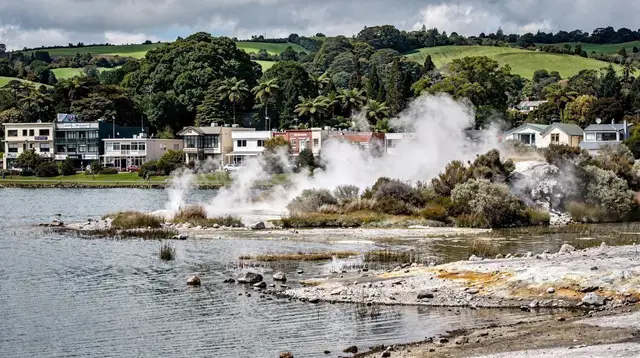
A short walk north of the CBD, the lakefront strip along Lake Rotorua gives you the same practical access to town but a calmer setting — the Rotorua Museum end of the Government Gardens is close, Ōhinemutu village and St Faith’s church are a walk away, and several properties here look directly out over the water toward Mokoia Island.
This is a good middle ground for couples or anyone who wants an evening walk without driving, and it suits a two- to three-night stay built around a lake cruise or kayaking trip as well as the geothermal parks further out. Room rates here tend to track slightly above the plainer CBD motels because of the view and the quieter street, though it isn’t a fixed premium — check what’s actually on offer for your dates rather than assuming the lakefront always costs more.
Ngongotahā
Ngongotahā sits on the western shore of Lake Rotorua, about 10 to 15 minutes from the CBD by car, and it has a distinct identity: part lakeside village with its own shops and a wharf, part gateway to Hamurana Springs and the Redwoods forest, both a short drive further on.
This is one of the two areas — with Fairy Springs — where you’ll find the highest concentration of Rotorua’s accommodations built around a private thermal pool. The geology that makes Rotorua smell of sulphur (see why Rotorua smells of sulphur) also means naturally hot groundwater is close to the surface here, and a number of motels, lodges and holiday parks around Ngongotahā tap into it to fill an in-room or on-site spa pool. It suits families or anyone who wants to soak without leaving the property, and it’s a reasonable base if you’re driving each day — to the Redwoods Treewalk, to mountain biking, or out toward Taupō for the day.
Public transport here is thinner than in the CBD, so a rental car makes a real difference to how usable this base is — see driving in New Zealand for visitors before you commit to it without one.
Fairy Springs
Fairy Springs runs along the northwestern edge of Rotorua, close to the wildlife park of the same name and within a short drive of the Redwoods. Like Ngongotahā, it’s semi-rural rather than urban, quieter after dark, and it’s the other main pocket of motels and lodges advertising rooms with their own thermally heated spa pool.
It works well if you’re driving anyway — say, basing yourself here for a Rotorua day trip circuit that takes in Waitomo or Hobbiton — but it isn’t a walk-to-dinner base, and travellers without a car will find it inconvenient for evenings. It also sits slightly further from the geothermal parks south of town, like Wai-O-Tapu and Waimangu, adding a few extra minutes each way compared with a central base.
What You Actually Pay
Rotorua doesn’t have a single citywide accommodation rate — it varies by room type, season, and how far ahead you book — but it’s useful to place lodging inside the destination’s overall daily budget bands, which cover accommodation, food, transport and activities together.
| Travel style | Approx. daily budget (per person) | What that typically buys |
|---|---|---|
| Backpacker / budget | ~150 NZD | Hostel dorm or budget motel, self-catering, free geothermal sights |
| Mid-range | ~350 NZD | Standard motel or hotel room, some paid attractions, a meal out |
| Higher-end | ~700 NZD | Lodge or hotel with extras (often including a private thermal pool), guided experiences |
Remember that the price you see already includes New Zealand’s 15% GST — there’s no tax added at checkout — and tipping isn’t expected on top of it. See tipping and costs in New Zealand for the wider picture, and Rotorua on a budget if the backpacker end of that range is your target.
Rates also move with the seasons. Summer (December to February) and school holiday periods push demand up across all four neighbourhoods, while winter (June to August) — when the geothermal steam is arguably more dramatic against the cold air — tends to be quieter and cheaper. See Rotorua weather month by month if timing is flexible.
Accommodation With a Private Thermal Pool
A private thermal pool means the water is drawn from Rotorua’s geothermal groundwater rather than heated electrically — the same source that feeds Rotorua’s public hot pools and spas. It’s a genuine local feature, not a marketing add-on, and it’s concentrated in Ngongotahā and Fairy Springs for the geological reasons above, though a smaller number of central and lakefront properties offer it too.
A few practical points before booking one:
- “Private” can mean different things. Some properties give each unit its own outdoor spa pool; others have a shared geothermal pool area available to book in private time slots. Check which one is being advertised.
- Mineral content varies. Geothermal water carries natural minerals and sulphur, which is part of the appeal but also means pools need regular draining and refilling — ask how often, particularly for longer stays.
- It’s not a substitute for the named thermal parks. A private in-room pool is a relaxation feature; it doesn’t replace a visit to a mineral spa like the one covered in Polynesian Spa: what to know, or Rotorua’s broader hot pools scene in the Rotorua hot pools guide.
- Free alternatives exist. If a private pool isn’t in budget, several free or low-cost geothermal spots around town are covered in free hot springs around Rotorua.
Choosing a Base Around What You’re Doing
If your days are built around the geothermal parks and Māori cultural sites south and east of town — Te Puia, Whakarewarewa Village, Wai-O-Tapu — a central or lakefront base cuts down on driving. An afternoon combining Te Puia’s living Māori village with time to unwind afterward works well slotted into an evening back in town.
If you’re spending more time outdoors — the Redwoods, Hamurana Springs, or day trips further afield — Ngongotahā or Fairy Springs put you closer to the trailheads and cut the drive time each morning. A guided walk through native forest with a local guide or an afternoon touring the wider geothermal landscape with an eco-focused operator both start with a pickup, which softens the base-location question either way.
Families splitting time between geothermal sights and gentler activities sometimes prefer Ngongotahā for the lakeside space and the chance to fit in something like a scenic horse trek through the countryside around Rotorua without a long drive back afterward. See Rotorua with kids for how that balances against the geothermal parks’ heat and smell, which isn’t for every child.
Cruise passengers docking in Tauranga and coming through on a single day don’t need to weigh any of this — see cruise ship day in Rotorua from Tauranga for that separate logistics question.
Holiday Parks and Longer Stays
Rotorua’s holiday parks sit mostly around the lake and toward Ngongotahā, offering powered sites, cabins and shared kitchens at a lower nightly cost than motels, and some include access to an on-site geothermal pool as part of the deal. They suit self-drive trips, campervan travel, and families wanting to cook rather than eat out every night. A fuller rundown of what to expect from them, including which ones sit closest to the geothermal parks, is in Rotorua holiday parks and camping.
For anyone weighing Rotorua against a Taupō base instead — a common question given the two towns are about an hour apart — see Rotorua vs Taupō: where to base yourself, which compares what each puts within easy reach.
Practical Booking Notes
- Book earlier for summer and school holidays. December through February is Rotorua’s busiest stretch, and rooms with a private thermal pool are a smaller pool of inventory that fills first.
- Confirm parking if you’re not central. Ngongotahā and Fairy Springs properties almost always include parking, but some CBD hotels charge for it or have limited spaces.
- Ask about the pool’s shared status. “Thermal pool on site” and “private thermal pool in your unit” are different products at different price points — confirm which one you’re booking.
- Sentinel your dates against events. Rotorua’s calendar includes mountain biking and cultural events that can tighten availability even outside the main summer season.
- Reconfirm any tour pickups against your chosen suburb. Most Rotorua tour operators pick up from central accommodation as standard and from Ngongotahā or Fairy Springs on request — check this when booking rather than assuming.
Where to Stay in Rotorua: Frequently Asked Questions
Is it better to stay in central Rotorua or by the lake?
Both are walkable to town. Central Rotorua puts you closest to restaurants, Kuirau Park and the bus interchange, while lakefront properties add lake views and a quieter street but are still a short walk from the CBD.
Where are most of the accommodations with private thermal pools?
Ngongotahā and Fairy Springs have the highest concentration of motels and lodges offering rooms with their own geothermally heated spa pool, because that part of Rotorua sits over accessible hot groundwater. Some central properties offer the same feature, but it is less common there.
Do I need a car if I stay in Ngongotahā or Fairy Springs?
It helps. Both are a 10 to 15 minute drive from central Rotorua, and while some accommodations run a shuttle, public transport options are limited outside peak times. If you plan to rely on buses or walking, base yourself centrally instead.
How much should I budget per night for accommodation in Rotorua?
There is no single citywide rate, since it depends on room type and season, but the destination’s overall daily budgets scale from roughly 150 NZD per person for a backpacker trip to around 350 NZD for a mid-range stay and 700 NZD for a higher-end one, accommodation included.
Are holiday parks and campgrounds available near the lake?
Yes, several holiday parks sit around Lake Rotorua and toward Ngongotahā, offering powered sites, cabins and shared facilities, and some include access to a geothermal pool on site.
Is Fairy Springs walking distance from the town centre?
No. Fairy Springs is on the northwestern edge of Rotorua, close to the wildlife park and Rainbow Springs area, roughly a 10 minute drive from central Rotorua. It is not a walkable base for evenings in town.
Tours near where you stay on GetYourGuide
Verified deep-linked GetYourGuide tours. Book through these links and we earn a small commission at no cost to you.
Photos show the destination, not the operator's own images.