Rotorua Holiday Parks and Camping: Freedom Camping, DOC Sites and Thermal Pools
Can you freedom camp around Rotorua?
Only in a certified self-contained vehicle, and only where the Rotorua Lakes Council bylaw allows it — most lakefront reserves are off-limits. Non-self-contained vehicles are restricted to holiday parks or DOC campsites with facilities.
Where a van can actually stop for the night
Rotorua sits on an active caldera, ringed by lakes, and a lot of visitors arrive assuming they can pull off the road at the water’s edge and stay. Some of that is possible. Most of it is not, or not without the right vehicle certification. New Zealand’s camping rules split into three separate systems that don’t always overlap the way people expect: freedom camping under national law and local bylaws, the Department of Conservation’s own campsite network, and privately run holiday parks. Knowing which one applies to which patch of ground is the difference between a quiet night by Lake Rotoiti and an infringement notice.
This guide covers what each option actually permits around Rotorua, which sites give access to the geothermal water the region is known for, and where the law is stricter than it looks from a Facebook group.
Freedom camping: the legal reality, not the internet version
The Freedom Camping Act 2011 is the national law that allows camping in a vehicle or tent on public land outside formally designated campsites, unless a local bylaw restricts or bans it. In practice, the bylaw is what matters day to day, and the Rotorua Lakes District Council bylaw is the one that governs the area covered by this site.
Two things determine whether you can legally freedom camp in a given spot:
- Whether the bylaw permits freedom camping at that location. Rotorua’s council has progressively narrowed the areas where it’s allowed, particularly around the Lake Rotorua shoreline and in town, in response to complaints about waste and overcrowding. Many lakefront reserves that look like obvious spots are signed as no-camping zones.
- Whether the vehicle is certified self-contained. A non-self-contained vehicle — a car, a basic van, most rental cars — cannot freedom camp in the areas where it is technically allowed even for certified vehicles. Only a vehicle carrying a current self-containment certificate (the blue sticker system checked against the official New Zealand standard) qualifies.
If a vehicle isn’t certified self-contained, the honest answer is that a holiday park or a DOC campsite with toilets is the legal option, not a layby with a view. This trips up a lot of visitors renting a standard car or an uncertified van and assuming freedom camping is a general right — it isn’t, it’s a conditional exception, and the exceptions are shrinking rather than growing. For background on New Zealand’s driving rules more broadly, see driving in New Zealand for visitors.
Enforcement is active rather than theoretical. Council officers patrol known freedom camping and problem areas, and infringement fines apply per vehicle for camping outside a permitted zone or without valid self-containment. Some of the busiest lake margins near town have signage precisely because they’ve been repeat problem spots — read the sign, not the assumption.
What a self-contained certificate actually covers
A certified self-contained vehicle carries its own fresh water supply, a sealed toilet, and enough grey and black water capacity to go several days without needing to empty anything into the environment. An authorised inspector checks the vehicle against the national standard and issues a certificate with an expiry date, and the vehicle displays a sticker showing that date. If you’re hiring a van specifically to freedom camp, ask to see the current certificate rather than taking a company’s marketing description of “self-contained” at face value — an out-of-date certificate is the same as having none.
The New Zealand Motor Caravan Association operates a members’ network of low-cost and free overnight parking spots around the country, mostly aimed at certified self-contained vehicles, which is a legitimate alternative to public freedom camping areas if you’re touring for an extended period.
DOC campsites: the other public option
The Department of Conservation manages a separate network of campsites on conservation land, graded by facility level rather than by the freedom camping rules above. DOC’s own categories run roughly:
| Category | Typical facilities | Booking |
|---|---|---|
| Basic | Toilet, sometimes a water source, no power | Usually first-come, first-served |
| Standard | Toilet, tap water, picnic tables | Mostly first-come, first-served |
| Serviced | Flush toilets, showers, sometimes powered sites | Often bookable in advance |
| Scenic/Backcountry | Minimal facilities, remote settings | Varies, some require a hut/campsite pass |
DOC sites near the Rotorua region range from basic bush and lakeside sites to more developed ones further afield toward Tongariro National Park, which also has its own network geared toward hikers doing multi-day routes or the Tongariro Alpine Crossing. Availability, exact facilities and current fees are listed per site on DOC’s own booking system, and it’s worth checking there directly rather than relying on a secondhand description, since sites do close for track work, weather damage or pest control operations without much notice.
DOC sites don’t require self-containment in the way freedom camping areas do — a basic tent or an ordinary van is fine at a site with a toilet — but they do require you to pack out anything the site doesn’t have facilities for.
Holiday parks — and which ones use geothermal water
Holiday parks are private, fee-paying campgrounds with a fixed site, and they’re the default option for any vehicle that isn’t self-contained, or for tent camping with proper toilets and showers on hand. Standard facilities across most parks include powered and unpowered sites, shared kitchens, laundry, and amenity blocks; cabins and units are usually available alongside tent and van sites for anyone travelling without their own gear.
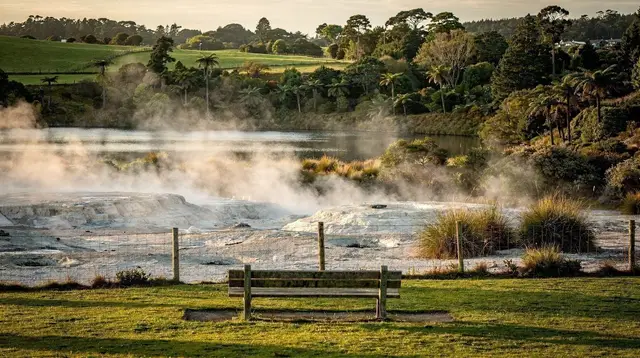
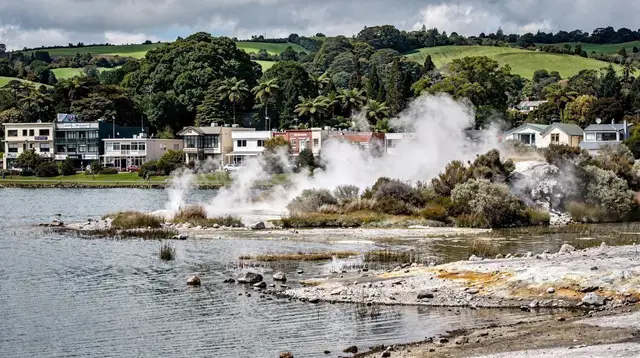
What’s specific to this area: because Rotorua sits directly on a geothermal reservoir, several holiday parks around the town and lake tap into that heat source and pipe naturally warmed mineral water into their own pools, on top of the usual camp facilities. This isn’t universal — plenty of parks run standard chlorinated pools like anywhere else — so it’s worth asking directly when booking if geothermal water access matters to you, rather than assuming every park near Rotorua has it. It’s a genuinely regional feature: this kind of on-site thermal pool at a campground is uncommon almost everywhere else in the country.
Booking ahead matters more in summer. Over the school holiday weeks from December to February, powered and lakefront sites at the more established parks can fill weeks in advance; outside that window, a same-day arrival is usually workable. For a general sense of what accommodation costs across styles in the region, see where to stay in Rotorua, and for cost planning more broadly, Rotorua on a budget.
Where campers actually base themselves
A van or tent base near Rotorua puts most of the region’s geothermal and lake attractions within a short drive, which is the main practical advantage over staying further out. From a site near town, the geothermal parks, Hamurana Springs, and the Blue and Green Lakes are all under half an hour, and Lake Tarawera isn’t much further. Day loops out toward Taupō or further along the Rotorua to Taupō road trip route work well from a fixed camp base, since you’re not packing up and moving the vehicle each night.
If mornings free of driving matter to you — an early Wai-O-Tapu visit, or a Pōhutu geyser check before the crowds — a site closer to town cuts the commute compared with basing further out at Taupō or Tauranga. See how many days in Rotorua if you’re still working out how long to allow, and Rotorua day trips for what’s realistically reachable in a day from a fixed base.
Campers with more time sometimes build in a guided activity or two rather than only self-driving between sights. A half-day small-group thermal valley walk with local commentary covers ground a self-guided stop often misses, and a scenic horse trek through farmland and native bush is a change of pace from driving between car parks. For campers with a full day free, a guided walk through Whirinaki forest with a local operator reaches native forest that’s harder to find independently.
Biosecurity and lake etiquette while camping
New Zealand runs one of the strictest biosecurity regimes in the world, and camping gear is exactly the kind of equipment it targets — tent pegs, boots, kayaks and fishing gear can all carry soil, seeds or aquatic pests between regions or across the border. Clean and dry gear before arrival and between lakes if you’re moving between more than one; see New Zealand biosecurity: what not to bring for what’s actually restricted.
Not every lake around Rotorua is open for the things campers typically do at a lakeside site. Rotokākahi, the Green Lake, is tapu to Te Arawa and closed entirely to swimming, boating and camping — it’s privately owned, and this isn’t a soft guideline, it’s a hard closure. Elsewhere, posted no-camping and no-fires signage on lake margins reflects real enforcement, not excess caution. The Tiaki Promise, the visitor behaviour commitment asked of everyone travelling in New Zealand, covers exactly this kind of judgment call; see the Tiaki Promise explained if it’s unfamiliar.
Geothermal ground adds a further layer most campers don’t think about until they’re standing on it: soft, hot ground can exist metres from a perfectly solid campsite, and it isn’t always visible. Stick to marked tracks and site boundaries rather than wandering toward interesting steam. See Rotorua safety around geothermal areas for what to actually watch for.
Camping budget, roughly
None of the figures below are fixed prices — camp fees, park rates and DOC charges all change and vary by season — but as an order of magnitude, camping and holiday parks sit at the lower end of the daily budget bands used across this site, well under the routine backpacker daily estimate of roughly 150 NZD per person once accommodation is factored in. A DOC basic site costs a small fraction of that; a holiday park powered site with facilities and a pool sits somewhere above it but still well under hostel or hotel rates. Confirm actual rates directly with DOC or the park in question when planning rather than budgeting off a remembered number, since posted rates change season to season.
Practical checklist before you park
- Confirm the vehicle’s self-containment status and expiry date if you plan to freedom camp anywhere.
- Check the Rotorua Lakes District Council’s current freedom camping map or signage rather than an old blog post — permitted zones have changed over time and keep shrinking.
- For DOC sites, check the specific site’s page for facility level, current fees and any closures before driving out.
- For holiday parks, ask directly whether geothermal pool access is included if that’s part of the appeal, and book ahead for summer school holidays.
- Carry out what you carry in at basic sites; not every DOC or freedom camping area has rubbish collection.
- Respect closed lakes and posted no-camping signage — Rotokākahi is closed outright, and other margins are signed for good reason.
Camping and holiday parks around Rotorua: common questions
Is freedom camping legal in Rotorua?
It is legal only under conditions. New Zealand’s Freedom Camping Act sets the national frame, but the Rotorua Lakes District Council bylaw decides exactly where within the district it is permitted, and it bans it outright on most lake reserves and in town. A vehicle also needs a current self-containment certificate to freedom camp almost anywhere it is allowed.
What does a self-contained vehicle actually need?
A certified self-contained vehicle carries its own fresh water, a sealed toilet, and grey water storage sufficient for several days, checked against the New Zealand standard by an authorised inspector. The vehicle displays a current blue self-containment sticker with an expiry date; a hire van’s paperwork should show it as well.
Do any holiday parks near Rotorua have hot pools?
Several holiday parks in the Rotorua area draw on the geothermal reservoir the town sits on and pipe naturally heated mineral water into their own pools, alongside standard camp facilities. It is worth checking with each park directly, since not all of them tap the geothermal system and access can be seasonal.
Can you stay for free at a DOC campsite?
Some DOC campsites are free, most are low-cost, and a few near Rotorua are bookable in advance through DOC’s own booking system. Facilities range from a toilet and a tap at basic sites to hot showers and powered sites at serviced ones — the category is listed on each site’s DOC page.
Where can’t you camp at all around the lakes?
Rotokākahi, the Green Lake, is tapu to Te Arawa and closed to swimming, boating and camping entirely — it is privately owned and access is not permitted. Several other lake margins carry no-camping signage even where freedom camping is technically allowed nearby, so check posted signs rather than assuming a lakefront is open.
What happens if you camp somewhere you shouldn’t?
Council enforcement officers issue infringement notices for freedom camping outside permitted areas or without a valid self-containment certificate, and fines apply per vehicle. Repeat problem areas sometimes get temporary or permanent bans added to the bylaw, which is part of why the permitted zones can shrink from one season to the next.
Do you need to book a holiday park in advance?
In the shoulder and winter months a same-day arrival is usually fine, but over the summer school holidays and around major events, powered and lakefront sites at popular parks can book out weeks ahead. It is worth calling or booking online rather than assuming a site will be free on arrival.
Family activities on GetYourGuide
Verified deep-linked GetYourGuide tours. Book through these links and we earn a small commission at no cost to you.
Photos show the destination, not the operator's own images.