Free Things to Do in Rotorua
What can you do for free in Rotorua?
Kuirau Park's bubbling mud pools and steam vents are open to the public at no charge, as is walking through the lakeside village of Ōhinemutu and the Government Gardens. The Redwoods forest has free walking tracks, and Kerosene Creek is a natural bush hot pool with no entry fee, though it has no facilities and no supervision.
A day in Rotorua without spending on admission
Rotorua sits on some of the most active geothermal ground in the country, and most of the sites that make that visible carry an entry fee — Te Puia, Wai-O-Tapu and Waimangu Volcanic Valley all charge admission, and rightly so, since they maintain boardwalks, staff and protected land. But a handful of places in and around the city cost nothing at all, and they are not an afterthought: Kuirau Park, the lakeside village of Ōhinemutu, the Government Gardens, the free walking tracks through the Redwoods forest and the natural hot pool at Kerosene Creek can fill a full day, or stretch across several if they are mixed in with paid activities.
This guide covers what each one actually offers, what it doesn’t, and how to string them together.
None of this is a consolation prize for travellers who skip the ticketed parks. Kuirau Park in particular shows the same geology — mud pools, steam, the smell of hydrogen sulphide — that visitors pay to see elsewhere, just on a smaller, more concentrated scale, in a public park rather than behind a gate. For background on why the air smells the way it does here, see why Rotorua smells of sulphur.
Kuirau Park: a geothermal park anyone can walk into
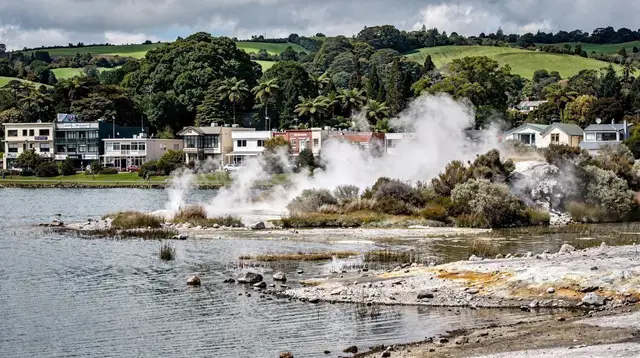
Kuirau Park sits a ten to fifteen minute walk west of central Rotorua, and it is unusual among the region’s thermal areas for one simple reason: it’s a public park, open around the clock, with no fence, no ticket window and no charge. Steam drifts across the paths most mornings, boiling mud pools churn behind low railings, and a large crater lake — the result of a hydrothermal eruption in 1886, the same year Mount Tarawera erupted — takes up much of the park’s centre.
Walking paths loop around the crater lake and past the mud pools, with signage explaining the geology and warning where the ground is unstable. There’s also a free footbath fed by geothermal water near the park’s Ranolf Street side, where people sit and soak their feet for as long as they like — bring a towel if you plan to use it. Because it’s unfenced and unstaffed, the same rules that apply to any active geothermal ground apply here: stay on marked paths, keep children close, and don’t step past a railing to get a closer photo. The ground can be hotter, and thinner, than it looks. For a fuller rundown of the safety basics around boiling mud and thermal water, see geothermal safety in Rotorua.
Kuirau Park works well early in the morning, when the steam is thicker in the cool air and there are fewer people around, or at the end of an afternoon walk from town. It’s also one of the few places on this list genuinely usable in the rain — heat rising through wet ground tends to look more dramatic, not less. For more ideas along these lines, see Rotorua’s free hot springs and, more broadly, Rotorua on a rainy day.
Ōhinemutu: a lived-in lakeside village
A short walk north of the city centre, on a point jutting into Lake Rotorua, Ōhinemutu is the papakāinga — home village — of Ngāti Whakaue. People live here now, the same as they have for generations; it isn’t a recreation or a museum piece, which is exactly what makes it worth walking through rather than skipping.
The most visited landmark is St Faith’s Anglican church, notable for a large glass window behind the altar etched with a life-sized figure of Christ, positioned so that from certain angles he appears to be walking on the waters of the lake outside. The church exterior and grounds can be viewed respectfully at any time; if the church itself is open, quiet visits are usually tolerated, but this is an active place of worship, not a tourist attraction, and services take priority. Nearby, steam vents rise between houses and from public grass verges — a reminder that this entire village sits directly on geothermal ground, and many homes here still use it for cooking and heating.
Because Ōhinemutu is a residential community, the etiquette matters more than at any ticketed site on this list: stay on public roads and footpaths, don’t walk onto marae grounds or approach the wharenui (meeting house) without invitation, and ask before photographing people or private property. For a broader grounding in what’s expected of visitors here, see Māori cultural etiquette in Rotorua and, for context on the iwi whose home this is, Te Arawa history. Ōhinemutu takes twenty to thirty minutes to walk through unhurried, and pairs naturally with a walk along the Lake Rotorua lakefront.
Government Gardens: lawns, roses and a closed Bath House
East of the city centre, right on the lakefront, the Government Gardens are Rotorua’s formal green space — manicured lawns, rose beds, and the black-and-white Tudor-style Bath House building that anchors the whole layout. Built in 1908 as a spa house at the height of Rotorua’s early tourism boom, the Bath House has been closed since 2016 for earthquake strengthening, with reopening happening in stages rather than all at once, so treat it as a building to photograph from outside rather than a venue to visit inside for now.
The gardens around it remain fully open, free, and pleasant for an unhurried walk or a picnic, with views across Lake Rotorua and occasional lawn bowls matches on the greens beside the Bath House. A geothermal area sits within the gardens too, with steam vents and small thermal features scattered among the plantings — smaller in scale than Kuirau Park but free in the same way. For the fuller history of the Bath House and what else the gardens hold, see the Rotorua Museum and Government Gardens guide. The gardens sit close enough to Ōhinemutu and the town centre to combine all three into one loop on foot.
Free walking tracks through the Redwoods forest
South of the city, the forest known as Whakarewarewa — usually just called the Redwoods — is a plantation of Californian coast redwoods first planted in 1901, now grown into a tall, quiet grove that’s become one of the more recognisable free attractions near Rotorua. The Redwoods Visitor Centre sits at the entrance, and from there a network of ground-level walking tracks fans out through the trees, ranging from a fifteen-minute loop past the tallest redwoods to longer routes of an hour or more, all free and open daily during daylight.
It’s worth being clear about what’s free here and what isn’t. The walking tracks at ground level cost nothing. The elevated canopy walkway — a series of suspension bridges strung between the treetops, lit for night visits — is a separate, ticketed attraction inside the same forest; see the Redwoods Treewalk guide if that’s of interest. The same forest also carries one of the country’s best-regarded mountain bike trail networks, covered in mountain biking at the Redwoods, though most of those trails are built for riders rather than walkers. For a wider list of no-cost trails around the wider region, see Rotorua’s free walking tracks.
Redwoods walking is a good match for a morning slot before or after a paid activity elsewhere, since the visitor centre car park is free and the loop tracks are well signed and easy to follow without a guide.
a guided walk through Whirinaki Forest with a local guide covers a different, less-visited native forest outside the city and adds context — plants, birdlife, history — that a self-guided loop through the Redwoods won’t give you, if a paid, guided forest experience is what you’re after instead.
Kerosene Creek: a free bush hot pool, with real caveats
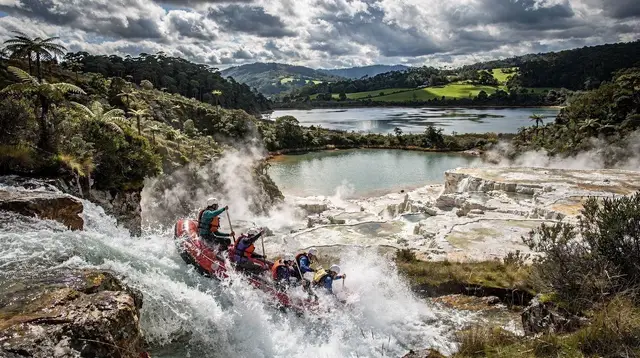
About 30 minutes south of Rotorua on the way toward Wai-O-Tapu, a short walk off a gravel side road leads to Kerosene Creek, a natural stream warmed by geothermal run-off that pools above a small waterfall into a swimmable basin. There’s no entry fee, no staff, and no infrastructure beyond a car park and a track — which is exactly the appeal and exactly the risk.
The creek bed is uneven and can be slippery underfoot, the water temperature varies along its length and isn’t monitored, there’s no lifeguard, and the car park has had a history of break-ins, so valuables are best left elsewhere entirely. It’s also affected by weather: heavy rain can make the access track difficult or temporarily close the area, so checking current conditions before setting out is worth the two minutes it takes, rather than discovering a closed gate after the drive. None of this makes Kerosene Creek unusual among natural hot pools in this part of the country — it simply means treating it with the same caution you’d bring to any unsupervised natural water feature, geothermal or not.
Kerosene Creek needs a car, or a tour that includes it, since it isn’t served by public transport and sits well outside easy walking range of town. It combines naturally with a day built around Wai-O-Tapu, given how close the two are along the same road south.
Other no-cost stops worth knowing about
A few smaller free spots round out a budget-minded day in Rotorua:
- Hamurana Springs — a short, easy loop walk beside one of the country’s deepest cold freshwater springs, on the northern shore of Lake Rotorua. See Hamurana Springs for details.
- The Lake Rotorua lakefront — a free walking and cycling path runs along much of the city-facing shore of Lake Rotorua, useful for an evening walk with lake and mountain views at no cost.
- Central city street steam — small, unmarked geothermal vents surface in odd corners of central Rotorua, from parking strips to footpaths — worth noticing rather than seeking out specifically.
None of these need a full afternoon on their own, but they add up well alongside the main five stops above, especially for a family looking to break up a day of driving or a longer paid activity. See Rotorua with kids for how families tend to sequence a day like this.
Building a free day into a longer Rotorua trip
A single day covering Kuirau Park, Ōhinemutu, the Government Gardens and a Redwoods walk is realistic on foot from central Rotorua, without a car, since all four sit within a comfortable walking radius of the city centre. Kerosene Creek is the outlier — it needs transport — so it’s usually better paired with a day that already involves a car, such as a day trip toward Wai-O-Tapu or Taupō.
For travellers planning a wider stay, these free stops slot naturally around one or two ticketed activities per day rather than replacing them entirely — a realistic rough budget, covered in more depth in Rotorua on a budget, runs from around 150 NZD a day for a no-frills traveller up toward 350 NZD for a mid-range one once accommodation, food and a couple of paid attractions are factored in. If it’s your first visit and you’re deciding how many days to give the region overall, see how many days in Rotorua, and for a ready-made low-cost schedule, the Rotorua budget 3-day itinerary weaves several of these free stops in around paid highlights.
For a paid alternative that sits close in spirit to a free geothermal walk but adds guiding and cultural context, an eco thermal afternoon tour through Rotorua’s geothermal landscape covers ground that Kuirau Park only hints at, with a guide explaining what’s happening underfoot rather than reading it off a sign. And where Ōhinemutu offers a respectful walk past a living village from the outside, a guided visit to Te Puia’s Māori village and cultural centre is the ticketed counterpart that goes further — carving schools, a kiwi conservation area and the geyser field included — for travellers who want that depth as part of their trip rather than only the free version of it.
Food isn’t part of the free-activities list above, since eating still costs money wherever you are, but pairing a low-cost sightseeing day with a simple lunch is straightforward — see Rotorua food and drink for what’s around town at a range of price points, and things to do in Rotorua for the fuller list of paid and unpaid activities across the wider city.
Free things to do in Rotorua: frequently asked questions
Is Kuirau Park really free to enter?
Yes. Kuirau Park is a public council park with open access at all hours, no ticket booth and no charge. It sits a short walk from central Rotorua and is one of the few geothermal areas in the country you can walk straight into.
Can anyone walk through Ōhinemutu village?
Ōhinemutu is a lived-in Ngāti Whakaue village, not a tourist attraction, so visitors are welcome to walk its public streets respectfully and view St Faith’s church from outside, but private homes, the marae grounds and the wharenui are not open to wander into uninvited.
Are the Government Gardens still worth visiting with the Bath House closed?
The Bath House building has been closed since 2016 for earthquake strengthening and is reopening in stages, so it is a photo stop rather than a museum visit for now. The gardens themselves, the rose beds and the lakefront lawns remain fully open and free.
Is Kerosene Creek safe and free to swim in?
Kerosene Creek has no entry fee, but it also has no lifeguard, no changing rooms and a slippery, uneven streambed, so caution matters more than it would at a managed pool. Check current road and track conditions before going, since access can change after weather events.
Which Redwoods walking tracks are free?
The ground-level walking tracks through Whakarewarewa Forest, including the loop past the tallest redwoods, are free and open daily. The elevated canopy Treewalk is a separate, ticketed attraction within the same forest.
How many free geothermal sites are there around Rotorua?
Kuirau Park in town is the main free geothermal site, alongside smaller roadside steam vents and the natural hot pool at Kerosene Creek outside town. The larger thermal parks such as Te Puia, Wai-O-Tapu and Waimangu Volcanic Valley all charge admission.
Do I need a car to reach these free attractions?
Kuirau Park, Ōhinemutu and the Government Gardens are all within walking distance of central Rotorua. The Redwoods forest and Kerosene Creek are outside town and are far easier to reach with a car or an organised transfer — a short scenic horse trek through the countryside around Rotorua is one way to cover some of that ground without driving yourself, if a self-drive rental isn’t part of the plan.
Good-value Rotorua tours on GetYourGuide
Verified deep-linked GetYourGuide tours. Book through these links and we earn a small commission at no cost to you.
Photos show the destination, not the operator's own images.