Wai-O-Tapu Visiting Guide: Hours, the Loop Walk and Lady Knox Timing
What is the best time to visit Wai-O-Tapu to see Champagne Pool without steam or crowds?
Arrive at opening and walk the loop toward Champagne Pool before the Lady Knox Geyser crowd returns around 10:45am. Steam sits heaviest over the pool on cold, still mornings, so a later, warmer, slightly breezier stretch of the day usually photographs more clearly than first light.
Getting the Timing Right at Wai-O-Tapu
Wai-O-Tapu sits about 27 km south of Rotorua on State Highway 5, roughly a 30 to 45 minute drive depending on traffic through town. It is the largest and most photographed of the Rotorua geothermal parks, built around a single walking loop that strings together colour-saturated craters, a milky-blue lake, and the bubbling Champagne Pool that appears on most Rotorua postcards. What trips up a lot of visitors isn’t finding the park — it’s the schedule inside it. There is a geyser that erupts once a day at a fixed time, a loop walk long enough that you can’t do everything twice, and a pool whose famous colours look completely different depending on how much steam is sitting over the water when you arrive.
This guide is built around those three timing decisions: when the park is open, how the loop and the Lady Knox side-trip fit together, and when to be standing at Champagne Pool if you want it without a wall of steam or a crowd of coach passengers in the frame.
Opening hours
Wai-O-Tapu operates daily except Christmas Day. Hours run longer through the New Zealand summer (December to February) and shorter through winter (June to August), and the exact opening and closing times shift a little year to year, so check the operator’s current hours before you drive out rather than working from a fixed number. What matters more than the precise clock time is the sequence of the day: the park opens, a set window later Lady Knox erupts at 10:15am, and after that the bulk of the day’s coach traffic moves from the geyser back into the main loop. If you’re planning around the geyser, opening hours are really just the earliest point at which you can get inside and walk part of the loop before that mid-morning rush arrives.
Getting there
Self-driving from Rotorua is straightforward: SH5 south, well signposted, with parking at the park entrance. If you don’t have a car, a half-day tour from Rotorua to Wai-O-Tapu handles the return trip and the Lady Knox timing for you, which removes the one piece of this visit that’s easiest to get wrong on your own. For general advice on renting and driving in New Zealand, see driving in New Zealand for visitors. If Wai-O-Tapu is one stop on a bigger day, it also sits on the road toward Taupō, so some visitors combine the two rather than returning straight to Rotorua.
The 3 km Loop Walk: What to Expect
The main walking track at Wai-O-Tapu is a single formed loop of about 3 km, mostly boardwalk and gravel path, that most people complete in roughly 1 to 1.5 hours at an unhurried pace with stops for photos. It isn’t a single straight line — the park signs it as a set of shorter coloured loops that combine into the full circuit, so you can choose a shorter version if you’re short on time, or the full loop if you want to see everything the park has close to the entrance.
How the loops are laid out
Near the entrance, a short loop covers craters, small steaming pools, and mineral terraces within a few minutes’ walk of the car park — useful if you’re tight on time or have limited mobility. The full loop extends further, taking in the Devil’s Bath (a bright, sulphur-yellow pool coloured by suspended sulphur and ferrous salts), the Champagne Pool itself, and a run of craters and mud features on the way back toward the entrance. Paths are flat and formed throughout, though uneven in places and often damp, so closed, grippy shoes matter more here than on a paved city walk — the same advice applies at every geothermal site in the region, covered in more detail in Rotorua safety around geothermal areas.
What you’ll actually see
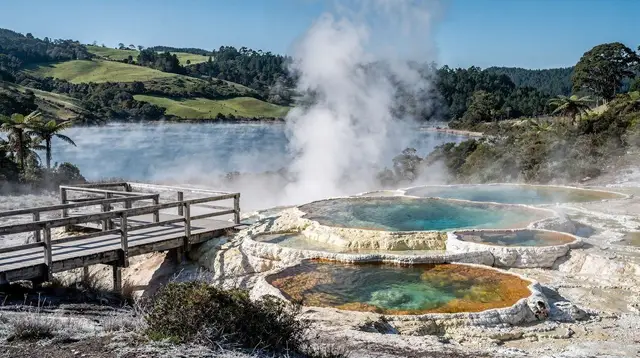
Colour is the headline at Wai-O-Tapu, and it comes from mineral chemistry rather than dye or lighting: the orange rim around Champagne Pool is antimony sulphide, the yellow of the Devil’s Bath and other pools comes from sulphur, and the greens and blacks elsewhere trace back to different trace minerals reacting with the geothermal water. It’s the same underlying system that produces the smell across the whole region — if the sulphur smell itself is new to you, why Rotorua smells of sulphur explains where hydrogen sulphide comes from and why it’s stronger in some spots than others. Unlike Hell’s Gate, there’s no mud bath you can get into here — Wai-O-Tapu is a look-but-don’t-touch park, walked entirely on boardwalk above the active features.
Lady Knox Geyser: The 10:15am Ritual
Lady Knox is a short drive from the main entrance, at a separate car park and viewing area with tiered seating, and it is the one fixed appointment in a Wai-O-Tapu visit. Each morning at 10:15am, a park guide introduces a natural surfactant into the vent, which lowers the surface tension of the water column and triggers an eruption that can run for around an hour once it gets going, typically reaching a good height within the first several minutes. It is a staged trigger rather than a spontaneous eruption — the surfactant technique dates back decades at this site — but the water and pressure behind it are real geothermal activity, not a special effect.
Timing your visit around it
Because it only happens once, at one fixed time, Lady Knox effectively splits a Wai-O-Tapu visit into two decisions: go there first, or walk part of the main loop first and get back to the geyser car park before 10am. Most visitors go to Lady Knox first, arriving 15 to 20 minutes ahead to get a decent seat before the tiered viewing area fills, then drive back to the main entrance afterwards to walk the loop at a calmer pace once the geyser crowd has dispersed into it. Doing the loop first and Lady Knox second works too, but it only pays off if you’re confident about the return drive and don’t mind a tighter first half of the walk.
If you’re relying on a guided day rather than self-driving, this is exactly the kind of sequencing a tour operator has already solved — a combined Wai-O-Tapu and Te Puia day with a cultural performance threads the geyser timing in alongside a separate stop, without you having to watch the clock yourself.
Champagne Pool Without the Steam or the Crowds
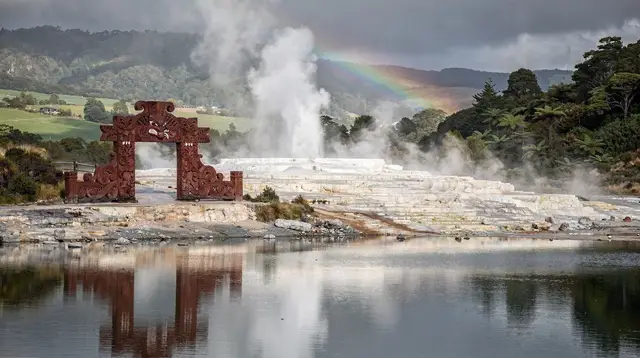
Champagne Pool is the single most photographed feature in the park — a wide, steaming lake with a bright orange mineral rim — and it’s also the spot most likely to disappoint visitors who arrive expecting a clean postcard shot. The pool steams constantly; that isn’t weather, it’s the water itself, so there’s no time of day when it stops entirely. What changes through the morning is how much of that steam sits low over the surface and how many people are standing at the rail with you.
Why timing matters more here than elsewhere in the park
Steam behaves differently depending on air temperature and wind. On a cold, still morning — common in Rotorua’s winter, and not unusual even in summer before the day warms up — the steam over Champagne Pool tends to sit heavy and flat, obscuring the colour and the surface detail that make the photo worth taking. As the air warms through mid-morning, or when there’s even a light breeze moving across the crater, the steam thins and drifts rather than pooling, and the orange rim and turquoise water become much easier to actually see and photograph. Crowding follows a separate rhythm tied to Lady Knox: the geyser show lets out at a fixed point, and a wave of visitors moves from there back into the main loop shortly after, so Champagne Pool sees a noticeable crowd surge roughly 30 to 45 minutes after the 10:15am eruption starts.
The strategy that works
Putting those two patterns together, the clearest and quietest combination tends to be later in the morning rather than right at opening: enough time for the air to warm and thin the steam, but before or after the main Lady Knox crowd wave has reached that part of the loop. Visitors doing the loop first and Lady Knox second sometimes get this by accident, reaching Champagne Pool in the first hour after opening when both the steam and the crowd are still lighter. There’s no way to guarantee an empty rail — this is one of the most visited single features in the region — but avoiding the immediate post-geyser surge, and avoiding the coldest, stillest part of the morning, solves most of what makes photos of the pool look worse than they need to.
Wai-O-Tapu Compared to Other Rotorua Geothermal Parks
Wai-O-Tapu isn’t the only geothermal park worth the drive, and it’s worth knowing what the others do differently before deciding whether one visit is enough. Waimangu Volcanic Valley, north of here, is the only geothermal system in the world with a known birth date — the 1886 eruption of Mount Tarawera — and it’s walked downhill through a valley rather than around a flat loop. Hell’s Gate is the most visibly active of the three and the only one where you can get into a mud bath rather than just look at one.
| Park | Distance from Rotorua | Walk style | Standout feature |
|---|---|---|---|
| Wai-O-Tapu | ~27 km south | 3 km flat loop | Champagne Pool, Lady Knox Geyser |
| Waimangu Volcanic Valley | ~20 km south-east | Downhill valley walk | Known 1886 origin, Inferno Crater |
| Hell’s Gate | ~16 km north-east | Short boardwalk loop | Most active surface, enterable mud bath |
If you’re deciding between them rather than fitting in all three, Rotorua’s geothermal parks compared breaks down the differences in more depth. For a mud-focused comparison specifically, see Rotorua mud baths and mud pools.
Tours and Ways to Visit
Independent visits work well at Wai-O-Tapu: the loop is fully signed, boardwalk throughout, and simple to navigate without a guide. Buy a Wai-O-Tapu entry ticket directly and drive yourself, timing the Lady Knox visit as above. If you’d rather not manage the driving or the 10:15am timing, a half-day tour from Rotorua covers the drive, the geyser, and the loop in one booked slot, and some day tours extend further to link Wai-O-Tapu with Taupō — a combined Taupō, Wai-O-Tapu and Huka Falls day is one way to see both regions without doubling back on the same stretch of SH5 twice.
Practical Tips for the Day
Wear closed, grippy shoes — boardwalk sections can be damp and the loop covers uneven ground in places. Bring sun protection regardless of season; New Zealand’s UV index runs high in summer even when the air temperature feels mild. There is no shade over most of the loop, so water matters on a warm day. Allow more time than the loop’s walking estimate if you also want to properly stop at Lady Knox and Champagne Pool rather than passing through — a half-day is realistic once you include both. Rain doesn’t rule out a visit; geothermal parks often look better under overcast or light rain than under a harsh midday sun, since the colours in the pools read more clearly without glare.
For a broader sense of how weather shifts through the year here, see Rotorua weather month by month, and for deciding when in the year to schedule the whole trip, best time to visit Rotorua. If Wai-O-Tapu is one stop in a longer geothermal-focused itinerary rather than a single day out, a 2-day geothermal itinerary spreads it across more than one park without rushing either.
Wai-O-Tapu Visiting Guide FAQ
What time does Wai-O-Tapu open and close?
Wai-O-Tapu operates daily except Christmas Day, with longer hours in summer and shorter hours in winter. Times change with the season, so check the operator’s current hours before you drive out rather than relying on a fixed schedule.
How long does the Wai-O-Tapu loop walk take?
The main loop covers about 3 km on formed boardwalk and gravel paths, and most visitors take roughly 1 to 1.5 hours to walk it at a comfortable pace with stops for photos. Add extra time if you also want unhurried minutes at Champagne Pool or the Artist’s Palette.
What time is the Lady Knox Geyser eruption?
Lady Knox erupts once a day, staged at 10:15am, when a park guide adds a natural surfactant to the vent to trigger the reaction. It is a separate stop from the main loop, a short drive from the entrance, and arriving 15 to 20 minutes early secures a decent seat.
Should I see Lady Knox before or after the main loop?
Most visitors see Lady Knox first because it only happens once, at a fixed time, and then walk the main loop afterwards. Walking the loop first and saving Lady Knox for last also works, but only if you are confident about timing your return to the geyser car park by 10am.
When is the best time to see Champagne Pool without steam or crowds?
Early in the visit, right after the gates open and before the coach groups that follow the Lady Knox show arrive, tends to be quietest. For clearer photos rather than just fewer people, later morning on a mild, slightly breezy day cuts through the steam better than a cold, still one.
How far is Wai-O-Tapu from Rotorua?
Wai-O-Tapu is about 27 km south of Rotorua on State Highway 5, a drive of roughly 30 to 45 minutes depending on traffic. It sits close enough to Rotorua for a half-day trip, and close enough to Taupō to combine with a stop there on the way through.
Is Wai-O-Tapu worth it compared to Waimangu or Hells Gate?
The three parks show different things: Wai-O-Tapu for colour and the Lady Knox ritual, Waimangu for a valley you walk downhill through with a known eruption history, and Hells Gate for the most active surface activity and a mud bath you can enter. Many visitors pick one for a single day and treat the others as a reason to come back.
Do I need a guide or can I visit independently?
Wai-O-Tapu is fully self-guided on marked boardwalks with interpretive signage, so independent visits are straightforward with your own car. A guided half-day tour from Rotorua removes the driving and adds commentary, which suits visitors without a rental car or who prefer not to navigate the Lady Knox timing themselves.
Geothermal park tours on GetYourGuide
Verified deep-linked GetYourGuide tours. Book through these links and we earn a small commission at no cost to you.
Photos show the destination, not the operator's own images.