The Pink and White Terraces: What Happened in 1886
An Eighth Wonder That Doesn’t Exist Anymore
I spent a long afternoon in Rotorua trying to work out exactly where the Pink and White Terraces used to be, and I came away with less certainty than I started with. That is, it turns out, the honest state of the science too. This is a guide about a place I cannot send you to, because it was buried, or destroyed, or possibly both, on the night of 10 June 1886. What I can do is walk you through what the terraces were, what happened to them, and why researchers are still arguing about what a lake bed survey actually proved.
What the Terraces Actually Were
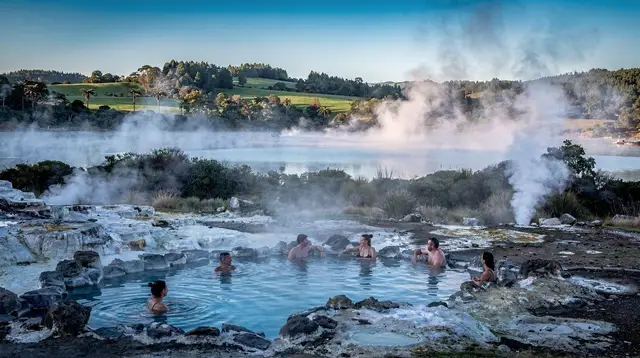
Before 1886, a pair of silica staircases descended into a lake at the foot of Mount Tarawera: the Pink Terrace, used for bathing, and the larger White Terrace, both built up over centuries by mineral-rich geothermal water flowing down the slope and hardening into wide, shallow, pale terraces of natural pools. This is the same geology that still produces places like Wai-O-Tapu today — silica sinter deposited by hot spring water, just on a scale and with a symmetry that made it internationally famous rather than merely notable. From the 1870s, they were the reason wealthy tourists made the long trip to this part of the world at all, decades before most of the planet’s landmarks were reachable by ordinary travellers.
Guidebooks and painters called them the eighth wonder of the world, and for a certain kind of Victorian visitor, that was not an exaggeration — there was very little else like it to compare it to.
The Night Tarawera Opened
Mount Tarawera had been considered dormant. On 10 June 1886 it split open along a line of craters and erupted for several hours, throwing out ash, mud and rock across the surrounding district. More than a hundred people died, most of them in the villages nearest the mountain, including Te Wairoa, which was buried under ash and mud and never resettled. The eruption also reshaped the landscape around the lake where the terraces stood: craters opened, the lake basin changed, and to the south a new geothermal system was born that same night — what is now Waimangu Volcanic Valley, the only geothermal system on Earth with a known birthdate. When the immediate area was surveyed afterwards, the terraces were gone. What exactly “gone” meant — destroyed, buried, or submerged — is the question that has never been fully settled.
a guided day covering Mount Tarawera and the Waimangu Volcanic Valley it created is the closest way to see the aftermath of that night in one trip, walking the crater rim and the valley the eruption formed rather than the terraces themselves.
Buried, Not Vanished — The Search Beneath the Lake
For well over a century, the working assumption was straightforward: the terraces had been destroyed in the blast, full stop. That started to shift when researchers began treating the adjoining lake, reshaped and enlarged by the eruption, as a possible resting place for at least part of the structures rather than a site where they had simply been vaporised. If the eruption had dropped ash and debris over the terraces and the lake had then risen and expanded to cover the lower slope, remnants could in theory sit submerged rather than obliterated. That reframing is what sent survey teams out onto the water with sonar equipment rather than shovels.
What a Lake Floor Survey Actually Showed
A scientific team working on the lake floor in the early 2010s used sonar mapping and identified terrace-like rock formations beneath the surface, and the find was widely reported as the rediscovery of the Pink and White Terraces. It reignited public interest in a story most people only knew from museum paintings. But it did not end the argument — it restarted it. Other geologists who reviewed the same data and returned to survey the area disputed both the identification of the formations as terrace remnants and the proposed location relative to historical maps and photographs of the original site, arguing that natural lake-floor terracing can look similar without being the same structure at all. Neither side has produced something that would let you point a boat at a spot and say “there they are” with total confidence.
The Debate That Still Runs
What I find genuinely interesting about this, rather than just sad, is that it is a live scientific disagreement, not a settled mystery with one dissenting crank. It touches on old survey maps and paintings that disagree with each other on exact positions, on how much the eruption changed the lake’s shoreline and depth, and on how confidently you can identify a buried silica structure from sonar imagery alone. It also sits on land and water that matters to Te Arawa well beyond the tourism story, which is part of why there is no rush to bring in heavy excavation equipment to settle the question by force.
Standing Where They Used to Be
You cannot walk up the Pink and White Terraces today, and I’d be cautious of anything that implies otherwise. What you can do is see the landscape the same eruption produced, which is arguably just as strange: Frying Pan Lake and Inferno Crater in the valley the 1886 eruption opened, the excavated foundations at Te Wairoa, and the crater scar across the top of Tarawera itself on a guided walk up the mountain. For the wider geothermal picture that explains why any of this was possible in the first place, it’s worth reading about why Rotorua is geothermal at all and, further back, about Te Arawa’s history in this exact stretch of country.
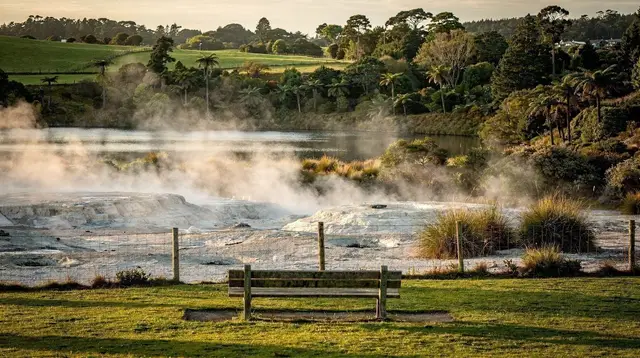
a half-day trip to Wai-O-Tapu shows you the same silica-terrace geology still forming today, at a scale you can walk right up to, which is about as close as you’ll get to picturing what the originals looked like in colour.
If you’d rather stay closer to town, the museum in the Government Gardens covers the eruption and the terraces in more depth than any roadside sign will, and it’s a sensible stop before or after a day out at the craters. For a broader look at the region’s thermal sites in general, the Blue and Green Lakes and Lake Tarawera both sit within the same eruption zone and are worth pairing with a Waimangu or Te Wairoa visit if you have a full day free.
an afternoon geothermal tour is a lighter option if a full day on the volcano isn’t what you’re after, and it still gets you into the same active thermal ground the 1886 eruption reshaped.
Questions I Get About the Pink and White Terraces
Where were the Pink and White Terraces?
They sat on the shores of a lake at the base of Mount Tarawera, southeast of Rotorua, in what is now the Tarawera and Waimangu area. The lake itself changed shape in the 1886 eruption, which is part of why relocating the terraces has been so difficult.
Can I visit the site of the Pink and White Terraces today?
You can visit the area, including the buried village of Te Wairoa and the volcanic valley that the eruption created, but there is no terrace to walk up to. Access to Mount Tarawera itself is only by guided walk, since the mountain belongs to the local iwi.
Were the terraces really destroyed, or just buried?
Both descriptions are used, and that is part of the disagreement. The eruption blew apart the immediate area and reshaped the lake, so some researchers argue the terraces were destroyed outright, while others argue sections were buried or submerged rather than obliterated.
What did the sonar surveys of the lake actually find?
Mapping work on the lake floor has identified terrace-like rock formations, which some scientists interpreted as remnants of the original terraces. Other geologists have disputed both the identification and the proposed location, arguing the features are natural lake-floor terracing rather than the historic silica structures.
Why did people call them the eighth wonder of the world?
In the second half of the 1800s they were the single biggest reason wealthy travellers came to this part of the world, before easy travel to most of the planet’s other landmarks existed. Painters, photographers and colonial guidebooks all promoted them under that title, and it stuck.
How many people died in the eruption that destroyed them?
The Tarawera eruption of 10 June 1886 killed more than a hundred people, most of them in villages around the mountain and lake, including the settlement of Te Wairoa. It remains the deadliest eruption in New Zealand’s recorded history.
Is there any chance the terraces could ever be rebuilt or uncovered?
There is no active plan to excavate or reconstruct them. The site is geologically unstable, culturally significant to Te Arawa, and the disputed location itself is still being argued over, so any large-scale dig is a long way from happening.
Seasonal experiences on GetYourGuide
Verified deep-linked GetYourGuide tours. Book through these links and we earn a small commission at no cost to you.
Photos show the destination, not the operator's own images.