The Arrival of Te Arawa: How Rotorua Was Settled
Who were Te Arawa and how did they come to settle around Rotorua?
Te Arawa were the crew of the Te Arawa waka (canoe), captained by Tama-te-kapua, who made landfall on the Bay of Plenty coast and whose descendants moved inland to settle the lakes around Rotorua. Their guiding tohunga, Ngātoroirangi, is credited in tradition with bringing the geothermal fire that still defines the region. Their descendants, organised today as Ngāti Whakaue, Tūhourangi, and other Te Arawa hapū, continue to hold and manage much of the thermal land around the lake.
A canoe, a coastline, and a name that stuck
Every place name around Rotorua carries a story, and most of those stories lead back to a single voyage. Te Arawa is both the name of an ancestral waka (ocean-going canoe) and the name of the confederation of iwi and hapū who trace their descent from the people who sailed on it. According to Te Arawa tradition, the waka made landfall on the Bay of Plenty coast, generally dated by iwi historians to somewhere around the fourteenth century, under its captain Tama-te-kapua. From that beach the crew’s descendants moved inland over generations, following river valleys and lake systems until they reached the crater lake that would become Lake Rotorua.
This is not a myth kept in a museum case. It is the working history that still organises land, marae membership, and speaking rights around the lake today. When a Te Arawa host stands to welcome visitors at Whakarewarewa Village or Te Puia, the whakapapa (genealogy) they draw on connects, in living memory, back to that same canoe.
Ngātoroirangi and the fire under the ground
Alongside Tama-te-kapua, Te Arawa tradition gives equal weight to Ngātoroirangi, the tohunga (priest-navigator) who guided the waka. After landing, Ngātoroirangi is said to have travelled inland exploring the new country, eventually climbing into the mountains near what is now Tongariro National Park. Caught by cold on the exposed tops, he called on his sisters back in Hawaiki to send him warmth. Fire travelled to him underground, the story goes, surfacing at points along the way — which is why, in Te Arawa telling, the volcanic and geothermal features stretching from the central plateau north through Rotorua and on toward the coast exist at all.
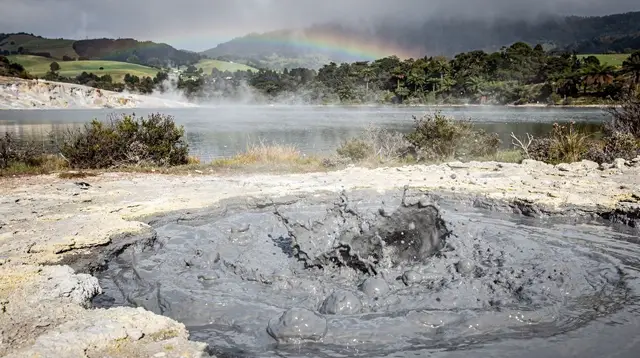
It is worth sitting with what this account actually explains, because it lines up strikingly with the geological reality. The fire’s underground path corresponds, more or less, to the line of active volcanism that geologists call the Taupō Volcanic Zone, running from the central mountains up through Rotorua’s lakes and craters to Whakaari/White Island offshore. Two explanations, one origin story and one plate-tectonics account, describe the same steaming ground. For Te Arawa, the geothermal features around Rotorua are not simply scenery or a curiosity of geology; they are physical evidence of an ancestor’s actions, which is a large part of why the land carrying them has never been treated as ordinary real estate.
Settling the lake: from waka crew to lake-edge hapū
Arrival on the coast was only the beginning. Over the generations that followed, descendants of the original Te Arawa crew spread out from the Bay of Plenty and established themselves inland, around Lake Rotorua and the smaller lakes nearby. Different lines of descent settled different stretches of shoreline, and over time these groups took on their own hapū identities while remaining part of the wider Te Arawa confederation.
Ngāti Whakaue became closely associated with the western side of Lake Rotorua, including the lakeside village of Ōhinemutu, still an active Ngāti Whakaue community today, with its meeting house and the church of St Faith’s standing right at the water’s edge. Tūhourangi, and in particular the hapū Ngāti Wāhiao, settled further south around the geothermal valley now known as Whakarewarewa and, in the nineteenth century, the village of Te Wairoa near Lake Tarawera. Other Te Arawa hapū took up positions around Lake Rotoiti and further afield, each with its own marae, its own stretch of shoreline to fish and gather from, and its own particular claim to a piece of the wider Te Arawa story.
What ties these separate settlements together is not proximity but genealogy. A Te Arawa hapū based at one end of the lake can trace a direct line back to the same waka as a hapū at the other end, even where the two groups have quite different local histories, resources, and relationships to specific thermal sites. This is the structure worth understanding before visiting: “Te Arawa” is not a single village or a single chief, but a network of related communities who share an origin and, in many cases, still work together on decisions about the land.
Living beside a smoking lake
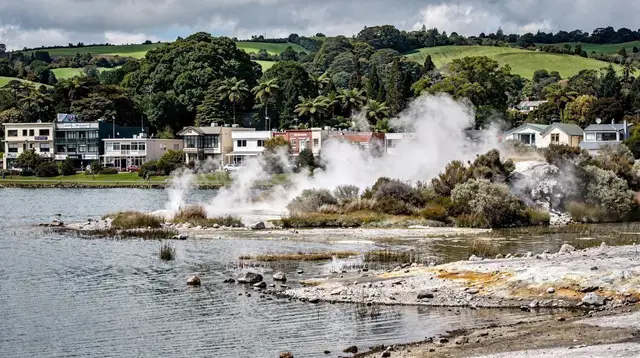
Settling around Rotorua meant settling on top of one of the most geothermally active landscapes in the world, and Te Arawa hapū built their daily lives around that fact rather than in spite of it. Steam vents and hot pools were put to immediate, practical use: cooking food in steam boxes and earth ovens, heating water for washing, warming sleeping houses in winter. This is the origin of the hāngī tradition as it is practised in Rotorua specifically — a food that elsewhere in the country is cooked with heated stones in an earth pit is, here, often steamed directly with geothermal heat, because the heat is simply present in the ground. Readers curious about how that works in practice, and where to try one, can find more detail in the guide to hāngī and where to eat one.
This working relationship with thermal ground is still visible today at Whakarewarewa Village, where Tūhourangi Ngāti Wāhiao families continue to live, using geothermal steam boxes for everyday cooking alongside hosting visitors through the valley. It is a genuinely different model from a heritage site interpreted after the fact: people are not re-enacting how their ancestors lived on this ground, they are still doing it. The neighbouring institution of Te Puia, home to the New Zealand Māori Arts and Crafts Institute and to the Pōhutu geyser, sits on the same valley and shares much of the same Tūhourangi and wider Te Arawa connection, though it operates with a different focus, on carving, weaving, and performance training.
Visitors weighing up the two are usually better served comparing them directly in the guide to Te Puia versus Whakarewarewa Village than picking blind.
a shared half-day itinerary that pairs a Te Arawa cultural visit with time in the wider geothermal valley is one way to see both the living village and the institute context in a single outing, with local guides drawing the connections between the two rather than leaving visitors to work it out from a signboard.
Why the boiling ground stays under iwi guardianship
Land ownership around Rotorua’s thermal features has followed a genuinely unusual path compared with most of the country. Much of the Whakarewarewa valley and other geothermal reserves were never fully sold or alienated from the Te Arawa hapū who held them, even through the nineteenth-century decades when large tracts of Māori land elsewhere in New Zealand passed out of iwi hands. Where land was taken or lost through Crown action, Treaty of Waitangi settlement processes in recent decades have returned ownership, co-governance rights, or formal recognition of mana whenua status to Te Arawa hapū over specific geothermal areas.
The practical effect is that access to many of Rotorua’s best-known thermal sites runs through hapū authority rather than through a purely commercial operator with no local tie. At Whakarewarewa Village, the residents themselves set the terms on which visitors move through the valley. At Te Puia, the institute operates under Te Arawa governance with an explicit mandate to train and employ young Māori in traditional arts. Even sites without a resident population, such as the geothermal reserve at Wai-O-Tapu or the volcanic history preserved at Waimangu Volcanic Valley, sit within a landscape where iwi interests and, in some cases, iwi ownership shape how the land is managed and interpreted for visitors.
This guardianship extends to places that are not open at all. Lake Rotokākahi, known in English as the Green Lake, is tapu to the hapū who hold it and is closed to swimming, boating, and fishing; it can be viewed from the road but not entered. Access to the summit of Mount Tarawera is similarly controlled: the mountain belongs to the iwi, and reaching the crater rim is only possible on a guided tour operating with hapū permission, not as an independent walk-in. These restrictions are not tourism rules imposed from outside; they follow directly from the same lines of descent and land connection that run back to the original Te Arawa settlement of the lake.
1886: when the thermal ground turned violent
For most of Te Arawa’s history, the geothermal land has been generous — a source of heat, food, and identity. On 10 June 1886, it also proved catastrophic. The eruption of Mount Tarawera destroyed the village of Te Wairoa, took more than a hundred lives, and buried the Pink and White Terraces, silica formations that had drawn visitors from around the world in the decades before. The disaster fell most heavily on Tūhourangi, whose village Te Wairoa stood closest to the mountain.
The site of that buried village is preserved today and can be visited at Te Wairoa Buried Village, with excavated building foundations giving a direct sense of what the eruption did to an ordinary lakeside community rather than an abstract account of ash and casualties. The wider story of the eruption and of the Terraces themselves — long assumed destroyed, and the subject of ongoing debate about what, if anything, survives beneath the crater lake — is covered in more depth in the blog posts on the 1886 Tarawera eruption and on the lost Pink and White Terraces. Tūhourangi families who survived the eruption resettled, and their descendants remain connected to both Te Wairoa and Whakarewarewa today; the 1886 disaster is part of hapū memory, not a closed historical chapter.
a walk-through visit of the excavated village site with its own museum on the eruption is the most direct way to connect the 1886 story to a specific place rather than reading about it secondhand.
Seeing Te Arawa history on the ground today
Understanding the Te Arawa settlement story changes what a visit to Rotorua’s geothermal sites actually is. This is not a natural park with some added local colour; it is inhabited ancestral land, with a documented and still-living connection between specific hapū and specific springs, valleys, and lakeshores. A short stop at Ōhinemutu makes this concrete: the meeting house and church stand in an active residential community, not a reconstructed exhibit, and the carved figures and the etched Christ window at St Faith’s carry genealogical meaning for the Ngāti Whakaue families who worship and live there.
For visitors arriving by cruise ship into Tauranga, a shore excursion built around Te Puia offers a fairly efficient way to reach this history within a single port day. a day trip from the Tauranga cruise terminal that includes entry to the Te Puia geothermal and arts complex covers Pōhutu geyser, the carving and weaving schools, and a cultural performance without requiring an overnight stay in Rotorua.
Travellers with more time and an interest in the landscape itself, rather than only the performance side of Te Arawa culture, might combine a cultural stop with a broader look at the geothermal valley. an afternoon tour that moves through the geothermal valley with an eye on the natural and cultural landscape together is one option for pairing the two without a full day’s commitment.
For basic grounding before any of these visits — how to behave on entering a marae, what a hongi is, when photography is and is not appropriate — the guide to Māori cultural etiquette in Rotorua is worth ten minutes’ reading. It is also useful to have a sense of the haka before seeing one performed live; the guide on what the haka means explains that it is not a single generic war dance but a category of ceremonial performance with several distinct forms and purposes. Visitors weighing up which cultural experience suits their time and interests can compare the main options directly in Rotorua’s Māori cultural experiences compared, and the broader category of Māori culture activities lists the full current range.
The confederation today
Te Arawa did not stop being a living confederation when the Treaty settlements were signed or when the first tour bus arrived in the Whakarewarewa valley. The hapū that trace descent from Tama-te-kapua’s crew still hold their own marae, elect their own representatives, and negotiate their own arrangements over land and thermal resources, both with each other and with the Crown. What a visitor sees at Te Puia, at Whakarewarewa Village, or standing on the shore of Rotokākahi is not a memorial to a finished history but a currently operating one — a settlement pattern laid down over centuries around a lake that has never stopped steaming, by descendants of the people who arrived by canoe and chose, in the face of all that ground had to offer and threaten, to stay.
Museum & art tours on GetYourGuide
Verified deep-linked GetYourGuide tours. Book through these links and we earn a small commission at no cost to you.
Photos show the destination, not the operator's own images.