Rotorua Museum and the Government Gardens
Is Rotorua Museum open?
The Bath House building has been closed since 2016 for seismic strengthening and is reopening in stages, so parts of the museum's collection are not currently on public display inside it. The Government Gardens that surround the building remain open every day, free of charge, with no restrictions on walking through them.
A Tudor Bathhouse on a Volcanic Lakeshore
Walk down toward the lake in central Rotorua and the building that stops people is impossible to miss: a mock-Tudor pile of dark timber beams and white plaster, sitting square in the middle of a formal park, looking like it has been airlifted in from an English spa town. That is the Bath House, opened in 1908 in the Government Gardens, and for most of the twentieth century it was the building Rotorua was known for.
It makes sense once you remember what put Rotorua on the map in the first place. This is a town that grew up around geothermal water — the same steam vents and mineral pools that still crack the pavements today drew visitors here from the 1880s onward, decades before “wellness tourism” was a phrase anyone used. The Bath House was built as the civic centrepiece of that era: a purpose-built bathing establishment where visitors could take the mineral waters under a roof, in a park laid out with the same manicured seriousness as a European spa town. It has carried the Rotorua Museum’s collection for decades since, telling the story of the town, the Te Arawa people who are its hosts, and the geothermal ground it sits on.
None of that history is visible in the same way today, and that is the point of this guide. Since 2016 the Bath House has been closed to the public for seismic strengthening, and it has been reopening in careful stages rather than all at once. If you are planning a Rotorua trip around visiting “the museum,” it is worth understanding exactly what that means before you build a day around it.
2016: Why the Building Closed
The short version is straightforward. Engineering assessments carried out in 2016 found that the century-old building did not meet the seismic standards New Zealand now requires for a public building of its size and the numbers of people who pass through it. Rather than keep operating a building flagged as below standard, the museum closed the Bath House to the public while strengthening work was carried out.
That kind of closure is not unusual in New Zealand, where building codes were tightened after a string of damaging earthquakes elsewhere in the country made seismic risk in older masonry and timber-frame buildings a national priority. A 1908 structure, built long before modern seismic engineering existed, was always going to need this kind of review eventually. What made it disruptive for Rotorua is that the Bath House is not a minor annex — it is the whole building the town’s main museum lives inside.
Strengthening a heritage building like this is slow, deliberate work. It has to happen without destroying the timber framing, plasterwork and layout that make the building worth protecting in the first place, and it has to be sequenced so that sections can reopen without waiting for the entire building to be finished at once. That is why the museum has come back into use section by section rather than reopening on a single date, and why the honest answer to “is it open” keeps changing depending on when you ask.
What “Reopening in Stages” Means for a Visitor
This is the part worth being clear-eyed about before you plan around it. A staged reopening means some parts of the Bath House may be accessible to the public while others remain closed for ongoing work, and which is which shifts over time as the strengthening project moves through different areas of the building. There is no way to guarantee, months or weeks in advance, that a specific gallery or the specific display you have read about elsewhere will be open on the day you arrive.
Practically, that means two things. First, do not build a tight day-trip itinerary around a fixed idea of “seeing the museum” the way you might for a place with predictable, unchanging opening hours — check the museum’s own website or call ahead close to your visit date, since guidebooks (this one included) cannot track a status that changes as building work progresses. Second, treat any part of the Bath House that is open as a bonus layered onto a Government Gardens visit, rather than the other way around. The gardens themselves are not affected by any of this and are worth the walk regardless of what is or is not accessible inside the building on a given day.
If you are specifically interested in Te Arawa history, geothermal science, or the Tarawera eruption of 1886 that reshaped this whole region, it is worth knowing that Rotorua tells those stories in more than one place. Te Puia and Whakarewarewa Village both cover Te Arawa culture and craft in settings that are fully open, and the buried village of Te Wairoa is built entirely around the 1886 eruption story, with excavated remains you can walk through outdoors regardless of what is happening at the Bath House.
The Government Gardens Themselves
Set the museum building aside for a moment, because the park around it is a destination on its own and it never closes. The Government Gardens are formally laid out in the Victorian and Edwardian style — trimmed lawns, rose beds, croquet-green geometry — which is a deliberate contrast with the loose, forested feel of most of Rotorua’s other green spaces. It sits directly on the shore of Lake Rotorua, so the walk along the water’s edge is part of the appeal even before you reach the Bath House facade.
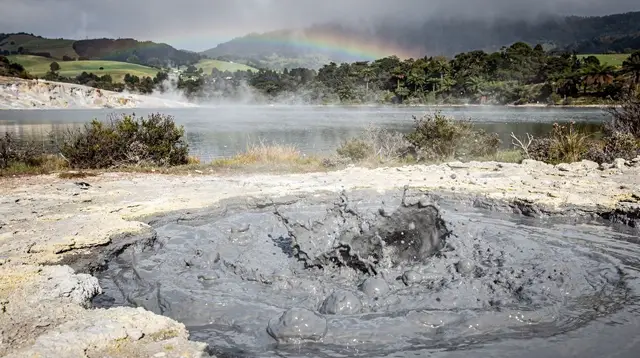
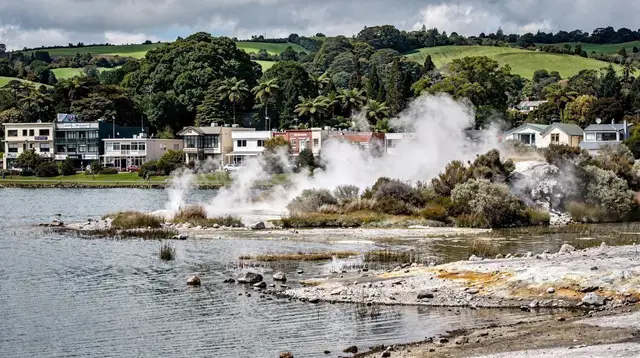
There is also steam here, because there is steam everywhere in this town: small geothermal features surface within the gardens themselves, a reminder that the whole area sits on the same active ground as Kuirau Park and the thermal valleys further out of town. It is one of the more approachable ways to see Rotorua’s geothermal character up close without booking anything or paying an entry fee — you are simply walking through a public park that happens to sit on a caldera.
The gardens are flat, paved in the main thoroughfares, and easy to cover on foot in well under an hour even at a slow pace, which makes them a reasonable stop to fold into a wider walk around the lakefront and into town. If you are short on time in Rotorua and want to know what is worth doing without spending money, this is one of the more reliable entries on that list — see our broader roundup of free things to do in Rotorua for others in the same category.
What’s Within Walking Distance
The Government Gardens sit close enough to several other Rotorua landmarks that it is worth treating this whole stretch of lakefront as one outing rather than a single stop. Heading around the lake edge brings you to Ohinemutu, the Ngāti Whakaue village built directly into the town, where St Faith’s Church has a well-known engraving of Christ etched into a window pane so that the figure appears to stand against the lake outside. It is a working village, not a museum piece, and it is a short, flat walk from the gardens.
In the other direction, central Rotorua’s main street, Tutanekai Street, is close enough to reach on foot for lunch or coffee before or after a Government Gardens visit. If you are looking to fill out a half day that combines the gardens with something more active, a couple of options sit nearby without requiring a car: a scenic horse trek through the wider Rotorua countryside is one way to see more of the landscape at a slower pace — a scenic horse trek around Rotorua covers exactly that — and for something lower-key and family-friendly close to town, a mini golf outing in Rotorua is an easy way to fill an hour that does not depend on the museum’s opening status at all.
Arts and Culture Elsewhere While the Bath House Rebuilds
Because the Bath House’s own exhibition space is only partly available, it is worth widening the lens if art and Māori craft are what drew you to this guide in the first place. Rotorua’s living Māori arts scene is centred at Te Puia, where carving and weaving are taught and practised daily rather than displayed behind glass, and our dedicated guide to Māori arts and crafts in Rotorua covers where to see that work being made. For a broader sense of how Rotorua’s cultural experiences compare to one another, the roundup of Rotorua’s Māori cultural experiences compared is a useful starting point before you book anything.
If you want a change of pace that leans toward craft rather than history, the wider region beyond Rotorua also has options worth knowing about. Over on the Coromandel Peninsula, a wheel-throwing pottery class is a hands-on alternative for a rainy afternoon, and further afield near Tauranga, a tour of the Bay of Plenty’s Te Puna sculpture park and historic village gives a different angle on regional art and heritage if your route takes you that way. Neither substitutes for the Bath House’s own collection, but both are reasonable ways to scratch the same itch while its galleries come back online in stages.
Planning Around an Uncertain Reopening
If the Bath House’s museum displays matter to your trip specifically, the most useful thing you can do is check status close to your travel dates rather than relying on anything written months in advance, this guide included. Museum websites and phone lines are more current than any travel article can be for a building whose accessible sections are still changing.
It is also worth deciding, honestly, how central this needs to be to your Rotorua plans. Compared with the town’s geothermal parks, its Māori cultural experiences, and its lake activities, the Bath House museum is a smaller and currently less predictable part of a Rotorua visit. Our Rotorua honest verdict and how many days in Rotorua guides both take a similarly unvarnished approach to what is and is not worth prioritising, and neither treats the museum as essential — worth reading if you are trying to build a realistic itinerary rather than a wish list.
For a first full day that still makes room for a Government Gardens stop without depending on the museum, our Rotorua 2-day itinerary folds the lakefront walk in alongside the geothermal and cultural sites that are reliably open year-round. And if the weather turns while you are in town, our Rotorua rainy day activities guide covers indoor options that do not depend on a building still under strengthening work.
Getting There Without a Car
The Government Gardens sit close enough to central Rotorua that a car is not necessary to reach them. If you are staying anywhere near town and are relying on buses or walking for the rest of your trip, our guide to getting around Rotorua without a car covers how realistic that is for the town’s other attractions as well, most of which sit further out than the gardens do.
For visitors arriving on a cruise ship day trip through Tauranga, a Government Gardens stop is an easy way to spend part of a short window in Rotorua without a long drive eating into your time — see our cruise ship day in Rotorua from Tauranga guide for how to structure that kind of tight schedule, and if you have a spare afternoon on the same trip, an eco thermal afternoon tour pairs a geothermal stop with a shorter time commitment than a full day out.
The Bottom Line
The Bath House is one of Rotorua’s most photographed buildings and it has earned that status honestly — a genuine piece of the town’s spa-tourism history sitting inside a formal park on the edge of an active volcanic lake. What it is not, right now, is a guaranteed full-day museum visit. It has been closed for seismic strengthening since 2016 and has come back into use in stages since, which means the honest way to plan around it is to treat a visit to the Government Gardens as the reliable part of the day, and whatever section of the museum happens to be open as a welcome extra on top — confirmed with the museum directly, not assumed from anything you read in advance.
Museum & art tours on GetYourGuide
Verified deep-linked GetYourGuide tours. Book through these links and we earn a small commission at no cost to you.
Photos show the destination, not the operator's own images.