A geothermal valley with a birth certificate
Every geothermal feature around Rotorua sits on ground that has been steaming, bubbling and shifting for thousands of years, usually with no exact starting point anyone can name. Waimangu is the exception. This valley did not exist before the morning of 10 June 1886, when Mount Tarawera tore open along a 17 km rift and threw out enough ash, mud and rock to bury villages and kill more than a hundred people. Waimangu formed inside the blast zone in the years that followed, as the shattered ground settled into craters, hot lakes and steaming terraces. That makes it, as far as anyone can document, the only geothermal system on Earth with a known date of birth.
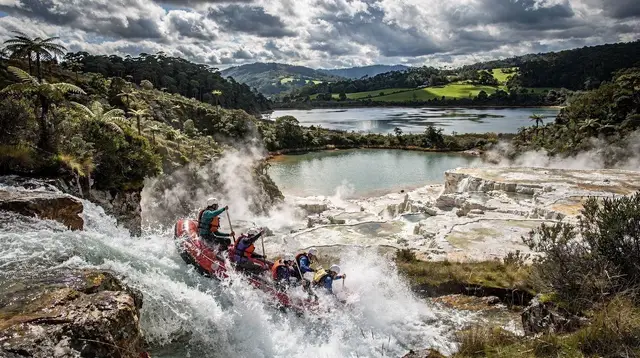
The name itself is descriptive rather than decorative: Waimangu means black water, a reference to the dark, ash-laden geyser that once erupted here in the early 1900s (it is now dormant, one of several features that have changed since the valley first opened to visitors). What has not changed is the basic shape of the visit. Unlike Wai-O-Tapu or Te Puia, where you walk a loop and end up back at the car park, Waimangu is arranged as a single descending track. You start near the crater rim and walk downhill for roughly an hour and a half to two hours, finishing at the shore of Lake Rotomahana, where a shuttle bus (included in most tickets) brings you back up to the entrance. Many visitors extend the day with a boat cruise on the lake itself, which is the section of the visit unique to Waimangu among Rotorua’s geothermal parks.
It is also, by most accounts, the least crowded of the well-known thermal areas in the region. That is partly geography: it sits a little further off the main tourist run than Te Puia or Whakarewarewa Village in town, and partly the format, since a one-way walking valley naturally spreads visitors out rather than funnelling them along a single loop past a handful of headline features.
The 1886 Tarawera eruption
To understand what you are looking at in Waimangu, it helps to know what happened immediately before it existed. On the night of 9 to 10 June 1886, Tarawera erupted along its full length, opening three craters and sending a column of ash and debris high into the sky. The eruption destroyed the village of Te Wairoa, now preserved as the buried village, and it destroyed the Pink and White Terraces, a pair of silica formations on the shores of what was then a much smaller Lake Rotomahana. The terraces had been one of the most visited natural attractions in the country before the eruption; they were gone within hours, and the basin that held them was reshaped into the far larger lake that exists today.
Waimangu Valley was born directly out of that violence. In the years after 1886, geothermal activity concentrated in this new rift, and by the early twentieth century it had become active enough to draw visitors of its own, including a geyser (the Waimangu Geyser) that was, for a short period, the largest known geyser in the world before it fell dormant. The valley you walk through today is the current, still-changing state of that same system: features shift, some pools cool and others heat up, and the landscape is understood by scientists as a working record of how a geothermal field develops from a fresh volcanic wound into a mature landscape. For the eruption itself and its aftermath in more detail, see our piece on the Tarawera eruption of 1886 and on the Pink and White Terraces, which some expeditions have since tried to relocate beneath the lake.
Walking downhill: what the trail actually shows you
The main track runs about 4.3 km one-way from the visitor centre near the crater rim down to the boat jetty on Lake Rotomahana, losing altitude gradually rather than in one steep drop. Shorter turnaround points exist along the way for anyone who does not want to walk the full distance, and a shuttle bus operates from several points back up to the entrance, so you are not required to commit to the whole descent before deciding.
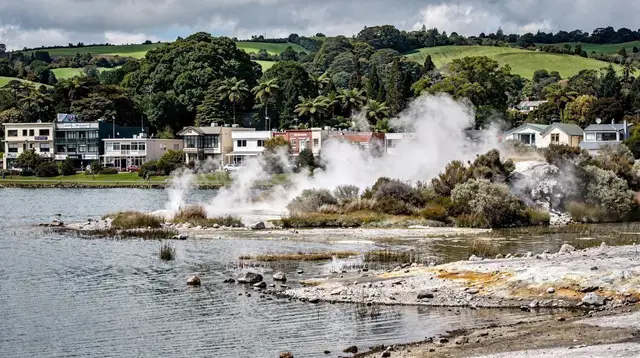
Two features anchor most people’s memory of the walk. Frying Pan Lake is usually described as the largest hot spring of its kind in the world, a wide, steaming, pale-blue-grey lake that sits in a crater formed by a 1917 eruption. Inferno Crater Lake is smaller but stranger: a near-perfectly circular crater lake whose water level and temperature rise and fall on a cycle of roughly five to six weeks, for reasons that are still not entirely settled among the geologists who study it. Along the rest of the track, expect a mix of steaming cliffs, silica terraces in various states of colour and mineral crust, native bush regrowing over disturbed ground, and boardwalks that keep you well clear of anything genuinely hazardous. Compared with Hell’s Gate, the activity here reads as quieter and more varied rather than concentrated into one or two dramatic set pieces.
Because this is a one-way walk rather than a loop, pace yourself with the return in mind: there is no version of the visit where you retrace your steps back up the valley, so plan around the shuttle timetable posted at the visitor centre rather than assuming you can simply walk back if you run late.
Lake Rotomahana and the boat cruise
The walk ends at Lake Rotomahana, the lake that grew dramatically larger during the 1886 eruption and now covers the site of the lost Pink and White Terraces somewhere beneath its surface. Most visitors finish here with an optional boat cruise, typically covering part of the lake’s steaming shoreline and its geothermally active bays before returning to the jetty for the shuttle back to the entrance. The cruise is the one experience in Waimangu that cannot be had on foot, and it is the reason many people budget half a day for what looks, from the outside, like a single geothermal park.
If you want that boat trip built into a single guided day rather than arranging tickets separately, Rotorua’s tour operators combine the walk and the cruise with nearby Wai-O-Tapu:
a guided day that pairs Wai-O-Tapu’s coloured pools with the walk and boat cruise at WaimanguFor a quieter way to see the steaming shoreline from water level, without the guided walking component, there is also a paddling option:
a kayak tour along Waimangu’s steaming cliffsWaimangu, Wai-O-Tapu and Hell’s Gate: how they differ
Rotorua visitors planning a single geothermal day often ask which park to choose, or whether it is worth doing more than one. The honest answer is that they are different enough in format that they do not really overlap.
| Feature | Waimangu Volcanic Valley | Wai-O-Tapu | Hell’s Gate |
|---|---|---|---|
| Format | One-way descending walk, ~4.3 km, shuttle back | Loop walk around a fixed circuit | Loop walk, most compact of the three |
| Signature feature | Frying Pan Lake, Inferno Crater, boat cruise on Lake Rotomahana | Champagne Pool, Devil’s Bath, Lady Knox Geyser (triggered each morning) | Most thermally active site; only one offering a mud bath soak |
| Distance from Rotorua | About 25 km south via SH5 | About 27 km south via SH5 | About 16 km north-east via SH30 |
| Crowd levels | Generally the quietest of the three | Busiest, especially around the Lady Knox trigger time | Moderate |
| Extra activity | Optional lake cruise or kayak | None beyond the walk | Mud bath immersion |
For a fuller breakdown of how all of Rotorua’s geothermal parks compare, including Te Puia and Whakarewarewa Village, see our guide to choosing between Rotorua’s geothermal parks and the separate Wai-O-Tapu visiting guide.
Getting there, tickets and timing
Waimangu sits south of Rotorua on State Highway 5, close to Wai-O-Tapu, which makes the two an easy pairing if you are driving yourself and have most of a day free. There is no public transport route direct to the valley, so a rental car, a private transfer, or a guided tour are the realistic options; see our general notes on getting around Rotorua without a car if you are travelling without your own vehicle.
Entry tickets cover the walk and the shuttle bus; the boat cruise on Lake Rotomahana is usually a separate add-on. Because opening hours, ticket structures and shuttle timetables are the kind of detail that changes with the season and with operational decisions at the site, check the current information directly with the operator or the Department of Conservation before you go rather than relying on a fixed schedule quoted elsewhere.
Allow at least two hours for the walk alone if you are moving at an easy pace and stopping to look at the features properly, and closer to four hours if you are adding the boat cruise. Combined with the drive from Rotorua, this comfortably fills a half day. Travellers building a longer geothermal-focused stop can also fold Waimangu into a two-day geothermal itinerary or a broader three-day Rotorua plan alongside Wai-O-Tapu and Hell’s Gate.
Best time to visit
Waimangu is open every day of the year, and there is no strict best season. Steam is generally more visible on cool, calm mornings, which points towards the cooler months from June to August, when Rotorua’s winter air makes any geothermal feature look more dramatic simply by contrast. Summer visits, by contrast, come with longer daylight and warmer temperatures for the walk itself, along with the strong UV that affects outdoor activity across the region in the December to February period, so sun protection matters even on a day that starts overcast.
Rain does not rule the valley out. The boardwalks are designed for wet conditions, and a light rain can make the steam plumes more visible rather than less. Because the walk is entirely outdoors and largely unshaded in the upper sections, check the forecast before you go and dress for whatever the day is doing rather than for what the season is supposed to be doing; New Zealand’s geothermal sites in particular tend to reward flexibility over a fixed plan.
Booking a tour to Waimangu
Several Rotorua operators run guided days that include Waimangu, usually paired with Wai-O-Tapu or with a wider geothermal itinerary, which suits travellers who would rather not manage tickets, the shuttle timetable and the drive themselves. A broader day option covering three sites in one trip looks like this:
a full day covering Wai-O-Tapu, Waimangu and Te PuiaFor travellers who want a shorter, more relaxed afternoon that touches on Rotorua’s geothermal side without committing a full day, there is also a lighter-format option:
a shorter eco thermal afternoon tourWhichever format you choose, Waimangu rewards unhurried walking more than most Rotorua attractions, precisely because the one-way layout removes the pressure to loop back before you have finished looking.
Waimangu Volcanic Valley: frequently asked questions
How long does the walk through Waimangu take?
Plan on roughly one and a half to two hours for the full 4.3 km one-way walk at an easy pace with stops. Shorter turnaround points exist for visitors who do not want to walk the whole distance, and a shuttle bus runs from several points back to the entrance.
Do I have to walk downhill and take a shuttle back?
Yes, that is the standard format. Waimangu is laid out as a single descending track rather than a loop, ending at Lake Rotomahana, and the return journey is by shuttle bus rather than by retracing the walk.
Is the boat cruise on Lake Rotomahana included in the entry ticket?
The cruise is generally sold as an add-on to the standard entry and walk, not automatically included. Check current ticket options with the operator before your visit, since pricing and combinations can change.
How does Waimangu compare to Wai-O-Tapu?
Wai-O-Tapu is a loop walk built around a handful of striking, colourful features, including the Lady Knox Geyser triggered each morning. Waimangu is a longer, one-way descending walk through a valley shaped by the 1886 Tarawera eruption, ending with an optional lake cruise; it is generally quieter than Wai-O-Tapu.
What happened to the Pink and White Terraces?
The Pink and White Terraces were destroyed in the Tarawera eruption of 10 June 1886, and the small lake they once sat beside was reshaped into the much larger Lake Rotomahana. Their remains are believed to lie somewhere beneath the current lake, though their exact condition remains a subject of ongoing investigation.
Is Waimangu suitable for wheelchairs or strollers?
Parts of the upper track and the visitor centre area are more accessible than the full one-way trail, which includes gradients and boardwalk sections. Contact the site directly for current accessibility details before planning a visit with mobility needs, since conditions can change with maintenance work.
What should I bring for a visit to Waimangu?
Sturdy, closed footwear, sun protection given the region’s strong UV even on overcast days, water, and rain-ready clothing regardless of season, since Rotorua sees rain throughout the year. A camera is worth having for Frying Pan Lake and Inferno Crater in particular.
Can I visit Waimangu and Wai-O-Tapu on the same day?
Yes, the two sites sit close together off State Highway 5 south of Rotorua, and several guided tours pair them into a single day. Doing both independently by car is also straightforward, though it makes for a full day once travel time and the walk itself are accounted for.