A Waterfall Built by a Squeeze, Not a Cliff
Most waterfalls happen because water drops. Huka Falls happens because water gets squeezed. The Waikato River — New Zealand’s longest, born out of Lake Taupō and eventually reaching the Tasman Sea on the far side of the North Island — flows out of the lake as a wide, unhurried channel. A few kilometres downstream, that channel narrows abruptly from around 100 metres to about 15 metres. The same volume of water that was ambling along the wide stretch is suddenly forced through a gap roughly a sixth as wide, and it has nowhere to go but through, fast.
The number usually quoted is about 220,000 litres per second in normal conditions, more after rain. That figure is easier to picture as scale than as a statistic: it is the entire volume of a large river being pushed through a gap you could walk across a footbridge in a few seconds. The height drop at the falls themselves is modest, only a few metres at the final ledge — this is not a tall waterfall in the way Cathedral Cove is a dramatic coastline. What makes Huka Falls worth the stop is the pressure, the noise, and the colour: the water comes out the far side an intense, milky turquoise-blue, a mix of dissolved minerals and trapped air bubbles that doesn’t photograph as an exaggeration — it really does look like that in person.
“Huka” is the Māori word for foam, which is a fairly literal description of what you’re looking at from the footbridge: a churn of white water forcing itself through rock, then flattening out downstream into the calmer, wide river that continues north past Taupō town toward Hamilton and, eventually, the sea near Port Waikato.
Getting There from Rotorua
Huka Falls sits a few kilometres north of Taupō town, just off State Highway 5, which is the same road that connects Rotorua to Taupō. In practice, if you’re driving from Rotorua to Taupō for any reason — the Tongariro Alpine Crossing, the lake, Craters of the Moon — Huka Falls is barely a detour, and most self-drive itineraries fold it in without extra driving time.
| From | Approximate driving time | Notes |
|---|---|---|
| Rotorua | ~1 hour | Direct via SH5, same route as Taupō town |
| Taupō town centre | 5–10 minutes | Huka Falls is just north of town |
| Tongariro (Mangatepopo end) | ~1 hour | Via Taupō and SH1/SH47 |
| Auckland | ~3.5 hours | Via SH1 through Hamilton and Taupō |
There’s a signposted car park with a viewing platform and footbridge right at the falls, and a longer riverside walking and cycling track (the Great Lake Trail’s Huka Falls section) that follows the Waikato River both upstream toward the lake outlet and downstream toward Huka Falls, past a smaller feature called Boulder Bend and the Huka Falls hydro intake. If you’re relying on public transport rather than a rental car, check current options under getting to Rotorua and general advice on driving in New Zealand before planning the Taupō leg, since Huka Falls itself has no direct bus service — most visitors reach it by car, tour, or on foot/bike from Taupō town.
Seeing It on Foot: Five Minutes, or an Hour
The free version of Huka Falls is genuinely free, in every sense — no ticket booth, no gate, no minimum spend. From the car park it’s a short, flat walk to the main footbridge, which crosses the gorge directly above the point of maximum squeeze. This is the classic photo spot: looking down at the turquoise water forcing itself under your feet, foam breaking against the rock walls on either side.
If five minutes at the footbridge is all the time you have, that’s a legitimate way to see Huka Falls — plenty of people driving between Rotorua and Taupō do exactly that. But the site rewards a slightly longer stop. Walking tracks run along both banks of the river, with a lookout a short distance downstream that gives a side-on view of the full ledge and churn, different from the straight-down perspective at the bridge. Further tracks connect toward the Huka Falls hydro intake structure and, in the other direction, back toward the Waikato River’s calmer stretch closer to the lake.
Budget 30 to 60 minutes to do the walk properly: footbridge, downstream lookout, and back. There’s minimal shade, so in summer the UV exposure is worth taking seriously even for a short walk — this is true generally around Taupō and Rotorua, not just here.
Seeing It by Jet Boat: The Same Water, From the Other Side
The on-foot view looks down into the gorge from above. The jet-boat view is the same water from underneath and in front of it — a very different experience of the same physical feature.
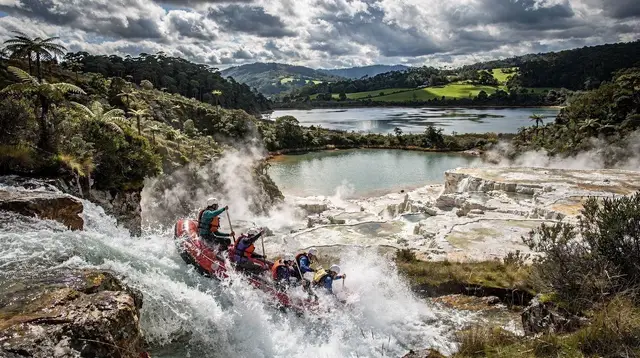
Jet-boat trips run on the calmer stretch of the Waikato River just below the falls, approaching to within a short distance of the base before turning back. From the boat, Huka Falls stops being a photograph you look down at and becomes a wall of moving water you’re facing directly, close enough that spray reaches the boat on a normal run. The rest of the trip typically covers a stretch of the river below the falls, often including some fast turns and a general sense of the river’s scale that the footbridge view doesn’t give you, since from above the water simply looks fast — from the boat, you feel the current’s force under the hull.
a full-day tour that combines Huka Falls with hot springs and the Hobbiton Movie Set is one way to see the falls without renting a car, particularly useful if Huka Falls is one stop among several you’d rather not self-drive between. For more detail on choosing between jet-boat operators and comparing them with other Taupō-area water activities, see the dedicated guide to Huka Falls and Taupō jet boats.
Seeing It From the Air
A third option skips the water entirely. Scenic flights and helicopter trips over the Taupō volcanic plateau typically pass over Huka Falls as one stop among several, alongside features like the Waikato River’s course toward the lake and, further south near Lake Taupō, the Māori rock carvings at Mine Bay — large contemporary carvings cut into a lakeside cliff face and reachable only by water or from the air.
a helicopter flight that passes over Huka Falls and the Māori rock carvings gives a view no ground-level visit can: from above, the gorge’s narrowing is obvious in a way it isn’t from the footbridge, where you only see the section directly beneath you. It’s also the option with the fewest crowds and the shortest total time commitment for what you see, though it comes at a different price point than the free walk or the jet boat. For a broader comparison of flight options around the region, see scenic flights compared.
Three Ways to See the Same 15 Metres
| Method | Time needed | Cost level | What it shows you |
|---|---|---|---|
| Footbridge and walking track | 30–60 minutes | Free | Straight-down view of the squeeze point; the classic photo |
| Jet boat | Around 30 minutes on the water, plus transfers | Mid-range | Face-on approach to the base of the falls, felt at river level |
| Scenic flight / helicopter | Short flight, often combined with other sights | Higher | Aerial view showing the full narrowing of the gorge |
None of the three replaces the others — they’re genuinely different vantage points on the same 15-metre gap, and the choice mostly comes down to time, budget, and whether being close to fast water appeals or doesn’t.
Combining Huka Falls With the Rest of the Taupō Area
Because Huka Falls takes so little time on its own, almost nobody treats it as a stand-alone destination. It sits naturally alongside a short list of other Taupō-area stops: Craters of the Moon, a geothermal walking area a few minutes away; Lake Taupō itself, with its cruises and the Mine Bay rock carvings; and, further south, the approach to Tongariro National Park for those continuing on to the Alpine Crossing or Ruapehu.
Coming from Rotorua, Huka Falls also fits into a longer loop that takes in Hobbiton Movie Set on the way back north, since Matamata sits roughly between Rotorua and the Waikato without much extra driving. a Hobbiton tour departing from Rotorua is a common way to pair the two if you’re not self-driving the whole loop, though it’s a separate excursion from a Huka Falls stop rather than a combined one on most operators’ schedules.
If your day is built more around Rotorua’s own geothermal parks with Taupō as a side trip, Wai-O-Tapu and Waimangu style combination tours cover a different part of the region entirely and are worth comparing against a Taupō-focused day before deciding where to spend limited time — the guide to Rotorua day trips to Taupō lays out the trade-offs.
For travellers who want adrenaline layered onto the same general area, Taupō is also the base for New Zealand’s most accessible bungy jumping and skydiving, both absent from Rotorua itself — see Taupō bungy and skydiving for what’s actually on offer and how it differs from Rotorua’s own adventure activities.
Practical Notes
Huka Falls has no entry fee, no opening hours in the strict sense — the footbridge and car park are accessible from early morning to evening light, though checking current signage on arrival is sensible since access details can change. There’s no swimming at the falls: the current through the gorge and the approach to it is fast and the rock underfoot is often wet and slippery, and this isn’t a spot where wading in is a reasonable idea at any water level. Toilets and a small amount of parking are available at the main site; in peak summer the car park can fill, particularly around the middle of the day, so an earlier or later visit avoids most of the congestion.
The walking tracks either side of the gorge are unshaded for long stretches, which matters more than it sounds given how strong UV exposure is in New Zealand summer — sunscreen and a hat are worth carrying even for a short visit. Because Huka Falls is a natural feature run by the Waikato River’s actual flow, conditions do shift: heavier rain upstream visibly increases the volume and noise within hours, and track conditions can change after storms. Checking current status through the operator or the Department of Conservation before a jet-boat trip in marginal weather is the sensible approach rather than assuming conditions match what’s described here.
Where Huka Falls Fits on a Wider Trip
On its own, Huka Falls is not a destination that needs a dedicated day. It earns its place on an itinerary as an efficient stop — high visual payoff for very little time spent — on routes that were already passing through the area. If you’re planning the wider drive south from Rotorua, the Rotorua–Taupō road trip itinerary places Huka Falls where it naturally sits in a multi-day loop, and travellers covering more of the North Island in one trip can see how it fits into a longer route via North Island highlights.
Whichever way you choose to see it — five minutes on the footbridge, thirty minutes face-on in a jet boat, or a few minutes from the air — the underlying fact stays the same: a very large river being forced through a very narrow gap, at a scale that’s easier to feel standing next to it than to describe in litres per second.