North Island Highlights: A 10-Day Road Trip from Auckland via Rotorua
Ten days is enough to link Auckland, Rotorua, Taupō and the Coromandel Peninsula without turning every morning into a long drive. The route below uses Rotorua as a base for four nights rather than a string of one-night stops, then moves in short hops — an hour here, an hour there — with only two longer transfers, at the very start and the very end. It suits a first trip to New Zealand’s North Island: geothermal country, Māori cultural experiences, Hobbiton, a national park crossing, and a beach finish, all reachable by car without chasing distance for its own sake.
Bring a driving licence valid in New Zealand, check entry requirements including the NZeTA before departure, and read up on driving on the left if this is your first visit. Budget figures below are rough guides only — actual costs vary by season and booking lead time.
Route at a Glance
| Nights | Base | Drive from previous stop |
|---|---|---|
| 1 | Waitomo | ~2 h from Auckland |
| 1 | Rotorua (via Hobbiton) | ~1 h Waitomo–Matamata, ~50 min Matamata–Rotorua |
| 4 | Rotorua | — |
| 2 | Taupō | ~1 h from Rotorua |
| 1 | Mount Maunganui / Tauranga | ~1 h 15 from Taupō area back via Rotorua, or direct |
| 1 | Coromandel Peninsula | ~2–3 h from Tauranga |
| — | Fly out of Auckland | ~2–2.5 h from Coromandel |
A mid-range budget for two people runs roughly 350 NZD per person per day once car hire, accommodation, food and a handful of paid activities are added up; a backpacker version can sit closer to 150 NZD, a top-end one near 700 NZD. Convert loosely at about 1.85 NZD per euro or 1.70 NZD per US dollar. New Zealand’s 15% GST is already included in every price you see.
Day 1 — Auckland to Waitomo
Pick up the rental car in Auckland and drive south, about two hours, to Waitomo. This is the longest single drive of the trip and it is over by lunchtime. Waitomo sits in the Waikato region and is known for limestone cave systems lit by glowworms — Arachnocampa luminosa, a carnivorous larva that hangs sticky threads and glows to lure insects. Spend the afternoon underground: a boat ride through the Waitomo Glowworm Caves is the classic option, while Ruakuri and Aranui caves and black water rafting trips go further into the system. See which Waitomo tour suits you before booking, and if you’d rather stay above ground, a guided e-bike ride through farmland and native bush near the caves is a lower-key alternative. Overnight in Waitomo village.
Day 2 — Waitomo to Rotorua via Hobbiton
Late morning, drive about an hour to Matamata for the Hobbiton Movie Set, built as a permanent set on the Alexander family’s working farm for the Lord of the Rings and Hobbit films — 44 hobbit holes and the Green Dragon Inn, all guided, no self-touring allowed. A guided walk through the movie set with a local guide covers the two to three hours needed to see it properly; read the complete Hobbiton guide for what to expect. From Matamata it’s under an hour to Rotorua — check in and use the evening to get oriented, maybe a walk around Lake Rotorua or the geothermal, free-to-enter Kuirau Park near the town centre.
Day 3 — Rotorua Geothermal and Māori Culture
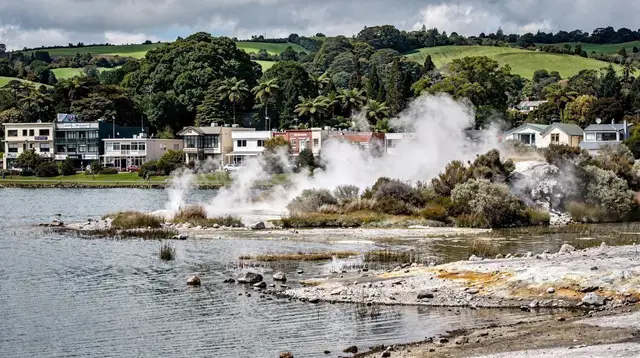
Rotorua sits inside the Taupō Volcanic Zone, which is why steam rises from drains and the air carries a faint sulphur smell — explained here if anyone asks. Spend the day at Te Puia, New Zealand’s national institute of Māori arts and crafts, where Pōhutu geyser — the most reliable in the Southern Hemisphere — erupts once or twice an hour. Te Puia sits alongside Whakarewarewa Village, a living village where Tūhourangi Ngāti Wāhiao residents still cook using geothermal steam; the two are complementary rather than duplicates, and the comparison guide explains why many visitors do both.
In the evening, a hāngī — food traditionally cooked in an earth oven, steam-heated here rather than fire-heated — paired with a cultural performance is worth booking; compare Rotorua’s cultural experiences to pick one that fits your evening.
Day 4 — Wai-O-Tapu and Waimangu
About 30 to 45 minutes south on State Highway 5, Wai-O-Tapu holds the Champagne Pool and the Devil’s Bath, plus the Lady Knox Geyser, triggered each morning with a surfactant rather than erupting naturally — check current timing before you go, since operating hours shift. Nearby, Waimangu Volcanic Valley is the only geothermal system anywhere with a known birth date: the 10 June 1886 eruption of Mount Tarawera. It’s walkable end to end past Frying Pan Lake and Inferno Crater. Compare both against Rotorua’s other geothermal parks in this overview before deciding how to split your day between them. Back in Rotorua by evening, soak tired legs — Rotorua’s hot pools range from commercial spas to free public soaks.
Day 5 — Redwoods and the Buried Village
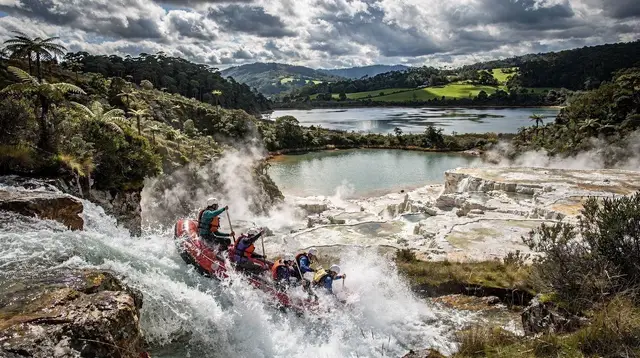
Morning at the Redwoods, Whakarewarewa Forest — Californian sequoias planted in 1901, now laced with mountain bike trails and a canopy walkway that runs day and night; see when to do the Treewalk for the difference between the daytime and lit night version. In the afternoon, drive out to Te Wairoa, the village buried by the 1886 Tarawera eruption that also destroyed the Pink and White Terraces — a quieter, more sobering stop than the geysers, and a chance to book a nearby buried village walking tour if you want a guided version of the site’s history. If adrenaline is more your speed than history, swap this for the Kaituna River, home to the highest commercially rafted waterfall in the world.
Day 6 — Rotorua to Taupō
Drive about an hour south to Taupō, on the shore of the country’s largest lake — a crater from a prehistoric super-eruption. Spend the afternoon at Huka Falls, where the Waikato River is forced through a gorge roughly 15 metres wide, and at Craters of the Moon, a geothermal walking area with a different feel to Rotorua’s parks. On the water, the Māori rock carvings at Mine Bay — carved into the cliffs in the late 1970s — are visible only by boat or kayak; a kayak trip out to the rock carvings is the quieter way to see them, or take a lakefront cruise instead.
See Rotorua to Taupō as a standalone day trip if you’re deciding whether an overnight stay is worth it — this itinerary says yes, mainly for the extra day it buys toward Tongariro.
Day 7 — Tongariro National Park
Tongariro National Park is New Zealand’s oldest national park and a dual UNESCO World Heritage site, listed for both natural and cultural values. The Tongariro Alpine Crossing — about 19.4 km, typically six to eight hours — is the main draw, weather and track conditions permitting; check with the Department of Conservation before committing, since alpine weather changes fast and the crossing closes without much notice. If the crossing isn’t open, or a full day on foot doesn’t suit everyone in the group, grade 3 rafting on the Tongariro River covers similar scenery from water level. Return to Taupō for the night.
Day 8 — Taupō to Mount Maunganui via Rotorua
Drive back through Rotorua (or take the more direct route, depending on road conditions) toward the coast, about an hour to ninety minutes to Mount Maunganui. Climb Mauao, the 232-metre volcanic cone the town is named for — about 45 minutes to the summit, with an easier base loop of roughly 3.4 km for anyone who’d rather skip the climb. The rest of the day is beach time on either side of the peninsula, plus dinner in Tauranga, the country’s largest port. If Hobbiton and Huka Falls both appealed but the schedule was tight, a combined Huka Falls, hot springs and Hobbiton day tour is worth knowing about for a future, shorter trip. See Rotorua to Tauranga as a day trip for the reverse version of today’s drive.
Day 9 — Coromandel Peninsula
The longest drive of the back half of the trip, roughly two to three hours depending on the route and stops, brings you onto the Coromandel Peninsula. Time the visit around low tide: at Hot Water Beach, you dig your own pool in the sand within about two hours either side of low tide, when geothermally heated water rises through the sand. Cathedral Cove — Te Whanganui-A-Hei — is reachable on foot or by kayak and is worth building the rest of the day around. Overnight somewhere on the peninsula rather than pushing on, since the roads here are narrow and slower than the highways used earlier in the trip.
Day 10 — Coromandel to Auckland
The final leg back to Auckland takes roughly two to two and a half hours depending on the exact route off the peninsula. Build in slack for the flight home or a last night near the airport rather than cutting it close — Coromandel’s roads are winding and slower than they look on a map. If there’s a spare hour, a stop in Hamilton or Cambridge on the way through breaks up the drive, though neither is essential to this route.
Adjusting This 10-Day North Island Route
Ten days is workable, not generous — every base above gets at least one full day rather than a single overnight, which is the point of routing through Rotorua as a hub instead of circling the whole North Island. Families might trade one Rotorua geothermal day for family-friendly activities, while anyone short on time can drop the Coromandel leg entirely and fly out from Tauranga or Hamilton instead of returning to Auckland by road. For the reverse question — what to cut if you only have three, five or seven days — see how many days you actually need in Rotorua. Whichever version you run, book accommodation in Rotorua and Taupō ahead in the summer months (December to February), when both towns fill up quickly.
Is 10 days enough for this North Island route?
Yes, for the destinations on this list. Ten days lets you stay two or more nights in most bases, so you are not packing and unpacking every morning. Adding the South Island would need a separate trip; the two islands do not connect by road.
Do I need to book a rental car in advance?
Booking ahead is worth it in summer (December to February), when demand is highest. New Zealand drives on the left, and most visitors are comfortable within a day or two — see the linked guide for specifics before you land.
Can this itinerary be done without a car?
Parts of it can, using shuttles and day tours out of Rotorua and Taupō, but the Coromandel leg and the flexibility to stop at Huka Falls or a random lake lookout depend on having your own vehicle.
Where should we base ourselves for the middle of the trip?
Rotorua. It sits within about an hour of Taupō and Tauranga and under an hour of Hobbiton, so it works as a hub rather than a one-night stop, which cuts down on repacking the car.
Is Hobbiton on the way between Waitomo and Rotorua?
Close enough. Matamata, where the Hobbiton Movie Set sits, adds only a short detour off the direct route and takes under an hour from central Rotorua.
What if the Tongariro Alpine Crossing is closed or the weather turns?
It is a mountain track and closes for wind, snow, or track work without much notice. Build in a buffer day around Taupō, and have Craters of the Moon or a Waikato River activity as a fallback — check conditions with the Department of Conservation before you commit.
Should Coromandel come at the start or the end of the trip?
This itinerary places it at the end, as the scenic way back to Auckland, since Hot Water Beach and Cathedral Cove are tide-dependent and easier to slot in once the rest of the plan is fixed.
tours.10 days
Verified deep-linked GetYourGuide tours. Book through these links and we earn a small commission at no cost to you.
Photos show the destination, not the operator's own images.