A Rotorua to Taupō Loop: Huka Falls, Craters of the Moon and Mine Bay
Can you do Rotorua to Taupo as a day trip?
Yes. Taupo is about an hour from Rotorua by SH5, so a full day gives comfortable time for Huka Falls, Craters of the Moon and a boat trip to see the Mine Bay rock carvings. Adding Orakei Korako on the return leg makes for a long but manageable day, roughly 9 to 10 hours door to door.
Taupo sits about an hour south of Rotorua on SH5, close enough that it works comfortably as a day trip rather than a separate base. The two towns share the same volcanic system — Taupo’s lake fills the crater of a vastly larger eruption than anything Rotorua produces — but the two sit far enough apart that a single loop can take in a genuinely different set of sights: a forced river gorge, a quiet steam field, rock carvings only visible from the water, and a geothermal valley reached by a short boat crossing on the way home.
This is a route built around driving yourself. It doesn’t require any single booking to hold the whole day together the way a guided tour does, but one piece — the boat out to see the Mine Bay carvings — does need to be arranged before or soon after you arrive in Taupo, since it runs on its own schedule rather than yours.
The route: down SH5, back a longer way
The direct drive from Rotorua to Taupo runs south on SH5, a sealed highway with no major climbs, passing through a stretch of pine forest and a couple of small settlements before the lake comes into view. At normal speeds, allow about an hour without stops. There’s little to see on this stretch itself — it’s a working transit road — so the point of the day is what waits at the far end and on the way back.
The loop described here treats the day as three phases: the drive down, a cluster of stops in and around Taupo itself, and a longer return leg via SH1 that swings past Orakei Korako before rejoining SH5 back into Rotorua. That return route adds some distance compared with driving straight back the way you came, but it turns a there-and-back errand into a proper loop with a fourth geothermal stop built in.
| Stage | Distance from Rotorua | Typical time on site |
|---|---|---|
| Huka Falls | ~1 hour | 20–40 minutes |
| Craters of the Moon | ~1 hour, 5 minutes further | 45–75 minutes |
| Taupo township | ~1 hour | 1–2 hours (lunch, waterfront) |
| Mine Bay carvings (by boat) | departs from Taupo | 1.5–2 hours round trip |
| Orakei Korako (return leg) | ~45 minutes back toward Rotorua | 75–100 minutes |
A day built around all five of these stops runs long — realistically nine to ten hours door to door once driving, parking and queuing are added in. Trimming Orakei Korako, or choosing between it and the boat cruise rather than doing both, brings the day back to a more relaxed seven or eight hours.
Huka Falls: the Waikato squeezed into a chute
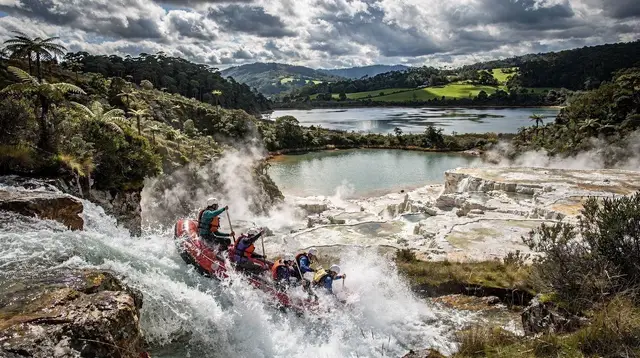
The first stop most people make is Huka Falls, where the Waikato River — New Zealand’s longest — narrows from a wide, slow riverbed into a hard rock channel only a few metres across. The volume of water doesn’t change; the width does, which is what gives the falls their force and their colour, an intense blue-green that comes from the sheer speed and aeration of the water rather than anything added to it. The drop itself is modest, around 11 metres, but the effect of that much river being forced through such a narrow gap is more dramatic in person than the numbers suggest.
A viewing bridge crosses the river right at the narrowest point, and a walking track along the bank gives a longer look from a different angle. There’s no entry fee and no booking needed; it’s a stop you can build around your own pace rather than a fixed timetable. Jet boats also operate close to the falls, running visitors up toward the base of the chute — worth knowing about if that kind of add-on interests you, covered in more detail in the guide to Huka Falls and Taupo jet boats.
Craters of the Moon: steam without the crowds
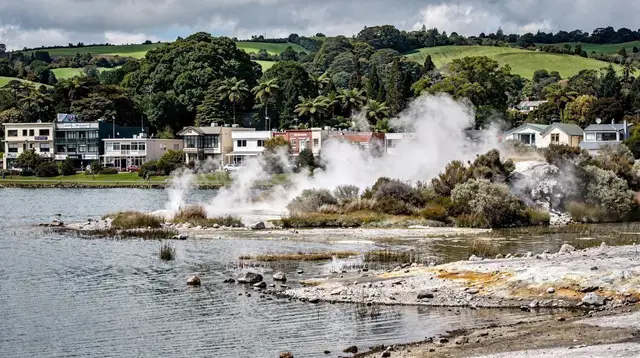
A short drive further toward Taupo brings you to Craters of the Moon, a geothermal field that gets a fraction of the visitor numbers of Rotorua’s bigger parks, largely because it has no coloured pools or geysers to put on postcards. What it does have is an extensive network of boardwalks through an active steam field — vents, fumaroles and bare, bleached ground where the heat has killed off vegetation. It’s a good stop for anyone who wants to understand the scale of the Taupo volcanic zone without paying for one of the larger, more elaborate parks closer to Rotorua, such as Wai-O-Tapu or Waimangu — both worth doing on a separate day rather than folding into this one.
The walk here is genuinely flexible in length: a shorter loop covers the main steaming area in under an hour, while a longer circuit extends further into the field for those with time to spare. Because it’s outdoors and exposed, it’s also one of the stops most affected by weather — check conditions before you go, and note that in Rotorua’s own geothermal parks, rain often makes the steam more dramatic rather than less pleasant, a pattern that holds here too.
Lake Taupo and the Mine Bay carvings
Lake Taupo itself is worth pausing for regardless of what else is on the itinerary. At 616 square kilometres it’s the country’s largest lake, filling the caldera left by a vastly larger eruption than the ones that shaped the Rotorua basin. The scale is hard to read from the shoreline — it looks more like a sea than a lake — and the waterfront in Taupo township gives an easy, unhurried way to take that in before or after lunch.
The specific reason many day-trippers build their schedule around a boat departure is the Mine Bay rock carvings: a series of Māori carvings, the largest around ten metres high, cut into a cliff face on the lake’s western shore in the late 1970s. There’s no road access and no walking track — a boat cruise or a kayak trip from the Taupo waterfront is the only way to see them, which means this is the one element of the day that has to be planned around a departure time rather than your own pace. Details on operators, timing and what to expect are covered in the guide to the Mine Bay rock carvings.
If your day is built around this boat trip, it’s worth deciding early — ideally before leaving Rotorua — roughly when you want to be back at the Taupo waterfront, since sailings run on their own schedule and afternoon slots can fill on busy days.
Taupo town itself offers a natural lunch stop between the drive down and the return leg, with a compact waterfront area that’s easy to walk without needing a plan. For those with more time or a taste for adrenaline, Taupo is also the base for bungy jumping and skydiving over the lake — activities that don’t exist in Rotorua itself, detailed in the guide to bungy jumping and skydiving in Taupo.
Timing it right: Orakei Korako on the way back
The return leg is where this loop distinguishes itself from a simple there-and-back drive. Rather than retracing SH5, the route back to Rotorua can swing past Orakei Korako, a geothermal valley sometimes called “the hidden valley” because it sits away from the main highways and is reached only by a short shuttle boat across a stretch of the Waikato River — a crossing of a few minutes included in the site’s own entry ticket, distinct from the longer, separately booked Mine Bay cruise earlier in the day.
Once across, the valley has silica terraces, geysers and hot springs spread across a walking circuit, generally quieter than the geothermal parks closer to Rotorua simply because it’s further off the direct road. Fitting it in requires a bit of arithmetic: it adds real time to a day that already includes a lot of driving and a boat cruise, so it’s the stop to plan around rather than squeeze in as an afterthought. Visitors doing the loop as described here — Huka Falls, Craters of the Moon, Taupo and the carvings, then Orakei Korako on the way home — should expect to be back in Rotorua in the early evening at the earliest.
For a shorter version of the same day, Orakei Korako is the natural stop to drop, saving the detour and the boat crossing while keeping the rest of the loop intact.
Should you drive yourself or take a tour
Self-driving is what makes the flexible parts of this loop possible — deciding on the spot whether to linger at Huka Falls, adjusting the Craters of the Moon visit to the weather, and timing the return around the Mine Bay boat rather than a bus schedule. It does mean adjusting to driving on the left with a right-hand-drive car, something covered for visitors in the guide to driving in New Zealand, and it means the boat cruise itself still needs to be arranged separately, since no self-drive itinerary can put you on the water on its own.
A guided day tour from Rotorua removes the driving and the logistics of booking a separate boat, at the cost of a fixed schedule that may not match this exact combination of stops — most tours built around Taupo focus on one or two highlights rather than stringing together four geothermal and lake stops in one day. If a full geothermal day without the driving appeals more than this specific loop, an afternoon geothermal tour around Rotorua covers similar ground closer to home, or a combined outing such as the Wai-O-Tapu and Te Puia tour with a cultural performance pairs a geothermal park with a Māori cultural experience in a single booked day.
For travellers who’d rather stay closer to Rotorua on the day itself and treat Taupo as a separate excursion another time, Rotorua’s own activity list holds up well on its own — a scenic horse trek around the Rotorua countryside or a guided walk through Whirinaki Forest with local guides both make for a slower-paced alternative to a long driving day.
Practical notes: distances, fuel and what to trim
The whole loop as laid out here — Rotorua, Huka Falls, Craters of the Moon, Taupo, the Mine Bay cruise, Orakei Korako, back to Rotorua — covers a meaningful amount of driving on top of the sightseeing, so it rewards an early start. Fuel stops are easiest handled in Taupo itself, roughly the midpoint of the day, rather than searching for one on the smaller roads near Orakei Korako.
If the day feels long on paper, the stops rank roughly in this order of priority for a first visit: Huka Falls and the Mine Bay carvings are the two hardest to replace, since neither exists in this form anywhere near Rotorua. Craters of the Moon is a strong but skippable addition if you’ve already got Rotorua’s own geothermal parks on your itinerary. Orakei Korako is the most rewarding but also the most time-costly stop, best kept for a day when you can start early or when the rest of the loop is trimmed to make room for it.
For those weighing this trip against other options out of Rotorua, the broader picture of day trips — including runs to Waitomo and Tauranga — is laid out in the guide to Rotorua day trips, and anyone still deciding how many days to allow for the wider region overall may find the guide on how many days to spend in Rotorua useful for fitting a Taupo day into a longer plan. Those continuing south afterwards rather than looping back the same day should also look at Tongariro National Park and the town of Turangi, both roughly another 45 minutes past Taupo — too far to add to this particular day trip, but a natural next stop for a multi-day itinerary such as the Rotorua–Taupo road trip.
Rotorua to Taupo day trip: frequently asked questions
How far is Taupo from Rotorua?
It’s about an hour’s drive by SH5 covering roughly 80 kilometres, with no significant climbs or gravel sections. Traffic through the small towns on the way can add a few minutes but the road is a fast, sealed highway for almost its entire length.
Can you see the Mine Bay rock carvings without a boat?
No. The carvings are cut into a cliff face on the western shore of Lake Taupo and there is no road or walking track that reaches them. A boat cruise or a kayak trip from the Taupo waterfront is the only way to see them, and both need to be booked or hired separately from a driving day trip.
Is Huka Falls worth stopping for?
Yes, and it costs nothing. A short, flat path leads from the car park to a viewing bridge over the point where the Waikato River is forced from a wide riverbed into a narrow rock chute, dropping about 11 metres. Most visitors spend 20 to 40 minutes there including the walk from the car park.
Can you fit Orakei Korako into the same day as Huka Falls and Taupo?
It’s tight but workable if you start early and keep the Taupo stops efficient. Orakei Korako sits off SH1 between Taupo and Rotorua, so it fits naturally on the return leg. Budget at least 90 minutes there including the short boat crossing to the geothermal valley, plus walking time on-site.
Do you need a boat to get to Orakei Korako too?
Yes, but a very short one. Unlike Mine Bay, the crossing at Orakei Korako is a brief shuttle boat included in the entry ticket, run by the site itself rather than booked as a separate cruise. It’s a few minutes each way, not a scenic cruise in its own right.
Is Craters of the Moon the same as Wai-O-Tapu?
No, they’re different sites in different places. Craters of the Moon is a steam field just outside Taupo, walkable on boardwalks with no coloured pools, and it’s on the direct route for this loop. Wai-O-Tapu, with its Champagne Pool and Lady Knox Geyser, is south of Rotorua in the opposite direction and belongs on a separate day.
Should you drive yourself or take a tour from Rotorua to Taupo?
Self-driving gives more control over timing, especially for the Mine Bay boat departure and for deciding whether to add Orakei Korako. A guided tour suits visitors who’d rather not drive on the right-hand-drive, left-side roads, or who want commentary included, but it will follow a fixed schedule rather than yours.
What should you skip if you’re short on time?
Orakei Korako is the first stop to drop if the day is running long, since it adds a detour and a boat crossing. Craters of the Moon is the next to trim, as it’s a shorter, free-to-low-cost alternative to bigger geothermal parks. Huka Falls and the Mine Bay carvings are the two most distinctive parts of this particular loop.
Best day trips from Rotorua on GetYourGuide
Verified deep-linked GetYourGuide tours. Book through these links and we earn a small commission at no cost to you.
Photos show the destination, not the operator's own images.