Rotorua to Taupō Road Trip: 4 Days on SH5 and SH1
The SH5–SH1 loop at a glance
Rotorua and Taupō sit on two different volcanic lakes about an hour apart on SH5. Push on south along SH1 and you reach Tūrangi and the northern edge of Tongariro National Park in a bit further again. Loop back the way you came and you’ve covered the two highways that link the geothermal country around Rotorua to the volcanic plateau further south — without ever needing the South Island, a glacier, or a kangaroo, none of which are on this route or in this country’s North Island.
This itinerary treats it as a proper four-day trip rather than a single long day, because one stop on the way — Orakei Korako — genuinely rewards slowing down, and Tongariro deserves more than a photo from the car park. It also says plainly which parts of this loop are skippable if time is tight, since not every signposted stop on SH5 earns the detour.
You’ll need a car for this one. Public transport does not cover Orakei Korako or the back roads into Tongariro, and the whole point of a road trip itinerary is setting your own pace. See driving in New Zealand for visitors before you start if this is your first time driving on the left here.
Day 1: Rotorua to Taupō via Orakei Korako
Leave Rotorua in the morning rather than after lunch — Orakei Korako takes longer than it looks on a map, mostly because of the boat crossing that gets you into the valley in the first place. It’s signposted off SH5 on the way toward Taupō, and it’s the one geothermal stop on this route that’s actually hard to reach any other way: the terraces and silica formations sit across a stretch of water, so a short boat ride is built into the visit rather than optional.
It’s called “the hidden valley” for a reason — most people driving SH5 between the two towns skip it entirely because it’s a slight detour off the direct road and doesn’t advertise itself the way the roadside attractions do. That’s exactly why it’s worth the stop: fewer crowds, and a geothermal landscape that doesn’t feel packaged for a car park. If you’d rather see it from above and skip the drive-in altogether, a floatplane flight that lands directly at Orakei Korako does the access differently — worth considering if you’re short on the day rather than short on the whole trip.
Continue on to Taupō in the afternoon. It’s about an hour from Rotorua on SH5 without stops, so with the Orakei Korako detour built in, plan to arrive by mid-afternoon. Taupō sits on the edge of Lake Taupō, the country’s largest lake and itself the crater of a supervolcano — a fact that’s easy to forget looking at what is now just a big, calm lake with a town on its shore. Settle in for the night here; it’s the base for the next two days.
Day 2: Taupō — Huka Falls, Craters of the Moon and the lake
This is the day to see why Taupō is worth more than a lunch stop on the way south. Huka Falls is a five-minute drive from town and doesn’t need more than that to appreciate: it’s not a waterfall in the dramatic-drop sense, but the sight of the Waikato River — the country’s longest — forced through a narrow rock gorge at speed is worth the short stop. It’s free, quick, and one of the better “worth it” calls on this whole loop.
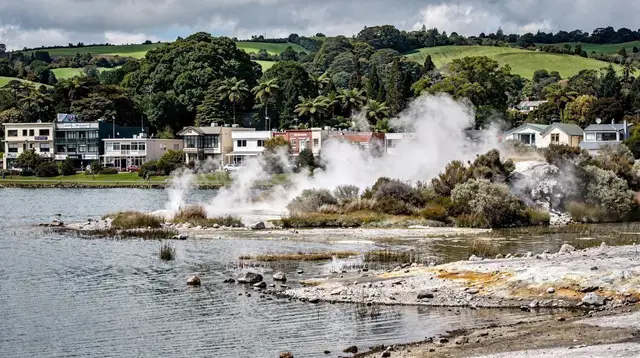
From there, Craters of the Moon is a short drive further and gives you a geothermal walk without an entry queue: boardwalks over steaming ground and craters, on a smaller and quieter scale than the big Rotorua parks. If you’ve already done Wai-O-Tapu or Waimangu on a previous Rotorua stay, this one is optional rather than essential — it covers similar ground, just with less scale and less spectacle.
Spend the rest of the day on the lake itself. The Mine Bay rock carvings — tall Māori carvings cut into the cliff face and only reachable by water — are the single best reason to get out on Lake Taupō rather than just look at it from the shore. A kayaking tour out to the Māori rock carvings gets you close at your own pace, or a lakefront cruise past the Māori rock carvings does the same trip with less effort if paddling isn’t the plan. For a different angle entirely, a helicopter flight over Huka Falls and the Māori rock carvings covers both of the day’s highlights from the air in well under an hour — a good option if you’re tight on time rather than tight on budget.
See Huka Falls and Taupō jet boats and Māori rock carvings at Lake Taupō before deciding which way to see them.
Day 3: Tūrangi and Tongariro National Park
Head south on SH1 along the lake’s western edge to Tūrangi, a small, quiet town that exists mainly as the southern gateway to Tongariro National Park and as a base for trout fishing on the Tongariro River. It’s not a destination in itself so much as a practical stop — fuel up, grab supplies, and use it as your jumping-off point for the day.
Tongariro was the country’s first national park and is one of the few places anywhere recognised as a double World Heritage site, for both its landscape and its cultural significance to local iwi. The famous Tongariro Alpine Crossing — 19.4 km, six to eight hours, past the cone of Ngauruhoe and across volcanic terrain — is a serious day walk, not a stroll, and needs its own full day plus transport arranged at both ends rather than being squeezed into an afternoon on a road trip. If you’ve come prepared for it and the weather and track conditions allow, it’s worth building a fifth day around; check current status with the operator or DOC rather than assuming it’s open, since alpine weather here changes fast. See Tongariro Alpine Crossing from Rotorua for what that actually involves.
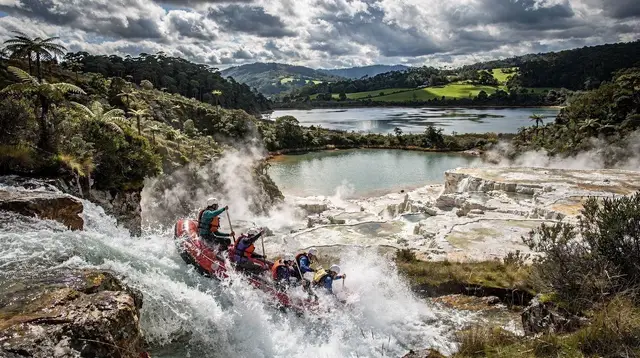
For this four-day version, a shorter walk from one of the park’s access points, or simply driving in to see Ngauruhoe and Ruapehu up close, is the realistic plan. In summer, Ruapehu is bare volcanic rock; in winter it’s the North Island’s ski field — either way, it’s the closest thing to genuine alpine scenery on this loop, and the only spot on the whole trip where the landscape stops looking geothermal and starts looking like real mountains. If white water is more your speed than a mountain walk, the Tongariro River below the park also carries Grade 3 whitewater rafting runs, a lower-key alternative that fits into half a day rather than a full one. Overnight back in Taupō or in Tūrangi itself.
Day 4: Back to Rotorua — what to skip on the way home
The return leg retraces SH1 to Taupō and then SH5 back to Rotorua, which is what makes this a loop through the same corridor rather than a straight there-and-back. Resist the urge to cram in one more stop for the sake of it. If you already saw Huka Falls and Craters of the Moon properly on day two, there’s no need to detour back to them — that’s exactly the kind of stop that looks efficient on a map and just eats the morning instead.
If you have a couple of hours in hand before reaching Rotorua, the better use of them is a Rotorua-side stop you didn’t get to before setting out — Kuirau Park or a short walk are easy additions — rather than backtracking into Taupō’s attractions a second time. Aim to be back in Rotorua by early afternoon, which leaves the rest of the day free rather than arriving exhausted after dark.
Which stops on this loop are worth the detour
- Worth it: Orakei Korako (quiet, genuinely different from the roadside parks), Huka Falls (five minutes, free, delivers), the Mine Bay rock carvings by boat or kayak, Tongariro’s mountain scenery.
- Worth it if you have the day: the full Tongariro Alpine Crossing, but only with a fifth day and good conditions — don’t force it into this four-day frame.
- Skippable if pressed for time: Craters of the Moon, if you’ve already done a Rotorua geothermal park; a second pass through Taupō town on the way back.
- Not on this route at all: don’t confuse this loop with Hobbiton (near Matamata, a separate direction) or Waitomo’s glowworm caves — both are covered in their own guides, not on the SH5–SH1 corridor.
Budget for the loop sits around the country’s mid-range travel figures — roughly 350 NZD per person per day covers fuel, mid-range accommodation in Taupō and Rotorua, meals, and one or two paid activities like the carvings tour. A tighter version closer to 150 NZD a day is workable if you skip the paid boat and air options and stick to free stops like Huka Falls and Craters of the Moon.
FAQs about the Rotorua–Taupō road trip loop
Is the Rotorua to Taupō loop worth doing as a day trip, or does it need four days?
It can be done in a single long day if all you want is to see Taupō and Huka Falls, but that skips Orakei Korako and rules out Tongariro entirely. Four days lets you actually stop at each place rather than just drive past it.
How long does the drive from Rotorua to Taupō take on SH5?
Around an hour without stops. Add extra time for the Orakei Korako detour and boat crossing if you’re doing it on the way, which is what turns a one-hour drive into a full first day.
Do you need to book Orakei Korako in advance?
Check current access and boat timings with the operator before you go — schedules and site access can change, and it’s a detour rather than a straight-through stop, so turning up unplanned risks a wasted trip out there.
Is the full Tongariro Alpine Crossing realistic inside this four-day loop?
Not comfortably. It’s a six-to-eight-hour walk needing transport arranged at both ends of the track. This itinerary treats Tongariro as a day of shorter walks and views; the full Crossing is better added as a fifth day, and only when track and weather conditions are confirmed as suitable.
Which stops on this route are safe to skip?
Craters of the Moon is the most skippable if you’ve already visited a Rotorua geothermal park like Wai-O-Tapu or Waimangu — it covers similar ground on a smaller scale. Backtracking into Taupō town a second time on the return leg is the other easy cut.
Is a rental car necessary for this itinerary?
Yes. Orakei Korako, the back roads around Tūrangi, and Tongariro’s access points aren’t served by public transport, and the appeal of a road trip is setting your own stops and pace.
What’s the best time of year to do this loop?
There’s no closed season for the drive itself. Summer gives longer daylight for the Tongariro day; winter shows off Ruapehu with snow and makes the geothermal steam at Orakei Korako more visible in the cold air. Rain is possible year-round, so check forecasts and track status before committing to any walking day.
Do the Māori rock carvings at Lake Taupō require a tour, or can you see them independently?
They’re only visible from the water, so some form of boat access is required — a guided kayak trip, a lakefront cruise, or a scenic flight are the practical options, since there’s no road or walking track to them.
tours.4 days
Verified deep-linked GetYourGuide tours. Book through these links and we earn a small commission at no cost to you.
Photos show the destination, not the operator's own images.