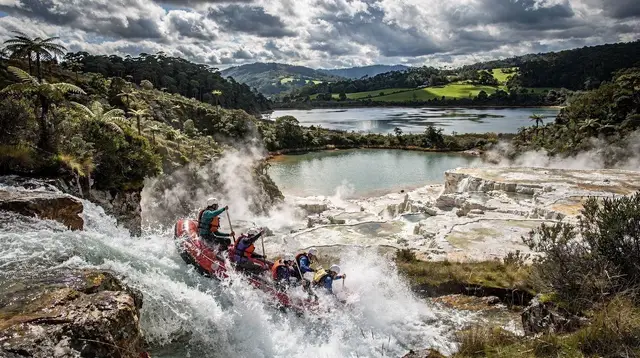
An Accident of Engineering, Not of Nature
Every other geothermal park around Rotorua and Taupō — Wai-O-Tapu, Waimangu Volcanic Valley, Hell’s Gate, Orakei Korako — sits on thermal features that are decades, centuries, or in Waimangu’s case exactly one eruption old. Craters of the Moon is the odd one out. Its steam vents, collapse craters, and cracked ground are largely a product of the second half of the 20th century, and the direct cause was not an eruption, an earthquake, or an underground fault shifting on its own timetable. It was a power station.
That makes Craters of the Moon a strange thing to find in a landscape otherwise defined by ancient forces: a geothermal field that visitors can watch continuing to change, shaped in large part by an industrial decision made in the 1950s. It also happens to be the cheapest thermal site to walk through in the entire Rotorua-Taupō corridor, which is reason enough on its own for budget-minded travellers to stop.
The Wairākei Power Station and the Falling Water Table
The geothermal system beneath this stretch of the Taupō Volcanic Zone doesn’t stop at any single park’s boundary. Underground, hot water and steam move through a connected network of fissures and reservoirs that extends well beyond the fenced-off tourist sites. When the Wairākei geothermal power station was built nearby and began drawing steam and hot water out of that underground system to generate electricity, it didn’t just power homes — it changed the pressure balance of the entire field.
As fluid was extracted for the power station, pressure in the underground reservoir dropped. Groundwater that had previously sat at a certain level began to fall. Where the ground above the reservoir was thin or already weakened, the drop in pressure let steam force its way to the surface through new cracks, and in places the ground itself collapsed into new craters as the support beneath it gave way. What had been unremarkable farmland and scrub became, over a matter of years, an actively venting geothermal field with fresh vents opening and old ones sometimes falling quiet as the system kept adjusting.
This is the detail that separates Craters of the Moon from everywhere else in this guide: the field is still considered comparatively young and still shifting. Vents that vent strongly one year can quiet down the next as pressure redistributes underground, and new ones can appear. It is a geothermal landscape you can plausibly describe as still being written, rather than one that settled into its current form long before anyone was around to watch.
What the Craters Actually Look Like
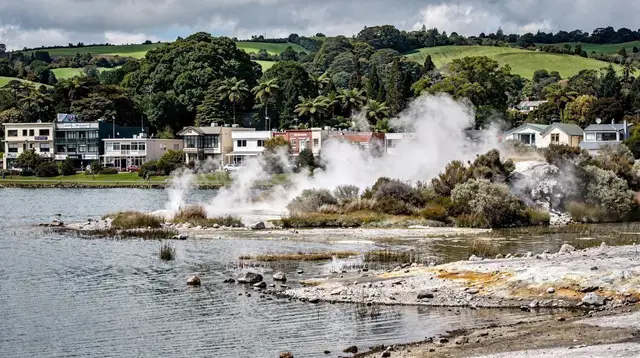
Don’t come expecting the colour palette of Wai-O-Tapu’s visiting guide — no turquoise Champagne Pool, no lurid Devil’s Bath. Craters of the Moon reads more monochrome: pale grey and white mineral-crusted ground, dark cracked craters with steam boiling up out of them, and scrubby native vegetation regenerating in between, since much of this land has only been thermally active for a few generations rather than millennia.
The steam itself is the main event. Columns rise continuously from vents scattered across the valley floor, sometimes thin and wispy, sometimes thick enough to drift across the boardwalk depending on wind and air temperature. As explained in why Rotorua smells of sulphur, the same hydrogen sulphide odour that hangs over Rotorua’s geothermal parks is present here too, though many visitors find it less concentrated than at a mud-pool-heavy site like Hell’s Gate, since Craters of the Moon has comparatively few mud features and mostly vents dry steam.
Several of the largest craters have collapsed rims and near-vertical steam-blasted walls, a visible record of the ground giving way as the underground pressure dropped. Interpretive panels along the walk explain which craters are older and which opened more recently, which is genuinely useful here in a way it usually isn’t at older sites, since the timeline of change is short enough to actually document.
Walking the Loop
Craters of the Moon is a self-guided walk on a formed boardwalk and gravel path, not a staffed tour with a guide leading groups between stops. A shorter loop covers the core cluster of craters and vents in around 45 minutes to an hour; a longer loop option extends further into the field for visitors who want to see more of it, pushing total walking time closer to an hour and a half.
The path is flat to gently undulating and suitable for most fitness levels, though enclosed footwear is sensible given the uneven, sometimes damp ground near the vents. As with every geothermal site in this guide, staying on the marked path matters: ground conditions across an active field can change without any visible warning, and the crust away from the boardwalk is not something to test.
Because there’s no ticketed show to time a visit around — no Lady Knox-style geyser eruption on a schedule — you can arrive whenever suits your itinerary. Early morning and late afternoon, when the air is cooler, tend to make the steam plumes more dramatic and photogenic, though the field is active and visible at any hour.
Craters of the Moon Compared to Rotorua and Taupō’s Other Thermal Parks
| Site | Signature feature | Cost level | Typical visit length |
|---|---|---|---|
| Craters of the Moon | Steam vents and collapse craters from a falling water table | Lowest of the main thermal parks | 45 min – 1.5 hours |
| Wai-O-Tapu | Champagne Pool, Devil’s Bath, timed Lady Knox geyser | Mid-to-higher | 1.5 – 2.5 hours |
| Waimangu Volcanic Valley | Frying Pan Lake, Inferno Crater, born from the 1886 eruption | Mid-to-higher | 1.5 – 3 hours |
| Hell’s Gate | Most active field, bathable mud pool | Mid-to-higher | 1.5 – 2 hours |
| Orakei Korako | Boat-access-only “hidden valley” | Mid-to-higher | 2 – 3 hours |
If you’re weighing which parks are worth your time, Rotorua’s guide to choosing a geothermal park covers the trade-offs in more depth, but the short version for Craters of the Moon is this: choose it when you want a low-cost, self-guided stop on the way to or from Taupō, not when you want colour, mud, or a guided cultural experience.
Getting There and Practicalities
Craters of the Moon sits just off SH5, on the northern approach into Taupō town, which puts it roughly an hour’s drive south of Rotorua — close enough to combine with Huka Falls and other Taupō-area stops in a single half-day loop, as covered in the guide to Huka Falls and Taupō jet boats. Self-driving is the most flexible way to reach it, since it isn’t on the main circuit of most Rotorua-based cultural or geothermal tours, which tend to cluster around Wai-O-Tapu and Waimangu instead.
There’s a car park at the entrance and the walk itself requires no special equipment beyond enclosed shoes and, in summer, sun protection — the UV index around Taupō reaches extreme levels in the warmer months and there’s limited shade along the boardwalk. Toilets and basic facilities are available near the entrance; this is not a site with a large visitor centre or café attached, which is part of why it stays inexpensive.
If you’d rather not self-drive the Taupō stretch, some full-day tours out of Rotorua bundle Huka Falls, hot springs, and other stops together, which is a reasonable way to see the wider area without renting a car for the day.
a full-day tour covering Huka Falls, hot springs, and Hobbiton on the same day out is one option for visitors basing themselves in Rotorua who want the Taupō stretch handled without driving themselves.
Why It’s the Cheapest Thermal Stop in the Region
The economics of Craters of the Moon follow directly from what it is. Wai-O-Tapu, Waimangu, Hell’s Gate, and Orakei Korako are all staffed attractions with visitor centres, guided elements or timed shows, and infrastructure to maintain across features that draw larger crowds. Craters of the Moon is a community-run, self-guided boardwalk through a field that, while genuinely dramatic to look at, doesn’t require the same level of staffing or infrastructure to present.
That keeps entry costs at the low end of what you’ll pay across the region’s thermal parks — useful to know if you’re travelling on a Rotorua on a budget itinerary and want geothermal scenery without eating into the day’s spending. It sits alongside the free things to do around Rotorua as one of the better low-cost geothermal stops in the wider area, even though it’s a short drive from Rotorua itself rather than in town.
For travellers weighing whether to prioritise one paid thermal park over another, Craters of the Moon is worth treating as a genuine addition to the day rather than a substitute for Wai-O-Tapu or Waimangu — it tells a different story and costs little enough that it rarely forces a trade-off.
Combining Craters of the Moon With the Rest of Taupō
Taupō itself, on the shore of the country’s largest lake, has enough beyond Craters of the Moon to fill a full day or more. Huka Falls, where the Waikato River is forced through a narrow gorge, sits a short drive away, and the Māori rock carvings at Mine Bay on the lake are reachable by boat or kayak from the Taupō waterfront.
a kayaking tour out to the Mine Bay rock carvings pairs naturally with a morning at Craters of the Moon, since both are on the Taupō side of the drive from Rotorua.
Visitors who want the wider geothermal picture in one day, rather than splitting it across a multi-day itinerary, sometimes combine Craters of the Moon with a stop at Wai-O-Tapu or Waimangu on the same loop.
a combined tour of Wai-O-Tapu and Waimangu Volcanic Valley covers the two larger, older parks, leaving Craters of the Moon as a self-driven add-on given how close it sits to the Taupō road.
For a shorter, lower-cost thermal experience closer to Rotorua itself on the same kind of budget-conscious day, an eco-thermal afternoon covers different ground back in town.
an eco-thermal afternoon tour based in Rotorua is worth considering if your itinerary keeps most of the day in Rotorua and only stretches to Taupō briefly.
If you’re mapping out how the whole region fits together across several days, the Rotorua–Taupō road trip itinerary places Craters of the Moon in context alongside Huka Falls, Tongariro, and the rest of the Taupō side of a North Island trip. And for background on why this entire stretch of the country behaves the way it does geologically, why Rotorua is geothermal covers the Taupō Volcanic Zone that Craters of the Moon, Wairākei, and every other thermal feature in this guide all sit within.
Craters of the Moon FAQ
What is Craters of the Moon and why is it different from other thermal sites near Rotorua?
Craters of the Moon is a geothermal field just north of Taupō that expanded rapidly in the second half of the 20th century after the nearby Wairākei power station drew down underground pressure, opening new steam vents and collapse craters. Unlike Rotorua’s ancient thermal parks, it is a landscape reshaped by industry, and it is generally the least expensive geothermal walk in the region.
Is Craters of the Moon worth visiting if I’ve already seen Wai-O-Tapu or Waimangu?
It is a different kind of site rather than a repeat. There are no coloured pools like Wai-O-Tapu’s Champagne Pool, but the story of a landscape reshaped by a power station in living memory is not something the older, natural parks can tell.
How long does the walk take?
Most visitors complete the shorter loop in 45 minutes to an hour. A longer loop option extends the walk to closer to 1.5 hours if you want to see more of the field.
Is it safe to walk close to the craters?
Stay on the boardwalk and marked track at all times. Ground temperatures and steam vents can change without warning across an active field, and the surface away from the path is not stable.
Can I combine Craters of the Moon with Huka Falls in one visit?
Yes, both sit on the same stretch of road just north of Taupō and are commonly done back to back, either self-driven or as part of a guided day tour that also covers other stops.
Is Craters of the Moon really cheaper than other thermal parks?
Yes, it is typically the lowest-cost geothermal walk of the main parks in the Rotorua-Taupō area, since it is a simple self-guided boardwalk rather than a fully staffed attraction with a geyser show or guided cultural experience.
Do I need a guide, or can I do it independently?
It is a self-guided walk with interpretive signage, so most visitors do it independently. If you would rather not self-drive, some day tours from Rotorua or Taupō include a stop here alongside other Taupō-area sights.