A lake next door, reached by a different route
Lake Rotorua gets the boat cruises, the lakefront walk, and most of the day-tripper traffic. Lake Rotoiti, its immediate neighbour to the east, gets almost none of that — not because there is less to see, but because its best feature has no road to it. Manupirua Springs, a set of geothermal pools on Rotoiti’s northern shore, can only be reached by kayak or boat. That single fact shapes everything about visiting this lake: fewer people, a slower pace, and an experience built around the water rather than a car park.
Rotoiti connects to Lake Rotorua through the short Ohau Channel, a stretch of moving water popular with trout anglers and, after dark, with paddlers looking for glowworms along its banks. From the channel mouth, the lake opens out into a long, island-studded body of water bordered by native bush, a scatter of lakeside baches (holiday houses), and steep forested hills that hide the springs from anyone not already on the water.
Manupirua Springs: hot pools with no road in
Manupirua sits on Rotoiti’s northeastern shore, roughly opposite the main settled bays. There is no track leading to it through the bush and no vehicle access of any kind — the pools exist as a strip of naturally heated water welling up at the lake’s edge, contained by simple rock and timber surrounds that keep the hottest water separate from the cool lake. Because the heat comes from the ground rather than a boiler, the pools stay at a soaking temperature through every season, which is not something that can be said for the lake itself.
Getting there means one of three things: paddling a kayak across open water, arriving by private boat, or booking a guided trip that runs its own boat shuttle from the Okawa Bay boat ramp. All three routes end at the same unmarked stretch of shoreline. This is a genuinely different kind of hot-pool visit from the developed spa experiences around Rotorua township — no reception desk, no changing rooms, no lockers, just a soak reached by effort. Readers weighing this against Rotorua’s built spa facilities will find a fuller comparison in the guide to Rotorua’s hot pools and the roundup of free hot springs around Rotorua.
For travellers who want geothermal bathing without the crossing, a lakefront spa experience closer to town is a reasonable substitute:
a Rotorua lakefront hot springs spa session with Māori wellness elements, reachable without a boatThat said, the appeal of Manupirua is specifically that it is not reachable that easily. Part of the experience is the twenty-to-thirty-minute paddle or boat ride across still, dark-forested water before the pools even come into view.
Getting onto the water: kayak, boat shuttle, or your own craft
Three practical options cover most visitors:
| Method | What it involves | Best for |
|---|---|---|
| Guided kayak tour | Small group, guide, supplied kayak and gear, launch from Okere Falls or Okawa Bay | First-time paddlers, evening trips, anyone wanting the glowworm stretch included |
| Boat shuttle | Operator drops you at the springs and collects you later, no paddling | Travellers who want the pools without the physical effort of a crossing |
| Own boat or rented kayak | Launch from the public ramp at Okawa Bay, navigate independently | Confident paddlers/boaters who already know the lake |
Daylight visits are straightforward paddling; the evening version is where Rotoiti stands apart from every other lake near Rotorua, because it pairs the crossing with two things visible only after dark — a sky largely free of Rotorua’s town lighting, and glowworms along the sheltered, overhung banks near the channel and quieter bays. A guide who knows exactly which stretch of bank still supports a healthy colony makes a real difference here, since glowworms depend on damp, undisturbed vegetation and are easy to miss without local knowledge.
Operators running the general geothermal circuit around Rotorua sometimes bundle a Rotoiti-style evening on the water with other volcanic sights; for travellers building a full day around geothermal features rather than a single lake, an afternoon tour covering several thermal areas is worth comparing:
an eco thermal afternoon tour through Rotorua’s geothermal featuresEvening kayaking and the glowworm stretch
The evening kayak trip is the version of Lake Rotoiti most visitors end up describing afterwards. It typically launches in late afternoon, crosses toward Manupirua while there is still light to see the water and the tree line, allows time to soak once the sky has started to dim, and returns after dark along a stretch chosen for its glowworms.
Glowworms — the larvae of a fungus gnat native to New Zealand, found nowhere else — glow to lure small flying insects into sticky threads they hang below themselves. They need still air, damp overhanging banks, and real darkness; any spill of artificial light dulls the effect within seconds, which is why guided evening kayak trips run without headlamps once the group is in position, relying on the guide’s local knowledge instead of a lit path. Readers wanting the biology in more depth, or comparing this option against the famous cave system further west, can check what glowworms actually are and where else near Rotorua they turn up.
Because the display depends on weather, moon phase, and how recently the colony has been disturbed, it is not guaranteed on any single night — a point worth setting expectations around before booking, and one any reasonable operator will be upfront about.
What the springs actually feel like
Manupirua is not a single pool but a run of pools of varying temperature along the shoreline, formed where geothermal water meets the cooler lake. Visitors typically move between hotter and cooler sections to regulate their own comfort, the same way people do at any natural hot spring rather than a temperature-controlled spa tub. The setting is unmanicured — bush right down to the water, a rough timber platform or two, no piped music or attendants — and that plainness is the point for people who find the built spa facilities around Rotorua too polished.
There is no facility for food, drink, or dry storage at the springs themselves, so anything needed for the return trip — dry clothes, a towel, water — has to travel there and back by kayak or boat, usually in a dry bag supplied by the operator.
Ohau Channel and the link to Lake Rotorua
The Ohau Channel is short — a few hundred metres of moving water joining Lake Rotorua’s eastern shore to Lake Rotoiti — but it matters for two reasons. It is a well-known trout fishing spot, since fish move between the lakes through it, and its overhung banks are one of the more accessible places to see glowworms without booking a trip all the way out to Manupirua. Kayak operators based around Lake Rotorua sometimes run channel-only evening paddles as a shorter, gentler alternative to the full Rotoiti crossing. Anglers interested in the wider picture — including the rule that New Zealand-caught trout cannot legally be sold or served in restaurants — will find the background covered in the guide to trout fishing around Rotorua and Taupō.
Other things to do around Lake Rotoiti
Beyond the springs, Rotoiti’s shoreline supports a scatter of low-key activities that reward slower travel:
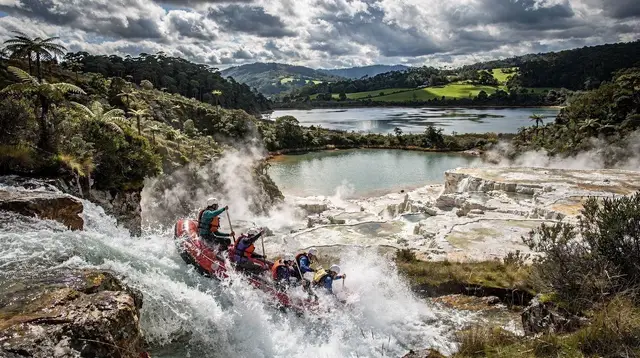
- Okere Falls, a short distance from the lake, is the put-in point for Kaituna River rafting and the location of Tutea Falls, a genuinely tall drop for a commercially rafted river. It is covered in full in the Okere Falls destination guide and in the dedicated Kaituna River rafting guide; travellers comparing it against Rotorua’s other whitewater options should see which river to raft.
- Fishing and swimming bays dot the accessible western shore, mostly used by locals and holidaymakers with baches rather than tour groups.
- Walking tracks around the lake’s accessible edges connect to the wider network of free walks near Rotorua, detailed in the free walking tracks guide.
- General lake kayaking, away from the springs, is covered across Rotorua’s lakes in the kayaking guide and the broader lake cruises and kayaking overview, useful for comparing Rotoiti against calmer, more sheltered paddling on Lake Tarawera or the smaller Blue and Green Lakes.
None of this amounts to a full day of sightseeing on its own — Rotoiti works best as a half-day or evening addition to a Rotorua base, not a standalone destination.
Practical planning: when to go, what to bring
Weather governs this trip more than most others near Rotorua. Wind chop on open water turns a pleasant paddle into hard work or a cancelled trip, and rain removes the point of an evening crossing meant to end in clear, dark sky for the glowworm stretch. Operators generally make the call on the day, and cancellations are refunded or rescheduled rather than run regardless.
Seasonally, summer (December to February) gives the longest evenings and the warmest lake water for the crossing itself, while shoulder months (spring and autumn) bring cooler but often stiller evenings — sometimes better for glowworm viewing precisely because fewer other boats are on the water. Winter trips run but start earlier relative to the light and require warmer layers for the boat or kayak back. The month-by-month patterns behind this are laid out in the Rotorua weather guide and the broader best time to visit guide.
A basic kit for an evening trip: swimwear, a full change of dry clothes, a towel, a warm layer for after dark, closed-toe water shoes if the operator doesn’t supply footwear, and a phone or camera in a genuinely waterproof case rather than a plastic bag. Sun protection matters for daytime crossings given how strong UV can be on open water even under cloud.
Given the lack of any facility at the springs, this is not a trip to attempt without a booked operator on a first visit — not because it is dangerous in daylight with calm conditions, but because there is no fallback plan (no shop, no shelter, no phone signal in most of the bay) if conditions change or a paddler gets into difficulty. General safety context for geothermal features around Rotorua, including why not every hot pool is safe to enter, is covered in the geothermal safety guide.
Getting there from Rotorua
Okere Falls and the Okawa Bay boat ramp, the two main launch points for Rotoiti trips, sit about 20 minutes’ drive northeast of central Rotorua along State Highway 33. Most kayak and boat-shuttle operators either collect guests from Rotorua accommodation or specify a meeting point at the launch itself — worth confirming at booking, since parking at Okawa Bay is limited. Visitors without a rental car can generally still join a guided trip through hotel pickup; those planning to explore beyond organised tours should check the options in getting around Rotorua without a car or, for a self-drive visit, driving in New Zealand for visitors.
Rotoiti also fits naturally into a wider day out from Rotorua that takes in the geothermal valleys further south — travellers stacking an evening kayak with a daytime valley visit can see how the pieces combine in the Rotorua day trips guide or the 3-day geothermal-focused itinerary and 3-day adventure itinerary. For a comparable boat-and-geothermal outing on a different lake the same afternoon, a cruise pairing a volcanic valley walk with time on the water is a reasonable complement rather than a substitute:
a Waimangu Volcanic Valley walk combined with a Lake Rotomahana cruiseAnd for travellers who want a hot-pool finish after a more adrenaline-heavy day rather than an evening paddle, a combo built around ziplines and rafting with a hot pool and sauna included covers similar ground on dry land:
a Rotorua ziplines and rafting combo that finishes with a hot pool and free saunaFAQ: Lake Rotoiti and Manupirua Springs
Can you visit Manupirua Springs without a kayak?
Yes. Several operators run boat shuttles from Okawa Bay on Lake Rotoiti to the springs, and anyone with their own boat can simply anchor and swim in. There is no road, track, or car park at Manupirua itself — a kayak is the cheapest way in, not the only one.
Are the Lake Rotoiti glowworms as good as Waitomo?
They are a different experience rather than a lesser one. Waitomo is a lit, guided cave system; the glowworms seen from a kayak on Lake Rotoiti or along the nearby Ohau Channel cling to a dark, unlit bank, so the display depends on a genuinely dark, calm night and how close the guide can bring the kayak to the vegetation.
How cold is Lake Rotoiti itself?
The open lake follows the seasons like any North Island lake — cool for swimming outside summer. Manupirua Springs is the exception: geothermal water rises at the lake edge and pools at a comfortable soaking temperature independent of the season, which is the whole reason people paddle out to it.
Is evening kayaking on Lake Rotoiti safe?
Guided evening trips supply life jackets, lights, and a guide who knows the crossing, and they typically cancel or reroute in poor wind. Lake Rotoiti is large enough to develop chop, so an unguided evening crossing in a rented kayak is a different level of risk than a guided small-group paddle.
How far is Lake Rotoiti from Rotorua?
It is close — about 20 minutes’ drive from central Rotorua to the Okere Falls and Okawa Bay area, where most kayak and boat trips launch. The lake is linked to Lake Rotorua by the short Ohau Channel.
Do you need to book the hot springs trip in advance?
Booking ahead is the norm rather than a formality, particularly for evening departures. Kayak groups and boat shuttles run on limited numbers and light, and Manupirua’s remoteness means there is no walk-up option if a trip is full.
What should I bring for an evening trip to Manupirua Springs?
Swimwear, a change of dry clothes for after the soak, a warm layer for the boat or kayak back once the sun is down, and a torch or headlamp if your operator does not supply one. Bookable operators generally provide the kayak, paddle, life jacket, and dry-bag storage.