Seeing Glowworms Near Rotorua Without the Waitomo Drive
Can you see glowworms near Rotorua without going to Waitomo?
Yes. Arachnocampa luminosa lives in any damp, dark, still spot on the North Island, not only inside Waitomo's caves. Guided night kayak trips on Lake Rotoiti, the free Ōkere Falls gorge track on the Kaituna River, and a roadside walkway at Karāpiro all show glowworms without the round trip to Waitomo or the cost of a cave tour.
Where else Arachnocampa luminosa turns up
Waitomo gets the name recognition, but the glowworm itself is not a cave specialist. Arachnocampa luminosa, the fungus gnat larva behind the light, needs three things: darkness, still humid air, and a surface to spin its silk fishing lines from. Limestone caves happen to supply all three reliably, which is why Waitomo built an industry around them. A shaded riverbank, an overhanging clay cliff in native bush, or a damp forest gully supplies the same conditions, and colonies of the same insect live in all of them across the central North Island. For a full explanation of the biology, see what glowworms actually are.
The practical case for looking closer to home is time and cost, not the insect itself. A Waitomo cave tour is roughly two hours each way from Rotorua before you have even booked a ticket, on top of the tour itself. The options below sit within about 20 minutes to just over an hour of Rotorua, and two of them cost nothing beyond getting there. None of them recreates the specific experience of a boat gliding under a ceiling of light in absolute cave darkness — that stays a Waitomo-only outing, covered separately in the comparison of Waitomo cave tours — but each shows the same glowworm, outdoors, on a normal evening.
What the outdoor colonies actually look like next to Waitomo’s
Anyone arriving with a phone full of Waitomo publicity photos should adjust expectations before setting out for any of the outdoor options below. Waitomo’s caves keep a nearly constant temperature and humidity year-round, which lets colonies grow dense and stay put on cave ceilings, sheltered from wind and rain. A riverbank or a bush gully is a harsher, more variable habitat by comparison, so the glowworms found there tend to sit in smaller, looser clusters spread along a bank rather than massed overhead in one dense sheet of light.
That difference is worth stating plainly rather than glossing over. A night kayak on Lake Rotoiti or a walk along the Ōkere Falls gorge track will show real, wild Arachnocampa luminosa doing exactly what the Waitomo colonies do, but the visual impact is usually a scattering of blue-green points along a dark bank rather than the enclosed, mirror-still spectacle that Waitomo’s marketing photos are built around. Neither version is wrong; they are different scales of the same phenomenon, and knowing that in advance heads off a letdown on the night itself.
Kayaking Lake Rotoiti at night
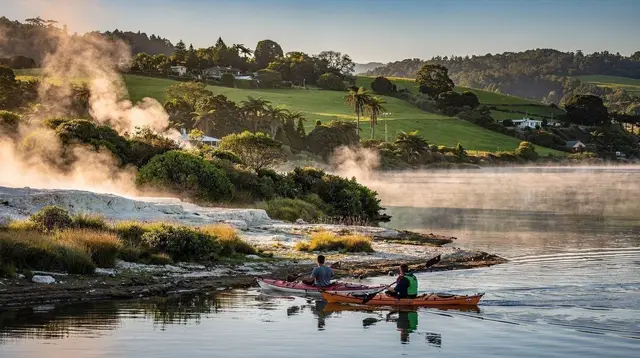
Lake Rotoiti sits northeast of Rotorua, connected to Lake Rotorua by the narrow Ōhau Channel. Guided evening kayak trips paddle into sheltered, tree-lined bays on the lake where colonies cling to overhanging banks and cliff faces just above the waterline. Paddlers switch off headlamps once the guide gives the signal, let their eyes adjust for several minutes, and drift close enough to see clusters of blue-green points reflected on the flat water.
The appeal here is the setting as much as the insect: still water, no traffic noise, and often a view of stars overhead at the same time as the glow at water level, which a cave cannot offer. It suits people who already want to be on the water rather than walking, and it pairs naturally with daytime paddling on the same lake system — see kayaking on Rotorua’s lakes and lake cruises and kayaking on Lake Rotorua for the daylight version of the same activity. Lake Rotoiti itself is also where some of the region’s hot springs sit, accessible only by water, if a group wants to build a longer outing around the lake rather than a single evening trip.
Because this is a guided operation on open water at night, numbers are usually kept small and trips run on a set evening schedule rather than on demand — check current departure times directly with the operator rather than assuming a fixed slot.
The Ōkere Falls gorge track, for free
The Kaituna River gorge at Ōkere Falls, a short drive northeast of Rotorua near the outlet of Lake Rotoiti, is better known by day for whitewater rafting over Tutea Falls — at seven metres, the highest commercially rafted waterfall in the world. See rafting the Kaituna and the broader comparison of Rotorua’s rafting rivers for that side of it. By night, the same gorge has a second use: a public Department of Conservation walking track follows the true right bank above the falls, and glowworms are visible in several damp, overhung sections along the way, clinging to the clay banks above the water.
There is no entry fee and no booking. The catch is that this is an unlit bush track above a steep river gorge, not a maintained boardwalk — footing is uneven in places, there is no handrail along most of it, and a dropped torch or a missed step matters more here than on a flat path. A dimmed torch or red-light headlamp to walk in and switch off once still, sturdy closed shoes, and a companion are worth the small extra effort for a free option this close to town. Ōkere Falls is also one of the region’s better free daytime lookouts if a return visit in daylight is useful for orientation first.
Rotoiti kayak or Ōkere Falls track: choosing for one evening
For visitors who only have one evening to spare and are weighing the two genuine Rotorua-area options — the Lake Rotoiti night kayak and the free Ōkere Falls gorge track — the decision usually comes down to budget, mobility, and whether being guided matters. The kayak trip costs more but removes the guesswork: a guide picks the bay, manages timing, and handles safety on open water at night, which suits anyone uneasy about walking an unlit track alone after dark. It also adds the water itself, and often a view of the night sky, as part of the experience rather than just the glowworms.
The Ōkere Falls track suits the opposite priorities: no cost, no booking, and a shorter overall commitment for anyone already staying near the gorge or passing it on the way back from daytime rafting. It asks more of the visitor in return — steady footing on an uneven, unlit path, a torch to manage, and no guide to fall back on if something goes wrong. Families with young children or anyone unsteady on rough ground at night are usually better served by the kayak trip’s structure; confident walkers looking for a free, quick option tend to lean toward the gorge track instead.
Karāpiro, if you are already driving that way
Lake Karāpiro sits on the Waikato River near Cambridge, on the corridor most visitors already drive through en route between Rotorua and Waitomo or Hobbiton. A short public walkway near the lake passes a glowworm grotto in a bank cutting, viewable after dark without a guide or a fee.
This one only makes sense as an add-on, not a destination. It is a five-to-ten-minute stop, not an evening’s outing, and it sits well outside Rotorua proper — closer to Cambridge than to anywhere on the Rotorua side of the map. Anyone building a Rotorua-to-Waitomo day trip that overnights near Hamilton or Cambridge, or who is timing a return drive from Hobbiton after dark, can fold in a few minutes here without adding real distance. It is not worth a dedicated round trip from Rotorua on its own.
Ruakuri Bush Walk: glowworms at Waitomo without the cave ticket
This one is a partial exception to “without Waitomo,” and worth naming precisely. Ruakuri Bush Walk is a free public loop track through the scenic reserve above Waitomo’s cave system, following the Waitomo Stream past a natural limestone arch and a boardwalk section. It is separate from the paid commercial cave tours that share the same reserve, and glowworms are visible along the stream banks from the walk itself after dark, at no cost and without booking a guided tour.
The distinction matters for anyone who is already making the roughly two-hour drive from Rotorua to Waitomo for Hobbiton or another reason, but does not want to commit to a full underground boat tour once there. Ruakuri Bush Walk lets that detour still include glowworms without the extra time and cost of a cave ticket. It does not substitute for the boat-through-the-cave experience itself — walking above ground past a stream bank is a different thing from drifting under a ceiling of light in total cave darkness — but as a free add-on to a trip already headed to Waitomo, it closes the gap for a lower commitment than choosing between Waitomo’s cave tours.
Accessibility and who each option suits
None of the outdoor options are built with accessibility in mind the way a paved visitor centre is. The Ōkere Falls gorge track and the Ruakuri Bush Walk are both natural-surface bush tracks with roots, uneven ground, and no lighting, which rules out wheelchairs, prams, and anyone unsteady without assistance; a torch and sturdy closed shoes are the minimum, not an option. The Lake Rotoiti kayak trip removes the walking problem but replaces it with a different one — getting in and out of a kayak in the dark requires reasonable mobility and balance, and operators typically set a minimum age for the same reason.
Karāpiro’s roadside walkway is the gentlest of the four, since it is short, close to a car park, and mostly flat, though it still runs at night without lighting. Anyone travelling with a wheelchair user, a very young child, or someone who cannot manage uneven ground after dark is generally better off treating the outdoor glowworm options as optional extras on this trip, and raising mobility needs directly with an operator before booking a night kayak trip in particular. A broader look at getting around the region with limited mobility is in the Rotorua accessibility guide.
Comparing the options
| Option | Distance from Rotorua | Cost | Time needed | What it does not replace |
|---|---|---|---|---|
| Lake Rotoiti night kayak | ~20 min drive to launch point | Guided tour price | An evening (2-3 hours incl. paddling) | The cave boat-ride setting |
| Ōkere Falls gorge track | ~25-30 min drive | Free | 45-90 min, plus drive | Guided context, lit path |
| Karāpiro walkway | ~1 hour, en route to Waikato | Free | 10-15 min add-on | A standalone evening out |
| Ruakuri Bush Walk | ~2 hours, at Waitomo | Free | 30-60 min | The paid underground boat tour |
| Full Waitomo cave tour | ~2 hours | Tour price | Half a day round trip | Nothing — it is the reference experience |
When the Waitomo cave tour is still the right call
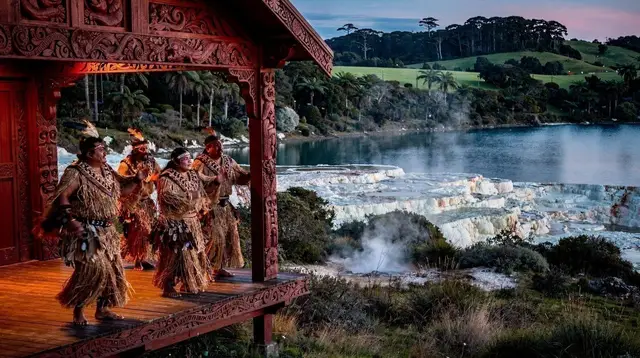
None of the above recreates a boat gliding in total darkness under a dense glowworm ceiling reflected on still cave water, with the temperature and acoustics of an underground cavern around it. If that specific scene is the point of the trip, Waitomo’s commercial caves remain the only place to get it, and the two-hour drive is the cost of admission. Several operators also combine the cave with other stops on the same day to make the drive worth more — a Māori cultural stop, Hobbiton, or a wider nature circuit — which spreads the travel time across more than one experience rather than a single cave visit.
a day tour that pairs a Rotorua Māori cultural visit with the Waitomo caves is one way to justify the full drive with more than glowworms alone, and a private day trip combining Hobbiton and the Waitomo glowworm caves does the same from the film-set side. For travellers who genuinely cannot spare the drive but still want a guided glowworm outing based in Rotorua itself, a Rotorua-based nocturnal glowworm tour covers the near-Rotorua alternative without leaving the area at all.
Practical notes for any of these
Glowworms glow year-round and in any weather, since they live under cover regardless of what is happening outside — rain does not cancel a viewing, though a night walk on an unlit track in heavy rain is its own consideration. What does matter is darkness: arrive after full dark, let eyes adjust for several minutes without checking a phone screen, and keep any torch dimmed or covered with red film once close to a colony, since white light and flash photography make the insects retract their glow and ruin the view for everyone nearby.
Whichever spot is chosen, the same courtesy applies as anywhere in the region’s forests and waterways: stay on the track, keep noise down, and do not touch the banks or silk threads. It is a small-scale version of the Tiaki Promise that New Zealand asks of visitors more broadly — leave the place as it was found. For a wider view of what else is free to do around Rotorua on the same trip, see free things to do in Rotorua and budget travel in Rotorua; for the driving logistics of reaching any of these spots without a rental car, see getting around Rotorua without a car and driving in New Zealand for visitors if self-driving.
A couple more questions
Will the glowworms outside Waitomo look as dense as in photos of the caves?
No, and it helps to expect that going in. Waitomo’s caves hold a stable, humid climate that lets colonies grow into dense, near-continuous patches on the ceiling. Outdoor sites like Lake Rotoiti or Ōkere Falls show the same insect in smaller, more scattered clusters along a bank, since the habitat is more exposed to weather and less constant.
Is a torch or headlamp allowed near the glowworms?
Yes, to get to the spot, but it needs to be switched off or dimmed to red once close to a colony. Glowworms retract their light when exposed to white light or camera flash, and other visitors nearby will also be trying to keep their eyes adjusted to the dark, so a bright beam left on ruins the view for everyone, not just the person holding it.
Anyone weighing this whole question against simply booking the cave day trip can also start from the broader caves and glowworms category or the Rotorua day trips overview for how a Waitomo run fits into a wider stay.
Waitomo cave & glowworm tours on GetYourGuide
Verified deep-linked GetYourGuide tours. Book through these links and we earn a small commission at no cost to you.
Photos show the destination, not the operator's own images.