Kayaking Rotorua's Lakes: Rotoiti, Ōkataina, Tarawera and the Kaituna
What's the best lake to kayak near Rotorua?
Lake Rotoiti stands out because its geothermal hot springs on the northern shore can only be reached by water, making a kayak or guided trip the only way in. Ōkataina and Tarawera offer quieter, more forested paddling, while the Kaituna River is a different kind of outing altogether: a guided tandem kayak through rapids near Okere Falls.
Rotorua sits inside a ring of lakes, and each one paddles differently. Some are calm enough for a first outing, one has hot springs you can only reach by water, and one isn’t a lake at all but a river with a genuine rapid at the bottom of it. This guide sorts through the options around Lake Rotorua, Lake Rotoiti, Lake Ōkataina, Lake Tarawera and the Kaituna River, and says which ones need a guide, which don’t, and what each is actually like on the water.
Four different paddles, one region
The lakes around Rotorua were formed by the same volcanic activity that produces the geothermal parks, and no two of them behave the same way. Lake Rotorua is broad, shallow near the shore and busy with boat traffic close to town. Lake Rotoiti is long, narrow and edged with hot springs that have no road access at all. Ōkataina and Tarawera sit further out, ringed by native forest, and see far less traffic than the two lakes closer to the city. The Kaituna, by contrast, is a river with a genuine drop in it, and paddling it is closer to whitewater rafting than to a lake outing.
That range means the right choice depends on what you want out of the day: a relaxed morning close to town, a half-day trip to somewhere the road doesn’t reach, or an adrenaline-heavy run through rapids. See things to do: lakes and kayaking for the fuller activity list this guide draws from.
Lake Rotoiti: hot springs only reachable by water
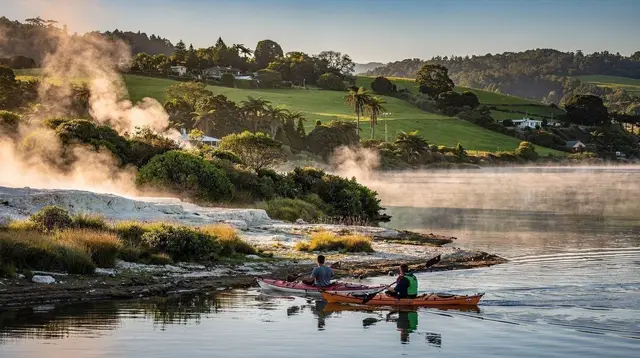
Lake Rotoiti is the paddling trip that does something a road trip can’t. Its northern shore holds geothermal hot springs with no vehicle access whatsoever — the only ways in are by boat or by paddling. That single fact makes Rotoiti the standout choice for anyone who wants a kayaking day with a genuine destination rather than just scenery.
Guided trips typically cross a section of the lake, land at the springs, and give paddlers time to sit in naturally heated water before returning. Because the crossing depends on wind and the exact landing spot benefits from local knowledge, most visitors do this with a guide rather than a rented kayak, though the lake itself is manageable for a reasonably fit paddler in calm conditions. Combine it with a wider look at the region’s soaking options in the Rotorua hot pools guide — Rotoiti is the one hot-water stop on that list that isn’t reachable by car.
Ōkataina and Tarawera: quieter water, volcanic backdrops
Lake Ōkataina and Lake Tarawera sit east of Rotorua, closer to Mount Tarawera than to the city itself, and both see noticeably less boat and jet-ski traffic than Rotorua or Rotoiti. The appeal here is quiet rather than a specific attraction: forest coming down to the waterline, long sightlines across the water toward the mountain that erupted in 1886, and none of the town-adjacent buzz of Lake Rotorua.
Tarawera is the larger and more exposed of the two, and paddling toward the mountain gives a sense of scale that’s hard to get from the shore — the peak’s split summit, a result of that 1886 eruption, is visible for most of a crossing. Ōkataina is smaller and more sheltered, and its shoreline forest is part of what makes the lake feel isolated even though it’s under an hour from town. Neither lake has the same infrastructure as Rotorua or Rotoiti, so anyone paddling unguided should check wind forecasts before setting out, since conditions on a large open lake can change faster than they do close to shore.
Two of the small lakes in this cluster are worth naming precisely for opposite reasons. Lake Tikitapu, known as the Blue Lake, is shallow, sheltered and one of the easiest places near Rotorua to kayak or swim. Its neighbour Lake Rotokākahi, the Green Lake, is tapu to Te Arawa and is not open to swimming, boating or kayaking at all — it’s worth knowing the difference before planning a route that includes the Blue and Green Lakes, since one is a paddling destination and the other is not.
The Kaituna River: tandem kayaking through rapids
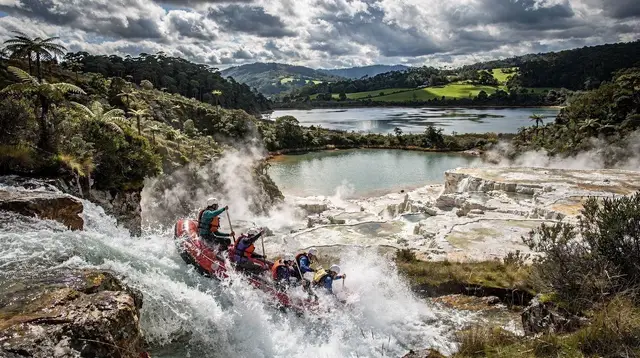
The Kaituna is the outlier on this list — a river, not a lake, and the one paddling option here that’s genuinely adrenaline-driven. It flows out of Lake Rotoiti and past Okere Falls, and one stretch takes in Tutea Falls, a seven-metre drop that is the highest waterfall commercially run anywhere in the world. Most visitors know the Kaituna through whitewater rafting, but guided tandem kayaking runs the same stretch of river, including that drop, in a smaller and more manoeuvrable craft.
This is not a self-guided activity. The Kaituna has genuine Grade III–V water depending on the section, and every commercial trip runs with instructors and safety kayakers. It’s a short outing — measured in hours rather than a full day — and works well paired with something calmer earlier in the trip, since it’s a different kind of paddling from anything else on this list. For the full comparison between rafting and kayaking this river, see the Kaituna River rafting guide and which river to raft in Rotorua.
Other water worth a paddle
Lake Rotorua itself is the easiest of all these options to reach, since it sits right against the town. Paddling routes here range from a short loop near the Government Gardens to a longer trip west toward Hamurana Springs, where clear spring water feeds into the lake — a good add-on for anyone already out on the water and not in a rush to get back.
Evening and night paddling is its own category around Rotorua, distinct from the daytime lake trips above. Guided glowworm kayak trips run after dark, pairing a calm paddle with a stop to view glowworms along the shoreline or an adjoining stream — worth checking against the guide to glowworms near Rotorua without Waitomo if the Waitomo caves aren’t part of the plan. An evening on the water with a meal built in is a different, slower version of the same idea, and pairs a sunset paddle with dinner rather than a wildlife stop.
Anyone extending a trip south to Taupō has one more water-only attraction worth factoring in: the Mine Bay rock carvings, a set of large Māori carvings on Lake Taupō that, like Rotoiti’s hot springs, can only be reached by boat or kayak. Details on the carvings themselves are in the Māori rock carvings, Lake Taupō guide.
Comparing the options
| Route | Type | Typical length | Guide needed | What makes it worth doing |
|---|---|---|---|---|
| Lake Rotoiti hot springs | Lake paddle | Half day | Recommended | Springs reachable only by water |
| Lake Ōkataina | Lake paddle | Half day | Optional | Forested, quiet, little boat traffic |
| Lake Tarawera | Lake paddle | Half day | Optional | Views of the 1886 eruption scar |
| Lake Rotorua | Lake paddle | 1–3 hours | Not required | Closest option, easy access to town |
| Lake Tikitapu (Blue Lake) | Lake paddle | 1–2 hours | Not required | Sheltered, easy for beginners |
| Kaituna River | Whitewater kayak | 2–3 hours | Required | Tutea Falls, the world’s highest commercially run drop |
| Evening glowworm kayak | Night paddle | 2–3 hours | Required | Glowworms viewed from the water after dark |
| Mine Bay rock carvings, Taupō | Lake paddle | Half day | Optional | Carvings accessible only by water |
Durations vary by operator and route; check the specific trip for exact timing rather than treating this table as a booking guarantee.
Gear, guides, and going it alone
Sit-on-top kayaks are standard for lake trips around Rotorua and don’t require prior kayaking experience to use safely in calm water. Guided trips supply the kayak, paddle and a life jacket, and generally cover the logistics that are hardest to arrange independently, such as the Rotoiti hot-springs crossing or the Kaituna’s rapids. Renting and paddling independently works well for Lake Rotorua, Lake Tikitapu, and calmer parts of Rotoiti and Ōkataina, but isn’t an option on the Kaituna, where every commercial run is guided.
A few of the region’s guided kayak trips combine paddling with something else rather than being a straight lake crossing. An afternoon kayak trip that pairs paddling with a stop at a geothermal feature works well for an afternoon slot, while an evening paddle that finishes with dinner on or near the water makes a slower, later-in-the-day alternative. For a night trip built specifically around wildlife, a guided evening kayak to see glowworms along the shoreline is the closest equivalent to Waitomo’s caves without leaving the water.
Anyone continuing on to Taupō can add a guided kayak trip to the Mine Bay rock carvings, the same water-only-access idea as Rotoiti’s springs, applied to a different lake.
Sun exposure is worth taking seriously on any of these trips. UV levels in summer around Rotorua are extreme, and there’s no shade at all on open water — a hat, sunscreen reapplied through the day, and sun-protective clothing matter more here than the water temperature does. See the geothermal safety guide for related outdoor-safety notes and the Rotorua weather month by month guide for how conditions shift across the seasons — wind patterns on the open lakes change with the season more than temperature does.
Planning your kayaking day
Most of these trips run year-round, since none of the lakes freeze and rain doesn’t rule out a lake paddle the way it can rule out a hike. Wind is the bigger factor on Ōkataina and Tarawera, both large and exposed enough that a calm morning can turn choppy by afternoon; checking a same-day forecast before committing to an unguided crossing is worth the five minutes it takes. Families travelling with children will find Lake Rotorua and Lake Tikitapu the easiest starting points — see the Rotorua with kids guide for how they fit alongside less water-based activities. For a itinerary that puts a lake or river paddle alongside other adrenaline activities across a few days, the three-day adventure itinerary is built around exactly that kind of mix.
FAQ: Kayaking Rotorua’s Lakes and the Kaituna
Do you need experience to kayak on Rotorua’s lakes?
No. Lake Rotorua, Lake Tikitapu (Blue Lake) and calm stretches of Lake Rotoiti are suitable for first-timers in a stable sit-on-top kayak, especially with a guide. The Kaituna River is different: it involves whitewater and is only done as a guided trip.
Can you kayak to the hot springs on Lake Rotoiti without a guide?
If you have your own kayak and know the lake, yes, since the springs sit on public shoreline reachable only by water. Most visitors go with a guided tour, which handles the crossing, timing and local knowledge of exactly where to land.
Is kayaking the Kaituna River the same as rafting it?
No. Rafting uses a multi-person inflatable raft; tandem or sit-on-top kayaking on the Kaituna is a separate guided activity on the same river, including the section past Tutea Falls, the highest waterfall commercially run in the world.
Which lake near Rotorua is best for a first-time paddler?
Lake Rotorua itself, close to town, or Lake Tikitapu (Blue Lake), which is small, sheltered and easy to reach. Both are calmer and more forgiving than the larger, more exposed Tarawera or Ōkataina.
Can you kayak on Lake Rotorua itself, next to the town?
Yes. Lake Rotorua supports kayaking, stand-up paddleboarding and cruises, and paddling routes can extend toward Hamurana Springs on the lake’s western side.
Is it safe to kayak alone on Ōkataina or Tarawera?
Both lakes are larger and more exposed than Rotorua or Tikitapu, with weather that changes quickly. Check conditions and tell someone your plan before heading out unguided, and treat Lake Rotokākahi (Green Lake) as fully off-limits, since it is tapu.
What should you wear or pack for a kayaking trip around Rotorua?
Quick-dry layers, a hat, and strong sun protection, since UV is intense in summer even when the air feels mild. A dry bag for a phone or camera and a change of clothes for after are worth carrying on any lake trip.
Kayaking tours on GetYourGuide
Verified deep-linked GetYourGuide tours. Book through these links and we earn a small commission at no cost to you.
Photos show the destination, not the operator's own images.