Lake Rotorua: Duck Tours, Dinner Cruises and Evening Kayaking
What's the best way to see Lake Rotorua from the water?
There's no single best way — it depends on pace. An amphibious duck tour covers the city and lakeshore in under two hours with no effort required. A dinner cruise adds a slower, seated evening on the water. A guided evening kayak trip is the most active option and the only one that can reach hot pools sitting right at the waterline, reachable no other way.
Rotorua sits on the edge of its lake rather than around it, and most visitors experience the water only as a backdrop — glimpsed from a café table in the Government Gardens or from the shore path near Ōhinemutu. Getting onto the water changes the trip. The lakeshore steams in places, waterfowl work the shallows, and the volcanic geography that shapes the whole region — Lake Rotorua itself sits in a collapsed caldera — reads differently from a boat than from a car window.
There are three practical ways to do this, and they suit different tempers. An amphibious duck tour is the low-effort option: you sit, it drives, it swims, it’s over inside two hours. A dinner cruise slows things down into a seated evening. A guided kayak trip is the most physical and, after dark, the only one that reaches shoreline hot pools no road or footpath touches. This guide runs through each, plus daytime paddling for anyone who wants the lake without a schedule at all.
Amphibious sightseeing: the duck tour
Rotorua’s amphibious duck tours use vehicles that drive through the city streets on ordinary tyres, then enter the lake directly and continue as a boat. It’s a genuinely unusual way to start a lake tour — you’re watching shopfronts and the Bath House building from your seat, and a few minutes later the same vehicle is floating.
Once on the water, the standard route covers the town waterfront, the Government Gardens shoreline, and the near shore of Lake Rotorua, with a guide narrating as you go — history, geology, the odd bit of Te Arawa context tied to specific points on the shore. It’s a fixed, narrated loop rather than a flexible outing, which is exactly its appeal for anyone short on time: you get a working overview of the city and its lake without planning a route yourself.
book the amphibious city and lakes tourA longer version of the same idea pushes further, extending the route out toward Lake Tarawera and taking in more of the lakes district beyond the town lake itself, at roughly double the length of the standard loop.
the extended Tarawera and lakes duck tourDuck tours run on a schedule and in a group, with commentary pitched at first-time visitors — useful context if this is an early stop in a Rotorua itinerary, less useful if you already know the history and just want quiet water.
Dinner cruises on the lake
A dinner cruise trades sightseeing coverage for pace. Rather than moving through several points of interest, the boat generally holds a slower course on Lake Rotorua while dinner is served, timed toward the evening light rather than toward covering ground. It’s the option that asks the least of you: no paddling, no walking route, just a seat, a meal, and the water working as the view rather than the activity.
This suits an evening when the rest of the day has been active — a morning at Whakarewarewa or a walk through the Redwoods leaves most people happy to sit down by dinner. It also suits travellers with limited mobility who want lake time without a physical activity attached — worth checking against a specific operator’s boarding setup if that’s a concern, since arrangements vary by vessel.
Compared with a duck tour, a dinner cruise is less about narration and more about atmosphere: steam still rises off parts of the lakeshore in the cooler evening air, and the water itself, rather than a running commentary, is doing most of the work.
Evening kayak to the hot pools
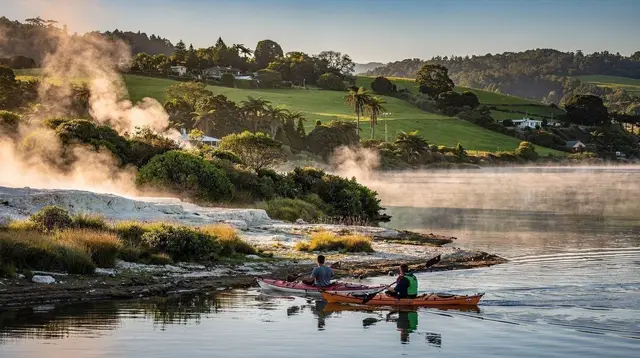
This is the most physical of the three, and the one built specifically around dusk rather than daylight. Guided evening kayak trips leave from the Rotorua lakes district in the late afternoon, paddle out as the light drops, and head toward hot pools sitting directly at the waterline — spots that have no road access and can only be reached by water. Some of these evening routes work the connected lake system beyond Lake Rotorua itself rather than staying on it, since it’s the neighbouring lake, Lake Rotoiti, that carries pools reachable only from the water; it’s worth checking a specific tour’s stated route if you want to be certain which lake you’ll actually be on.
The appeal is straightforward: you paddle in, tie up, and get into naturally hot water with no built infrastructure around it, under a sky that’s usually dark or close to it by the time you arrive. Guides supply headlamps, a safety briefing, and stable kayaks that don’t demand prior paddling experience — this is an evening for people who want the experience of self-propelled arrival, not a technical paddling challenge.
An evening kayak trip built around a different kind of after-dark water experience — paddling toward glowworm-lit banks rather than hot pools — runs on Lake Karāpiro, further out toward Cambridge in the Waikato, for anyone extending a Rotorua base into a longer loop.
the evening glowworm kayak trip on Lake KarāpiroDress for the temperature drop rather than the daytime forecast — even a warm Rotorua afternoon cools fast on open water after sunset, and everyone gets wet getting in and out of the kayak regardless of how careful the launch. A dry bag for a phone and a warm layer for the paddle back matter more here than on any daytime outing on this list.
Kayaking and paddling by day
Daytime paddling on Lake Rotorua works on your own schedule rather than a fixed departure, and it’s the option most people underrate. Rental kayaks and stand-up paddleboards are available around the town lakefront, and the near shore — past Kuirau Park and toward the Ōhinemutu shoreline — gives an unhurried look at a working geothermal lake edge: steam vents, waterfowl, and the volcanic geography that put Rotorua on this spot in the first place.
For clearer water, several of the smaller lakes around Rotorua suit paddling better than the town lake itself. Tikitapu, the Blue Lake, is a common choice for its clarity and calm conditions, sitting close enough to town for a half-day outing without committing to a full lakes-district drive. Lake Ōkataina and the wider Tarawera lakes system offer longer, quieter paddling for anyone with more time and their own transport.
Guided half-day and full-day paddling combinations exist too, sometimes bundled with other eco-focused activity around the geothermal shoreline rather than sold purely as a kayak hire.
a guided eco and thermal afternoon on the waterNone of this requires booking ahead the way an evening kayak trip to the hot pools does — rental kayaks and paddleboards are generally a same-day, turn-up arrangement, weather and stock permitting.
Comparing the four ways onto the water
| Option | Typical length | Effort | When it runs | What it adds |
|---|---|---|---|---|
| Amphibious duck tour | Under 2 hours | None — you’re a passenger | Daytime, fixed schedule | Combined city and lakeshore sightseeing, narrated |
| Extended duck tour | Around 2 hours | None | Daytime, fixed schedule | Reaches further toward Lake Tarawera |
| Dinner cruise | An evening | None | Evening | Slow-paced meal with lake views, no activity required |
| Guided evening kayak | A few hours | Moderate — paddling required | Dusk into dark | Arrival at shoreline hot pools by water only |
| Daytime kayak or SUP hire | Flexible, self-timed | Moderate | Daytime | Independent pace, choice of lake, closer look at the shoreline |
Beyond Lake Rotorua
Not every lake-based tour departing Rotorua stays on Lake Rotorua itself. Several options work other water in the wider region for visitors who want a change of scenery or are combining a lake activity with a day trip further afield.
Tauranga’s harbour, an hour from Rotorua on the coast, has its own cruise option distinct from anything on the inland lakes.
a harbour cruise out of Tauranga
Lake Taupō, the country’s largest lake and around an hour south, supports its own boat trips, including flexible private options that can be timed around a same-day return to Rotorua.
a flexible private boat tour on Lake Taupō
Anyone planning a Taupō stop for its lake trips alongside geothermal sights further south can pair it with a Wai-O-Tapu or Orakei Korako visit on the same day, as several combined tours already run that exact route out of Rotorua.
a combined Lake Taupō and geothermal valley day tour
Practical notes
None of these activities require special preparation beyond ordinary lake-trip sense. Sun protection matters more than it looks like it should — the UV index here runs high through summer, and an afternoon on open water without shade adds up faster than an equivalent afternoon on land. For evening activities, bring a warm layer regardless of the daytime temperature; lake air cools quickly after dark even in summer months, and more so in winter.
Life jackets are standard equipment on guided kayak trips and most cruises; ask directly if you don’t see one offered. Rotorua’s lakes sit inside an active geothermal system, so some shoreline areas carry the same general geothermal cautions as the region’s thermal parks — stick to marked entry points for any hot pool reached by water, since ground and water temperatures near geothermal features can vary sharply over short distances. For a fuller picture of what that caution covers, see the guide to geothermal safety around Rotorua.
Booking ahead matters most for the evening kayak trips to the hot pools, since group sizes are limited and daylight-to-dusk timing is fixed by the season; duck tours and dinner cruises typically run on a more frequent daily schedule. Daytime kayak and paddleboard hire is usually the most flexible of all, bookable same-day depending on weather and availability.
If choosing between these is part of a bigger planning question — how many days to give Rotorua overall, or when in the year to visit for calmer lake conditions — the best time to visit and how many days in Rotorua guides cover that ground, and the free hot springs around Rotorua guide is useful background before committing to a paid evening kayak trip specifically for the hot pools. For families weighing which of these suit children, see Rotorua with kids, and for the district’s broader kayaking options beyond this page, the dedicated kayaking the Rotorua lakes guide goes deeper on routes and hire spots.
Anyone tracking wildlife sightings on the water — waterfowl are common on Lake Rotorua’s shallows — can cross-reference the Rotorua wildlife guide. Browse the wider lake cruises category or lakes and kayaking category for the full current list of on-water activities in the area.
Lake Rotorua cruises and kayaking: FAQ
Can you swim in Lake Rotorua?
Yes, in places, though water quality varies with rainfall and algae conditions and is monitored seasonally. Many visitors prefer the clearer, geothermally warmer swimming at Tikitapu (Blue Lake) or the Ōhau Channel area instead of the main town waterfront.
Do I need experience to join a kayak tour on the lake?
No. Guided evening and daytime kayak trips on Lake Rotorua are built for beginners, with stable sit-on-top kayaks, a safety briefing, and a guide setting the pace. Fitness helps but technical paddling skill isn’t required.
Are the hot pools reached by kayak actually on Lake Rotorua?
Some evening paddles head onto the connected lake system rather than staying on Lake Rotorua itself, since the shoreline pools accessible only by water sit on a neighbouring lake. Check the specific tour’s route before booking if this detail matters to you.
What is a duck tour, exactly?
It’s a sightseeing trip in an amphibious vehicle that drives through Rotorua’s streets and then enters the lake directly, continuing as a boat. It covers ground a walking tour can’t and needs no separate transfer between land and water sightseeing.
Is a dinner cruise worth it if I’ve already done a duck tour?
They cover different things. A duck tour is a moving, narrated overview of the city and shoreline; a dinner cruise is a slower, seated evening on the water focused on the meal and the view rather than sightseeing coverage.
What should I bring on a lake kayak trip?
A change of dry clothes, a warm layer for after dark (lake evenings cool quickly even in summer), closed-toe water shoes, and sun protection for daytime paddles given the strength of the UV here. Operators generally supply the kayak, paddle and life jacket.
Is Lake Rotorua the only lake worth doing this on?
No. Several tours based around Rotorua work on other lakes in the district — Tauranga’s harbour, Lake Taupō, and smaller lakes further afield — and some visitors prefer those for calmer water or a different kind of scenery.
Kayaking tours on GetYourGuide
Verified deep-linked GetYourGuide tours. Book through these links and we earn a small commission at no cost to you.
Photos show the destination, not the operator's own images.