Pohutu Geyser: When It Erupts and How to Time a Visit
When does Pohutu Geyser erupt?
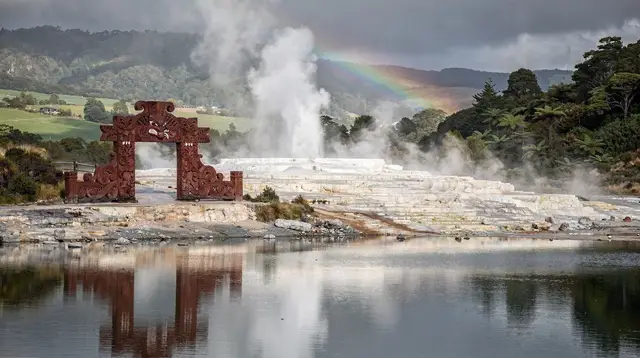
Pohutu has no fixed schedule, but it is active enough that most visitors who allow 60 to 90 minutes at the Te Puia or Whakarewarewa valley will see it. It typically erupts one to two times an hour, throwing water up to about 30 metres, and short bursts are frequent between the larger eruptions.
What “reliable” means for a geyser
Geysers are not machines. They depend on an underground plumbing system of cracks and chambers that fills with groundwater, gets heated past boiling point by the same magma that powers the whole Taupō volcanic zone, and eventually flashes to steam with enough pressure to blow the column of water above it into the air. Change the plumbing even slightly — a blocked vent, a shift in groundwater, an earthquake — and a geyser can slow down, change shape, or stop altogether. Most of the world’s geysers are unpredictable for exactly this reason.
Pohutu, in the Whakarewarewa geothermal valley, is the exception that gets called “the most reliable geyser in the Southern Hemisphere.” That claim is about consistency of activity, not a timetable. Pohutu does not erupt on a clock the way Lady Knox at Wai-O-Tapu does, where staff trigger an eruption at a fixed time each morning with a surfactant. Pohutu erupts on its own, from its own pressure, and it does so often enough that a visitor with a bit of patience will almost always see it happen. That is what “reliable” means here: not a schedule, but a very short average wait.
The numbers: how often, how high
On a typical day, Pohutu produces roughly one to two substantial eruptions an hour. Between those larger events, it rarely goes fully quiet — smaller surges, splutters and short bursts of a few metres are common, and they tend to build in frequency just before a bigger eruption arrives. A major eruption throws water somewhere in the range of 20 to 30 metres into the air, though the exact height shifts from one eruption to the next depending on underground conditions that day. There is no way to predict a specific eruption time or height in advance, and no operator or website can promise one.
What this means in practice: if you plan on 60 to 90 minutes in the Whakarewarewa valley, the odds of catching at least one clear eruption are good. Allow only 15 or 20 minutes and you are gambling — you might arrive during an active burst, or you might not.
| Geyser | Location | Schedule | Typical height |
|---|---|---|---|
| Pohutu | Whakarewarewa valley (Te Puia) | Unscheduled, natural, 1–2 major eruptions/hour | Up to ~30 m |
| Prince of Wales Feathers | Same mound as Pohutu | Unscheduled, often precedes Pohutu | Smaller, a few metres |
| Lady Knox | Wai-O-Tapu | Triggered daily by staff at a fixed morning time | Up to ~20 m |
Prince of Wales Feathers: the early warning
Standing just below Pohutu on the same geyser mound is a second, smaller vent called Prince of Wales Feathers. It shares Pohutu’s underground plumbing, and the two behave like connected pressure valves on the same system. In practice, Prince of Wales Feathers often starts spouting a few minutes before Pohutu builds to a full eruption — guides at Te Puia watch it for exactly that reason. If you notice the smaller vent starting to spit and spout more insistently, it is worth staying put rather than wandering off to another part of the valley; a larger eruption from Pohutu may follow shortly after.
This relationship is also why Pohutu’s activity has stayed unusually consistent for well over a century of recorded observation, compared with geysers elsewhere that have gone dormant after an earthquake or a change in groundwater use nearby. The valley’s geothermal plumbing has kept doing more or less the same thing it was doing when European visitors first began describing it in the 1880s.
Where to actually watch it
The main public vantage points sit at Te Puia, the national institute of Māori arts and crafts built around this section of the valley. Purpose-made platforms and boardwalks put visitors close to the geyser terrace without crossing onto ground that is genuinely dangerous — the surrounding silica terrace is fragile, hot in places, and off the marked paths for good reason. Te Puia combines the geyser viewing with carving and weaving workshops, a kiwi conservation area, and cultural performances, so a wait for an eruption is rarely dead time.
Next door, sharing the same thermal valley but run and ticketed separately, is Whakarewarewa Village, a living community where Tūhourangi Ngāti Wāhiao residents still cook using the geothermal steam in their own backyards. Pohutu is visible from parts of the village too, giving a second angle on the same geyser field from the perspective of people who have watched it their whole lives, not just from a tourist platform. Deciding between the two — or visiting both — is covered in more detail in the comparison of Te Puia and Whakarewarewa Village.
For a different kind of visit, an evening light trail through the valley lets you see the geyser and the surrounding thermal features illuminated after dark, when the steam catches the light in a way daytime visits do not offer.
an evening light trail through the Te Puia geothermal valley combines the geyser terrace with a guided night walk through the wider site.
How to time your visit
There is no app, sign, or livestream that tells you when Pohutu is about to erupt — treat any claim otherwise with scepticism. What you can control is how much time you give it and what you do while you wait.
- Arrive with time in hand. Build 60 to 90 minutes into your visit specifically for the geyser terrace rather than treating it as a five-minute photo stop on the way to somewhere else.
- Watch for Prince of Wales Feathers. Increased activity on the smaller vent is the best informal cue that Pohutu may be about to build.
- Don’t rush off after one small burst. Pohutu’s activity often comes in cycles — a lull can be followed by the largest eruption of the hour.
- Combine the wait with the rest of the site. At Te Puia this means the carving school, the kiwi house, and the wider Whakarewarewa forest nearby, rather than standing at the rail the entire time.
- Weather is not a reason to skip it. Rain does not affect the geyser’s underground mechanics, and cold, still air often makes the steam plume more visible and more photogenic than on a warm, dry day.
If your schedule genuinely cannot flex — a cruise-ship stopover from Tauranga, for instance, or a tight day-trip itinerary — it is worth knowing that Pohutu’s unscheduled nature is the trade-off for a park that, unlike Wai-O-Tapu’s Lady Knox, never asks you to show up at one specific hour.
Comparing your odds across Rotorua’s geothermal parks
Rotorua sits inside a wider volcanic zone with several distinct geothermal parks, and each one offers a different kind of certainty. Understanding the difference helps set expectations before you go, and is covered in full in the guide to choosing between Rotorua’s geothermal parks.
| Park | What’s scheduled | What isn’t |
|---|---|---|
| Te Puia / Whakarewarewa | Cultural performances, guided tours | Pohutu eruptions themselves |
| Wai-O-Tapu | Lady Knox Geyser, triggered daily mid-morning | Colour intensity of the Champagne Pool, which shifts with light and weather |
| Waimangu Volcanic Valley | Shuttle bus timetable through the valley | Frying Pan Lake and Inferno Crater’s exact appearance day to day |
| Hell’s Gate | Mud bath and spa bookings | Mud pool activity levels |
If a scheduled, guaranteed geothermal moment matters more to you than an unscheduled but frequent one, pairing a Pohutu visit with Wai-O-Tapu’s timed Lady Knox eruption on the same day covers both bases.
a half-day trip from Rotorua to Wai-O-Tapu Thermal Wonderland, timed around the Lady Knox eruption, works well as a same-day pairing with a morning at the Whakarewarewa valley.
entry to Wai-O-Tapu on your own schedule is the option if you’d rather drive yourself and set your own pace.
Beyond the geyser: the rest of the valley
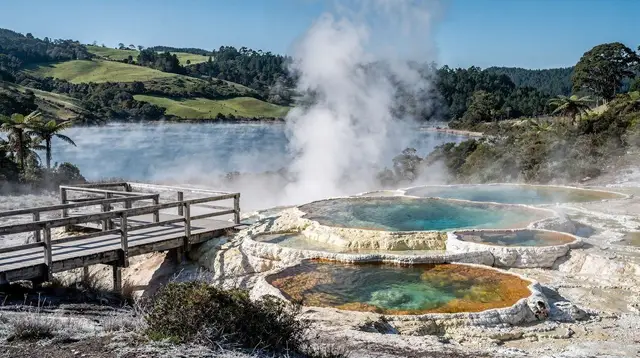
Pohutu is the best-known feature of the Whakarewarewa valley, but it sits inside a much larger active field of mud pools, silica terraces, and steaming ground that is worth seeing in its own right. If the smell of hydrogen sulphide that hangs over the whole city has you curious about the source, the valley’s boardwalks put you right above it. The wider geothermal picture across the region — including the bubbling mud pools and mud baths found at several parks — is worth reading before you decide how many geothermal sites to fit into a trip; most visitors do not need to see all of them.
For an afternoon that pairs geothermal walking with a broader introduction to the Rotorua area, a guided half-day trip covering several thermal features works as an alternative to a single-site visit.
a guided eco-thermal afternoon tour around Rotorua takes in more of the geothermal landscape beyond a single geyser terrace, with a guide explaining what’s happening underground.
Respect and context
Pohutu and the surrounding valley are not a backdrop; they sit at the centre of Te Arawa and specifically Tūhourangi Ngāti Wāhiao life, and Whakarewarewa Village is a place people actually live, not a reconstruction. The geyser’s name and the valley’s ongoing use for cooking, bathing, and daily life reflect a relationship with this ground that predates tourism by generations. Staying on marked paths matters for safety — some ground nearby is genuinely hot and unstable underfoot — but it also matters as a basic courtesy in a place that is someone’s home. General guidance on visiting Māori cultural sites respectfully, including terraces and thermal areas like this one, is covered in the Māori cultural etiquette guide for Rotorua.
Frequently asked questions about Pohutu Geyser
Does Pohutu Geyser erupt on a timetable?
No. Unlike Lady Knox Geyser at Wai-O-Tapu, which is triggered by staff at a set time each morning, Pohutu is entirely natural and unscheduled. It is simply active often enough that a reasonable wait almost always pays off.
How often does Pohutu actually erupt?
On an average day it produces one or two substantial eruptions an hour, with smaller surges and splashes in between. Activity can run in short bursts for minutes at a time, then quieten before building again.
How high does Pohutu erupt?
Major eruptions reach roughly 20 to 30 metres. Height varies eruption to eruption and depends on conditions in the geothermal field that day; there is no guaranteed maximum.
Where do you watch Pohutu from?
The main public viewing is from Te Puia, which has purpose-built platforms close to the geyser terrace. Pohutu also erupts within Whakarewarewa Village, the living Māori village next door, where residents have watched it from their own homes for generations.
What is Prince of Wales Feathers Geyser?
It is a smaller geyser sharing the same underground plumbing as Pohutu, sitting just below it on the same mound. Prince of Wales Feathers often starts spouting shortly before Pohutu, which is why guides treat it as an early cue that a bigger eruption may follow.
How long should I allow to see Pohutu erupt?
Budget at least 60 to 90 minutes at the valley if seeing an eruption matters to you, and treat anything shorter as a gamble. There is no way to guarantee timing in advance, so the safest approach is to build in enough time to wait it out.
Is Pohutu better in rain or in dry weather?
Rain does not stop Pohutu, and cold, damp air often makes the steam and spray more dramatic and photogenic. Geothermal valleys in general are not weather-dependent activities, which makes them a solid choice on a wet day.
Can I see Pohutu without paying for Te Puia?
Whakarewarewa Village, immediately next to Te Puia, sells its own entry and gives residents’ and guides’ views of the same geyser field, including Pohutu. The two sites share the same thermal valley but are run and ticketed separately.
Geothermal park tours on GetYourGuide
Verified deep-linked GetYourGuide tours. Book through these links and we earn a small commission at no cost to you.
Photos show the destination, not the operator's own images.