Why Does Rotorua Smell Like Sulphur?
Why does Rotorua smell like sulphur?
Rotorua sits inside the Taupō Volcanic Zone, where groundwater moves through hot rock and reacts with volcanic gases before reaching the surface as steam and mineral pools. The gas responsible for the smell is hydrogen sulphide, not sulphur itself, and it is what gives geothermal areas their rotten-egg odour. Most visitors' noses stop registering it within about 48 hours.
Most first-time visitors to Rotorua notice the smell before they notice anything else: a faint, sometimes not-so-faint, rotten-egg note in the air as soon as they step out of the car or off the plane. It is not a flaw in the town’s plumbing and it is not pollution in the usual sense. It is a direct, physical consequence of where Rotorua sits on the map, and understanding why it happens tends to do more to settle nerves than any reassurance ever could.
The Gas Behind Rotorua’s Rotten-Egg Smell
Rotorua is built inside the Taupō Volcanic Zone, a roughly 250-kilometre tear in the earth’s crust that runs from Whakaari / White Island in the Bay of Plenty down to Ruapehu in the central North Island. Underneath the town, magma sits close enough to the surface to heat groundwater to very high temperatures. That water doesn’t just get hot; it dissolves minerals and reacts with sulphur-bearing rock on its way up, and one of the by-products of that reaction is a gas called hydrogen sulphide.
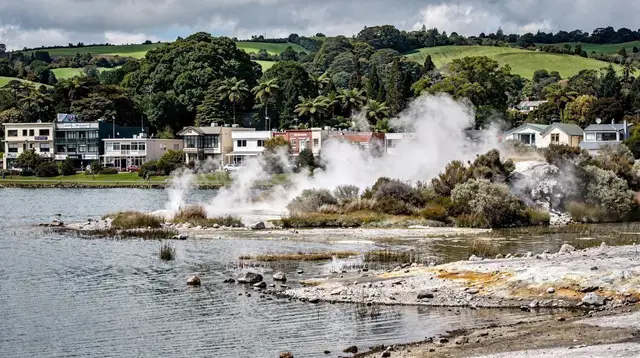
Hydrogen sulphide is the compound responsible for the classic rotten-egg smell associated with geothermal areas worldwide, from Yellowstone to Iceland. Rotorua’s version is distinctive mainly because of how much geothermal activity sits directly beneath an inhabited town rather than in an isolated national park. Steam vents from footpaths, drains, and cracks in ordinary suburban lawns because the geothermal field genuinely extends under residential streets, not only under the marked tourist attractions. For the full geological background on why this stretch of the North Island behaves this way, see why Rotorua is geothermal.
It’s worth being precise about the chemistry, because the smell often gets blamed on “sulphur” as if raw sulphur itself were floating through the air. It isn’t. Elemental sulphur, the yellow crystalline mineral visible around some vents and pools, is largely odourless on its own. The smell comes from hydrogen sulphide gas, a compound of hydrogen and sulphur that forms when geothermal water interacts with sulphide minerals underground and is released as the water surfaces or as steam escapes through the ground. The human nose is extraordinarily sensitive to this particular gas, capable of detecting it at concentrations far too low to register on many instruments, which is part of why the smell feels so immediate and unmistakable even in small amounts.
The 48-Hour Adjustment
The good news, and it is consistent enough to count as one of the most reliable pieces of practical advice for a Rotorua trip, is that the human nose adapts. Olfactory receptors that detect hydrogen sulphide fatigue relatively quickly under steady, low-level exposure. In practice, most visitors report that the smell is at its most noticeable in the first few hours after arrival, fades through the first day, and has become background noise they no longer consciously register by around the second day.
This is genuine sensory adaptation, not the gas itself weakening. Someone arriving fresh from the airport and stepping into your hotel room on day two will often ask “what’s that smell?” even though you stopped noticing it that morning. It is a useful thing to know before a trip: if the smell hits hard on arrival, that reaction is close to universal and near-certain to soften within about 48 hours rather than a sign that something is unusually wrong with your accommodation or the town in general.
A few practical implications follow from this timeline:
- A one-night stopover is the hardest way to experience Rotorua’s smell, since it often ends just as the adjustment period would normally kick in.
- Staying at least two nights, which most itinerary planning already recommends for seeing the region properly, naturally works with the adaptation curve rather than against it. See how many days in Rotorua for a fuller breakdown of typical stay lengths.
- Choosing accommodation a short distance from the most active geothermal ground can make the first evening noticeably easier, without meaningfully changing access to the attractions the following day.
Where It’s Strongest Around Town
The smell is not evenly spread across Rotorua. It correlates directly with proximity to active geothermal ground, and it varies with weather on top of that. The table below is a general guide to relative intensity rather than a precise measurement, since underground activity shifts over time and no two days are identical.
| Area | Typical intensity | Why |
|---|---|---|
| Geothermal parks (Te Puia, Wai-O-Tapu, Hell’s Gate, Waimangu) | Strong, expected | Sitting directly on or beside active vents, pools and craters |
| Southern edge of the central city, near geothermal reserves | Noticeable | Public land with active steam vents and mud pools within the town itself |
| Ōhinemutu and the lake’s southern shore | Noticeable, variable | Village built on active ground, close to lakeside geothermal features |
| Central business district, away from geothermal reserves | Mild to faint | Further from major vents, though still within the wider volcanic field |
| Lakefront away from the geothermal reserves, and northern/eastern suburbs | Faint to negligible most days | Greater distance from the most active surface features |
Calm, still weather tends to trap gas closer to ground level, so mornings after a windless night or immediately following rain are often when the smell feels most present, even in areas that are usually mild. Breezy days disperse it faster and can make a normally noticeable spot seem almost odourless. This is one reason the same visitor can have wildly different first impressions depending on the day they arrive, and why online reviews on the subject are so inconsistent with each other.
For visitors who want to plan their first exposure carefully, the geothermal parks comparison guide covers which sites are more or less intense, and the Wai-O-Tapu visiting guide gives a sense of what to expect at one of the stronger examples. Te Puia, Whakarewarewa Village, Waimangu Volcanic Valley and Hell’s Gate are the four sites where the smell is a built-in, expected part of the experience rather than an incidental side effect of the town itself.
Is It Actually Dangerous?
This is the question that matters most, and the honest answer has two parts: outdoors in ordinary tourist areas, no; in specific enclosed or unventilated situations close to a vent, it can matter, which is exactly why marked geothermal parks control where visitors walk.
At the low concentrations present in Rotorua’s outdoor air, most people experience hydrogen sulphide as an unpleasant smell rather than a health threat. It is a genuinely different situation from sulphur dioxide, a distinct gas more associated with volcanic eruptions and industrial emissions, which is not what causes the day-to-day Rotorua smell. Local and regional authorities monitor air quality in the town, and geothermal parks are designed with boardwalks and marked paths specifically to keep visitors away from higher-concentration pockets near active vents and craters rather than have people wander freely across thermal ground.
The situations where hydrogen sulphide becomes a real concern are fairly specific:
- Confined, poorly ventilated spaces directly above or beside an active vent, which is why straying off marked paths at geothermal parks is both a safety rule and a practical one.
- Low-lying depressions on very still days, where gas can pool close to ground level rather than dispersing.
- Extended, close-range exposure rather than the brief passing whiff most visitors experience while walking between attractions.
People with asthma or other respiratory sensitivities sometimes notice more irritation than the average visitor, particularly in those confined or low-lying spots, and it is reasonable for anyone in that position to check with a doctor before travelling and to be a little more cautious about lingering at the most intense sites. For a broader look at how geothermal areas are made safe for visitors and what the marked paths and barriers are actually protecting against, see Rotorua geothermal safety.
It’s also worth separating the ambient town smell from immersion in the geothermal water itself. Soaking in a hot pool or mud bath brings you much closer to the source, and that is addressed separately in the guides to Rotorua’s hot pools, mud baths and mud pools, and what to expect at the Polynesian Spa, along with the free hot springs scattered around the wider area.
Practical Ways to Manage the Smell
None of this requires elaborate preparation, but a few small choices make the first day or two noticeably easier for anyone who finds strong smells genuinely unpleasant rather than merely surprising.
Pick accommodation deliberately. Areas further from the main geothermal reserves and away from the lake’s southern shore are consistently milder, without any real trade-off in how central they feel. This matters more for a short stay than a longer one, since a longer trip gives adaptation time to do its work regardless of location.
Expect it, rather than being caught off guard. Visitors who know in advance that the smell is normal, temporary in terms of noticeability, and tied to a well-understood geological process tend to find it far less bothersome than those who arrive without warning. This single piece of context does more practical good than almost anything else in this guide.
Time your first visit to the strongest sites for later in the trip, if it helps. Arriving in Rotorua, settling in for a day, and then visiting Wai-O-Tapu or Waimangu once the adjustment has already begun is a reasonable way to soften the intensity of that first encounter, although it isn’t necessary for most people.
Weather-watch a little. If the smell is genuinely important to you, calm, humid, low-pressure days will be the most noticeable, and breezier days will be milder. This isn’t worth building an itinerary around, but it explains a lot of the variation people report.
Bring context to shared travel, not just tissues. Travelling with kids or anyone unfamiliar with geothermal towns goes more smoothly with a short explanation of what the smell is and why it’s there; the family-focused Rotorua guide covers this alongside other practical planning notes for visiting with children.
A guided visit to a geothermal park is also a reasonable way to experience the smell within its proper context rather than as an unexplained inconvenience, since guides typically explain what visitors are smelling and why, alongside the cultural and geological significance of the site. The Eco Thermal Afternoon Tour covers several active geothermal features with commentary along the way, and the Te Puia Māori Village and Rejuvenation Tour combines the geothermal valley with Te Arawa cultural context, including a look at Pōhutu geyser in full flow.
Visitors travelling in from Hamilton can combine the smell’s biggest source with a wider cultural itinerary on the Rotorua Wai-O-Tapu Te Puia with Haka day trip, and cruise passengers based in Tauranga have a dedicated option in the Rotorua Shore Excursion with Te Puia.
What the Smell Is a Sign Of
It’s easy to treat the sulphur smell as a nuisance to be tolerated, but it’s more accurate to see it as the most obvious, unmistakable evidence of exactly what makes Rotorua worth visiting in the first place. The same geothermal system responsible for the smell is what produces Pōhutu geyser, the mineral terraces at Wai-O-Tapu, the mud pools at Hell’s Gate, and the naturally heated pools threaded through the region. Lake Rotorua itself sits inside a volcanic caldera, and the wider region’s history, including the 1886 Tarawera eruption, is a direct continuation of the same underlying geology.
Visitors who arrive expecting a smell-free lakeside town are always going to be surprised. Visitors who understand it as a side effect of one of the most active and accessible geothermal fields anywhere in the world, one that has drawn travellers here since the 1880s, tend to find it becomes part of the character of the place rather than a complaint about it. For a broader, unfiltered take on what a Rotorua trip is actually like, including this and other adjustments first-time visitors tend to make, see the honest Rotorua verdict and the note on whether Rotorua feels overly touristy.
Sulphur Smell in Rotorua: Common Questions
Is the sulphur smell in Rotorua dangerous?
At the concentrations present in outdoor air around town, hydrogen sulphide is a nuisance rather than a hazard for most people. It becomes a genuine concern only in enclosed, poorly ventilated spaces close to a vent, which is one reason marked geothermal parks keep visitors on defined paths.
Why can’t I smell it after a day or two?
This is olfactory adaptation, not a change in the gas itself. The nose’s receptors for hydrogen sulphide fatigue quickly with steady low-level exposure, so the brain stops flagging a smell that was never actually getting weaker outside.
Which parts of Rotorua smell the strongest?
Areas sitting directly on active geothermal ground register the most, including the geothermal reserves at the southern edge of the central city and the thermal valleys just outside it. Neighbourhoods further from vents and away from the lake’s southern shore are noticeably milder.
Does the smell get worse in certain weather?
Still, cool, low-pressure conditions trap gas closer to the ground and make it more noticeable, which is why many visitors find the smell most obvious on calm mornings or just after rain. Wind and warmer, more mixed air disperse it faster.
Is it hydrogen sulphide or sulphur dioxide?
It is hydrogen sulphide, the gas produced when geothermal water reacts with sulphur-bearing minerals underground. Sulphur dioxide is a different compound, more associated with volcanic eruptions and industrial combustion, and it is not the source of Rotorua’s everyday smell.
Will I get used to it if I’m only staying one or two nights?
Short stays are often the hardest, since adaptation typically takes about 48 hours and a one or two night visit may end just as the smell starts to fade into the background. Choosing accommodation further from the geothermal reserves can soften the first impression.
Can the smell affect people with asthma or respiratory conditions?
People with pre-existing respiratory sensitivity sometimes notice more irritation than others, particularly in low-lying pockets on still days. Anyone with a known sensitivity to sulphur compounds should ask their doctor before a trip and avoid lingering in confined geothermal areas.
Does the whole city smell all the time?
No. Large parts of Rotorua smell like an ordinary lakeside town most of the time, and the sulphur note is strongest in specific pockets close to active ground rather than uniform across the city.
Trip-planning essentials on GetYourGuide
Verified deep-linked GetYourGuide tours. Book through these links and we earn a small commission at no cost to you.
Photos show the destination, not the operator's own images.