Māori Cultural Etiquette in Rotorua: A Visitor's Guide
What are the basic etiquette rules for a Māori cultural experience in Rotorua?
Follow instructions from your host at all times, take your shoes off if asked before entering a building, don't sit on tables or eat while walking around, ask before photographing people or carved meeting houses, and treat the visit as someone's living culture rather than a performance staged for tourists.
Why the small rules matter here
Rotorua sits at the centre of the Te Arawa rohe, the traditional territory of the Te Arawa confederation of Māori tribes, and it has been welcoming outside visitors to its geothermal valleys and villages since the 1880s. That history means most cultural experiences here are genuinely practised, not staged for the season: people live in Whakarewarewa Village, cook with geothermal steam as their grandparents did, and host manuhiri (guests) as an extension of everyday marae protocol rather than as a costume. Reading a full history of that relationship is worth doing before you go — see our guide to Te Arawa history in Rotorua for the background.
None of the etiquette below is complicated, and no host expects a visitor to already know it. What they do notice, and what genuinely causes offence, is a visitor who ignores clear instructions, treats a ceremony as a photo backdrop, or handles sacred objects like props. This guide covers the handful of situations most tourists actually encounter — a marae welcome, a wharenui, a hāngī meal, a performance — and what’s expected in each.
Marae: what it is and how the same rules travel
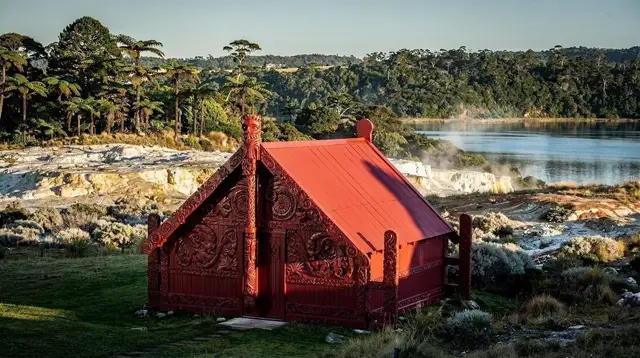
A marae is a fenced, purpose-built complex belonging to a hapū (sub-tribe) or iwi (tribe), built around a carved wharenui (meeting house) and a marae ātea, the open space in front of it where formal welcomes and challenges happen. It functions as a community hub for funerals, meetings, celebrations and the education of tribal history — it is not a museum exhibit, even when a version of it is built specifically to receive tourists, as at several Rotorua venues.
Because commercial cultural experiences in Rotorua are often designed by the same iwi and hapū that run private marae, the protocols transfer directly: you’ll be welcomed as a group, guided in where to walk and sit, and asked to follow the same sequence a genuine pōwhiri (formal welcome) would use. Practical points that come up in almost every setting:
- Wait to be called forward. Visitor groups are usually gathered outside a gate or entrance and led in together rather than wandering in individually.
- Follow your host’s line, not your own instinct. Where you sit, when you stand, and when you can move around are all directed — this isn’t about restricting you, it’s the same structure a Māori guest would follow.
- Stay quiet during speeches (whaikōrero) and songs (waiata). Conversation, phone calls and photography during formal speaking are the etiquette lapses hosts notice most.
- A hongi may be offered. This traditional greeting — pressing noses and often foreheads together to share the breath of life — is optional and led entirely by the host; there’s no wrong way to receive one if you simply stay still and follow their lead.
Several evening experiences package this welcome alongside a full performance and meal — comparing formats side by side is covered in our guide to Māori cultural experiences in Rotorua compared, and one option built specifically around the pōwhiri sequence is the evening cultural experience with a hāngī dinner near Rotorua.
Shoes: on or off depends on the building
This is the single most common etiquette question, and the honest answer is that it varies by venue, so watching your host and asking is more reliable than any blanket rule:
| Setting | Typical expectation |
|---|---|
| Wharenui (meeting house) interior | Shoes off, almost always |
| Dining hall for a hāngī meal | Shoes on |
| Outdoor performance area or amphitheatre | Shoes on |
| Geothermal walkways (Te Puia, Whakarewarewa) | Shoes on — required for safety |
| A home you’re invited into in Ōhinemutu | Shoes off, as with most NZ homes |
The reasoning behind removing shoes for a wharenui is the same idea that runs through most Māori protocol: the floor of a meeting house is treated as an extension of the ancestors it represents, and bringing in dirt from outside is disrespectful to that space. Staff at ticketed venues will tell you clearly when this applies — you won’t be left guessing at the door.
Tapu and noa: the logic underneath the rules
Two concepts explain almost every specific rule you’ll encounter, and understanding them makes the individual instructions make sense rather than feel arbitrary:
- Tapu means sacred, restricted or set apart. Heads, meeting houses, certain ceremonial objects and some natural sites carry tapu. Lake Rotokākahi (the Green Lake), for instance, is tapu and closed to public access entirely — no boats, no swimming, regardless of how inviting it looks from the road.
- Noa is the opposite state: ordinary, unrestricted, free of tapu. Food is noa, which is precisely why food and the head — the most tapu part of the body — are never mixed: you won’t see anyone pass food over someone’s head, sit on a table, or put a hat down on a dining surface in a Māori setting.
Once this framework clicks, several “odd” rules stop feeling random. Don’t sit on tables, don’t put bags or clothing where food is served, and don’t touch someone’s head — even a child’s — without real familiarity. None of this requires memorising a list; it follows from a single, consistent idea about what belongs together and what doesn’t.
Food: hāngī, karakia and shared tables
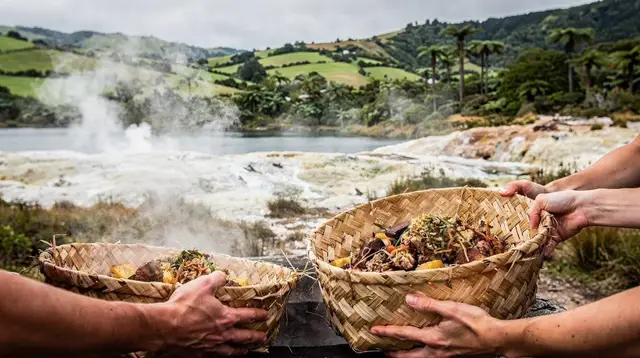
A hāngī is food cooked in an earth oven — in Rotorua, commonly using geothermal steam instead of the traditional heated-rock pit, since the ground itself does the work. Full detail on how it’s prepared and where to genuinely eat one is in our guide to hāngī: what it is and where to eat one. At most cultural evenings, the meal follows the performance and welcome rather than opening the event, and a few habits smooth the experience:
- Wait for the signal to start eating. A karakia (blessing) is frequently said before a shared meal, and starting to eat during or before it is one of the more noticeable lapses a visitor can make.
- Let hosts explain the food. Hāngī-cooked meat, kūmara (sweet potato) and vegetables are usually introduced by name and method — it’s worth listening rather than treating it as a generic buffet.
- Table manners are ordinary table manners. Nothing about eating itself is unusual; it’s what happens around the table — sitting on it, putting non-food items on it — that carries meaning.
Full evening formats built around exactly this sequence — welcome, performance, hāngī dinner — include the three-hour evening cultural tour departing from Rotorua, which runs on the same welcome-to-meal structure described above.
Photos: usually fine, sometimes ask first
Rotorua’s cultural venues depend on visitors sharing their experience, so photography during a performance is typically welcomed rather than restricted. Where it’s worth pausing to ask first:
- Close-up portraits of individual performers or hosts, especially outside the general performance — a quick “may I take your photo?” is normal practice and rarely refused.
- Interior carvings and tukutuku panels inside a wharenui, since some carved elements represent specific ancestors and some venues restrict photography inside the house for that reason. Signage or your guide will say so.
- Any moment your host explicitly asks you to watch rather than record — this comes up occasionally during a wero (ceremonial challenge) or a particularly significant part of a welcome, and it’s stated clearly when it applies.
Cruise passengers on a tight schedule often combine a cultural stop with the geothermal valley itself; the shore excursion to Rotorua with a visit to Te Puia pairs a guided cultural introduction with time at Pōhutu geyser, and the same photo etiquette applies across both halves of the day.
Haka: more than the war dance visitors expect
Most visitors arrive expecting haka to mean only the aggressive challenge performed before rugby matches, but haka is a broader category of chanted, rhythmic performance used to mark occasions of all kinds — welcome, celebration, mourning, and yes, challenge. A dedicated explainer on the different forms and their meaning is at haka: what it means. The etiquette during one is simple: stay still, stay quiet, and don’t join in uninvited — performers occasionally invite visitor participation in softer, teaching-oriented moments, and that invitation will be unmistakable when it happens.
Handling sacred and ceremonial objects
Carved weapons, cloaks, adzes and other taonga (treasured objects) shown during a performance or displayed at a site like Te Puia are not props. A few venues offer a supervised, explained moment to hold or wear something as part of a guided activity — that’s fine, since it’s offered deliberately and explained in context. Picking an item up yourself, asking to borrow a performer’s costume piece for a selfie, or handling a carving inside a wharenui without invitation are the situations that actually cause discomfort. When something is meant to be touched, a host will say so.
Language: a little goes further than expected
You’ll hear te reo Māori used naturally throughout a cultural visit — in welcomes, in song, in place names — and using a few words back is noticed and appreciated, never expected as a test. “Kia ora” as a greeting or thank-you, and getting place names close to correct (Rotorua has no macron; nearby Ōhinemutu and Taupō do) go a long way. Our phrasebook-style guide to te reo Māori words for travellers covers the handful worth learning before you arrive, and how to pronounce New Zealand place names helps with the geothermal valley names you’ll be reading on signage all week.
Koha and paying respect without overthinking it
Koha is a voluntary contribution or gift, traditionally offered to a host in acknowledgment of hospitality — it’s a two-way exchange of respect, not a fee. On a ticketed commercial cultural evening, your ticket price already covers this, so no separate koha is expected; you won’t be asked for one and offering cash at the door of a paid venue would be unusual rather than polite. Koha becomes relevant mainly if you’re invited onto a private marae outside a commercial setting, in which case your host or a local contact will guide you on what’s appropriate.
Choosing an experience with this in mind
Not every “Māori cultural show” in Rotorua is run the same way, and the etiquette above matters more at some venues than others simply because of how embedded the hosts are in the community they represent. Whakarewarewa Village is a living village where residents host visitors in their own home ground; Te Puia combines a cultural performance with the national māori arts and crafts institute and the geothermal valley itself. A side-by-side comparison of the two is in Te Puia versus Whakarewarewa Village, and a broader look at Rotorua’s carving schools and weaving traditions is in Māori arts and crafts in Rotorua.
If you’re planning a full day or two around this theme rather than a single evening, our two-day Māori culture itinerary sequences a daytime and evening experience together, and general respectful-visitor guidance beyond culture specifically — covering geothermal areas, native forest and conservation — is summarised in the Tiaki Promise explained.
Daytime options that combine a cultural welcome with the geothermal valley itself, without committing to a full evening, include the Rotorua eco-thermal afternoon tour, which sets a lower-key pace for visitors who prefer a shorter first exposure to the protocols above before an evening hāngī experience.
A short list to carry in your head
If none of the above sticks beyond one afternoon, this is the compressed version:
- Do what your host does, and ask before you photograph a person up close.
- Shoes off in a wharenui, on almost everywhere else — check if unsure.
- Nothing goes on a table except food, and nothing sits on you above the shoulders you didn’t put there yourself.
- Wait for the karakia before eating.
- Stay quiet and still during speeches, songs and haka unless invited to join.
- Treat carved objects and cloaks as belonging to someone, because they do.
None of it is a test to pass. Hosts in Rotorua welcome thousands of visitors a year precisely because sharing this culture, on these terms, is something Te Arawa communities have chosen to keep doing — the etiquette exists to keep that choice comfortable on both sides.
Māori culture & heritage tours on GetYourGuide
Verified deep-linked GetYourGuide tours. Book through these links and we earn a small commission at no cost to you.
Photos show the destination, not the operator's own images.