Rotorua vs Taupo: Where Should You Base Yourself?
Should I base myself in Rotorua or Taupo?
Base in Rotorua for geothermal parks, Māori cultural experiences, mountain biking and the widest range of accommodation and food. Base in Taupo for the lake, Tongariro National Park, and outdoor activities built around water and mountains. The two towns sit about an hour apart on the same road, so most visitors see both regardless of where they sleep.
Same Road, Two Different Trips
Rotorua and Taupo sit about an hour apart on State Highway 5, both inside the Taupō Volcanic Zone, both built around a lake, and both firmly on the North Island tourist route. From there they diverge. Rotorua is a caldera town that smells faintly of sulphur, ringed by geysers, mud pools and Māori cultural sites. Taupo is a lakeside town with New Zealand’s largest lake at its front door and Tongariro National Park an hour further south. Neither is a detour from the other; most travellers see both. The real question is which one earns your nights, and this guide works through that by what you actually came for rather than by which town is “better.”
What Rotorua Is Built Around
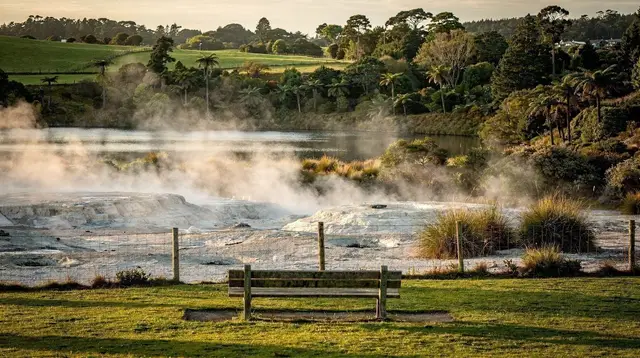
Rotorua’s identity is geothermal and cultural. The city sits inside an active caldera, part of the roughly 250-kilometre Taupō Volcanic Zone that runs from Whakaari/White Island to Ruapehu, and it shows: steam rises from footpaths and lawns around town, and the smell of hydrogen sulphide is part of arriving here, not a sign anything is wrong.
Within a short drive you get Whakarewarewa Village, where Tūhourangi Ngāti Wāhiao residents still live and cook with geothermal steam, and Te Puia next door, home to Pōhutu, the most reliable geyser in the Southern Hemisphere. Further out are Wai-O-Tapu with its Champagne Pool and the clockwork Lady Knox Geyser, Waimangu Volcanic Valley, and Hell’s Gate, the only reserve where visitors can enter a mud bath. This concentration is the main reason Rotorua, not Taupo, tends to be the base of choice: several very different geothermal experiences sit within thirty minutes of the city centre, so an itinerary can be built with minimal driving.
Our guide to choosing between Rotorua’s geothermal parks breaks down which ones overlap and which don’t.
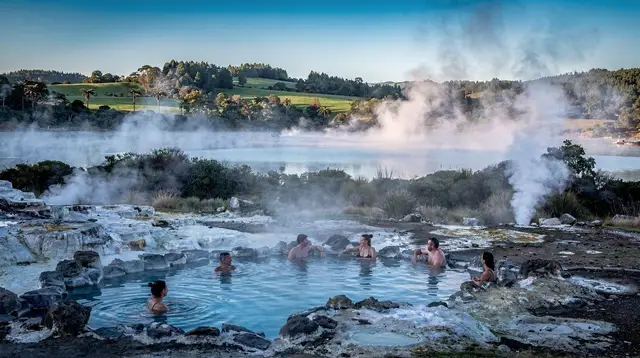
Rotorua is also the centre of Te Arawa, and Māori culture here is lived, not staged for visitors. Ōhinemutu, a Ngāti Whakaue village inside the city, has a working marae and St Faith’s Church. Evening cultural experiences pairing a hāngī with performance are common and worth comparing before booking — see our rundown of Rotorua’s Māori cultural experiences. For a single outing that combines several strands of what Rotorua does well, a guided visit such as the Te Puia visit that pairs the geyser field with a cultural welcome and a soak afterwards covers geothermal sights and culture in one afternoon.
Rotorua also carries most of the region’s adventure and forest activity: mountain biking through the Redwoods, rafting on the Kaituna at Okere Falls, and ziplines through native bush. A combo built around this side of Rotorua, like the zipline and whitewater rafting combo that finishes with a sauna, fills a full day without leaving a 20-minute radius of town.
What Taupo Is Built Around
Taupo’s centre of gravity is water and mountains rather than steam vents. Lake Taupo is 616 square kilometres, the caldera of a supervolcano, and the town sits right on its northern shore. The lake supports boat trips to the Mine Bay rock carvings, kayaking, and trout fishing that draws people back year after year — trout that, as everywhere in New Zealand, can’t be bought in a restaurant, only caught. Closer to town, the Huka Falls force the Waikato River through a narrow gorge, and Craters of the Moon gives Taupo its own, smaller-scale geothermal walk.
The bigger draw south of Taupo is Tongariro National Park, New Zealand’s oldest national park and a dual World Heritage site for both its natural and cultural values. The Tongariro Alpine Crossing, a 19.4-kilometre day walk past active volcanic cones including Ngauruhoe and Ruapehu, starts closer to Taupo and Turangi than to Rotorua, and it’s a genuine draw for anyone building a trip around hiking rather than thermal parks. Our Tongariro Alpine Crossing from Rotorua guide covers timing if you’re doing it as a long day trip either way.
Taupo is also where the region’s bigger adrenaline activities concentrate — bungy jumping and skydiving both operate here rather than in Rotorua, something worth knowing if a specific activity is the reason for the trip; see Taupo bungy and skydiving. Jet boating on the Waikato near the Huka Falls is another Taupo-specific outing, covered in Huka Falls and Taupo jet boats.
Side by Side
| Rotorua | Taupo | |
|---|---|---|
| Landscape | Active geothermal caldera, city built into it | Lake and river town, mountains to the south |
| Main draw | Geysers, mud pools, Māori culture | Lake activities, Huka Falls, Tongariro access |
| Adventure focus | Mountain biking, rafting, ziplines | Bungy jumping, skydiving, jet boating |
| Distance to Tongariro | About 2 hours 20 minutes | About 45 minutes to 1 hour (Turangi closer) |
| Accommodation range | Widest in the region — hostels to lakefront hotels | Smaller, lakefront-heavy, motels and hotels |
| Best short-trip base | Yes — most sights within 30 minutes | Better for a mountain- and lake-focused trip |
| Smell/atmosphere | Sulphur, steam from footpaths | None of that — a standard lake town |
If You Came for Geothermal Parks and Culture
Base in Rotorua. Nothing about the geothermal sights or the cultural experiences is closer from Taupo, and doing Wai-O-Tapu, Te Puia or Hell’s Gate as day trips from Taupo adds an unnecessary hour each way. If a cultural evening with a hāngī is on the list — see hāngī: what it is and where to eat one — Rotorua has by far the wider choice of operators. An outing like the guided walk through an active thermal reserve with a Māori guide narrating the landscape is a straightforward half-day from a Rotorua base and hard to match in convenience from Taupo.
If You Came for the Lake, Rivers and Mountains
Base in Taupo, particularly if the Tongariro Alpine Crossing or a lake-based activity like kayaking to the Mine Bay carvings is the centrepiece. Doing the Crossing as a day trip from Rotorua is possible but long, usually meaning an early transport pickup and a late return; based in Taupo or Turangi, it’s a shorter and less rushed day. If skydiving or bungy jumping matters more than geothermal sights, Taupo removes the extra driving Rotorua would otherwise add.
Families
Rotorua generally works better with children because the sights are compact and varied without long drives: a thermal park in the morning, the Redwoods or a farm show in the afternoon, with none of it more than 20 to 30 minutes from most accommodation. Taupo’s activities — jet boats, the lake, Tongariro — tend to suit slightly older kids and involve more time in the car or on the water per outing. If travelling with children, our Rotorua with kids guide has more on sequencing a family-friendly few days, and a gentler outing like a horse trek through farmland and forest is an easy half-day that works for most ages without technical difficulty.
Couples and Short Breaks
For a two- or three-night trip, Rotorua’s concentration of sights matters more than it does on a longer itinerary — every hour not spent driving is an hour spent doing something. A short trip built around Rotorua can realistically cover a thermal park, a cultural evening and a scenic outing like the Blue and Green Lakes without feeling rushed. Taupo suits a similar short break if the plan is specifically the lake and a day at Tongariro, but trying to add Rotorua’s cultural sights onto a Taupo-based short trip usually means one long day rather than two relaxed ones. Our how many days in Rotorua guide and the 3-day Rotorua itinerary both assume a Rotorua base for this reason.
Budget Travellers
Rotorua has the wider spread of accommodation, from holiday parks and hostels through to full-service hotels, and that range keeps genuinely low-cost options on the table even in peak season — see Rotorua on a budget and Rotorua’s free things to do, several of which are geothermal (Kuirau Park costs nothing to walk through). Taupo’s accommodation skews more heavily toward lakefront motels, which can carry a premium for the view even when the room itself is modest. As a rough guide, a budget traveller in either town should plan on the same broad range covered in tipping and costs in New Zealand — tipping isn’t expected in either place, and the displayed price already includes GST.
Doing Both Without Overcomplicating It
Because the drive between them is about an hour, most visitors don’t need to choose exclusively — they base in one and day-trip to the other. Basing in Rotorua and taking a Rotorua to Taupo day trip covers Huka Falls and a look at the lake without changing accommodation. Basing in Taupo and driving up to Rotorua for a day works the same way in reverse, though it compresses the geothermal and cultural sights into a single day rather than spreading them out. If Tongariro is the priority alongside Rotorua’s geothermal parks, a structured loop like the Rotorua–Taupo road trip is built around exactly this trade-off, spending a few nights in each rather than forcing a single-base compromise.
For a broader look that includes a cultural add-on along the way, tours running from further afield — for instance the day trip from Hamilton that combines Wai-O-Tapu with Te Puia and a haka performance — show how tightly these two towns’ highlights can be linked into one day for visitors not staying overnight in either.
Climate and Timing
Both towns share the same inverted, Southern Hemisphere seasons — summer runs December to February, winter June to August — and neither has a dry season; rain falls throughout the year in this part of the North Island. Rotorua’s geothermal parks are often more atmospheric in cooler weather, when steam shows up more visibly against the cold air, while Taupo’s lake activities are more comfortable in summer’s warmer water and longer daylight. Neither town has a true off-season for tourism. More detail on seasonal planning, including UV exposure in summer, is in best time to visit Rotorua and Rotorua weather month by month.
The Short Version
If the trip is about geothermal parks, Māori culture, mountain biking or a short, sight-dense stay, base in Rotorua — it has the wider range of accommodation and the least driving between highlights. If the trip is about the lake, Tongariro National Park, or the region’s bigger adrenaline activities, base in Taupo or push on to Turangi. For anything longer than three or four days, don’t force a single-base decision: an hour’s drive links the two towns closely enough that most itineraries end up including both, and the road trip approach in our combined itinerary is built specifically around that reality rather than around picking a winner.
Frequently Asked Questions About Basing in Rotorua vs Taupo
Is Rotorua or Taupo better for a first visit to New Zealand?
Rotorua is the more common choice for a first visit because it concentrates geothermal sights and Māori cultural experiences within a short drive of town, and it has more beds, restaurants and organised tours to fall back on if plans change.
How far is Taupo from Rotorua?
About an hour by car on State Highway 5, roughly 80 kilometres. Both towns work as a day trip from the other, which is why many itineraries base in one and visit the other rather than splitting nights between them.
Which town is better for families?
Rotorua tends to suit families better because attractions are shorter and more varied within a small radius, from thermal parks to farm shows to the Redwoods, with less driving between stops than Taupo’s more spread-out, outdoor-focused activities.
Does Taupo have geothermal sights like Rotorua?
Taupo has some, including Craters of the Moon, but nowhere near Rotorua’s concentration of geysers, mud pools and thermal reserves. Taupo’s landscape is built around its lake and the volcanoes of Tongariro National Park rather than active geothermal fields.
Can I stay in one town and do everything from there?
Yes. Rotorua and Taupo are close enough that day trips in either direction are straightforward, so basing in one and visiting the other for a day covers most of what people come for without changing accommodation.
Which town has better access to Tongariro National Park?
Taupo, and specifically Turangi further south, sit closer to the Tongariro Alpine Crossing trailheads. From Rotorua the crossing is a longer day, usually with an early transport pickup, so travellers focused on Tongariro often base in or near Taupo.
Is one town more expensive than the other?
Neither is consistently cheaper. Rotorua has a larger range of accommodation types, including budget holiday parks and hostels, while Taupo’s lakefront motels and hotels can carry a premium for water views. Prices in both move with season rather than town.
Which town is better for a short two- or three-day trip?
Rotorua, because it packs geothermal parks, cultural experiences and adventure activities into a smaller radius, so a short trip loses less time on the road than one split around Taupo’s more spread-out lake and mountain attractions.
Popular Rotorua experiences on GetYourGuide
Verified deep-linked GetYourGuide tours. Book through these links and we earn a small commission at no cost to you.
Photos show the destination, not the operator's own images.