Māori Rock Carvings at Lake Taupō: Boat, Sail, or Kayak
How do you see the Māori rock carvings at Lake Taupō?
The carvings sit in a cove on a cliff face at Mine Bay, on the western shore of Lake Taupō, and there is no road or track to them. They are reached only by water, most commonly on a scheduled lakefront cruise from Taupō, or under sail, or by self-paddled kayak for anyone comfortable on open water.
A Cliff Face You Will Never See From the Road
Drive the western edge of Lake Taupō and nothing gives it away. No sign, no car park, no lookout points toward it. The cove sits under a stretch of ordinary-looking bush and rock at Mine Bay, and from the shoreline road there is simply no line of sight into it. The only way to know it exists is to already know it exists — or to be standing in a boat, a yacht, or a kayak on the water in front of it, looking up at ten metres of carved face staring back down.
That carving is Ngātoroirangi. It is one of the largest Māori rock carvings in the country, and one of the newest: cut into the cliff over several years in the late 1970s and finished in 1980. It is not a ruin, not an archaeological find, and not something local iwi stumbled on and decided to protect. It was made deliberately, by hand, by people who wanted this stretch of Lake Taupō to carry a face and a story where before it carried only rock.
Who Ngātoroirangi Is, and Why He’s on This Cliff
In Te Arawa tradition, Ngātoroirangi was the tohunga, the priest-navigator, who guided the ancestral waka into this part of the North Island and is credited with naming a string of landmarks across the wider region as he travelled — the same tradition that ties his name to the volcanic country running south toward Tongariro National Park. Placing his likeness on a cliff above Lake Taupō is not decoration. It is the same instinct that runs through the meeting houses, gateways, and carved figures found across the Rotorua region: a way of keeping an ancestor visibly present in a place that matters, rather than filing him away in a book.
That is also why the carving reads differently once you know it is recent. It was not made to be found by accident or admired as a curiosity. It was placed here, by a community, to be looked up at from the water — which is exactly how everyone who visits it still sees it today, cruise passenger and self-paddling kayaker alike.
Cove, Not Roadside: What’s Actually There
The carving sits in a cove where the cliff drops straight into the lake with no beach, no ledge, and no way to land a boat. The main figure of Ngātoroirangi dominates the rock face at around ten metres tall, and it shares the cove with smaller carved figures alongside it, all cut into the same stretch of stone. There is nothing else built around it — no visitor centre, no signage at the site itself, no facilities. The experience is entirely the approach by water, the few minutes in front of the cliff, and the return.
Because there is no landing point, every visit happens from the deck of a boat or the seat of a kayak, at a respectful distance from the rock. That is not a restriction imposed on tourists so much as simply how the place is built: a cliff with no shore.
How to Get There: Boat, Sailboat, or Kayak
Three ways to reach Mine Bay exist, and they suit different budgets, timeframes, and appetites for effort.
| Option | Typical duration | Effort required | Best for |
|---|---|---|---|
| Scheduled lakefront cruise | Roughly 1.5–2 hours round trip | None — seated the whole way | Most visitors, families, limited time |
| Sailing trip | Similar to a cruise, weather-dependent | None to light | Visitors who want a quieter, wind-powered crossing |
| Self-paddled kayak | Several hours round trip | Moderate to high | Fit, experienced paddlers comfortable on open water |
A scheduled cruise from the Taupō lakefront is the straightforward option: fixed departure times, a set route out to the cove and back, and no planning beyond turning up. For a shorter version that still gets you in front of the carving without committing a full morning, look at a scenic option built specifically around the carvings —
a 1.5-hour scenic cruise to the Māori rock carvings— while a longer lakefront cruise gives more time on the water and often takes in more of the shoreline along the way:
a lakefront cruise to the Māori rock carvingsSailing trips cover similar ground under canvas rather than engine, which makes for a quieter approach but leaves timing more exposed to wind. Kayaking is the only option that puts you directly at water level in front of the cliff under your own effort, and it is worth being honest about what that takes: Lake Taupō is large enough to turn choppy quickly, the return paddle runs to several hours, and it is not the place to learn to kayak for the first time. Checking conditions with a local operator before heading out independently is the sensible move rather than an optional extra.
Getting to Taupō From Rotorua
Taupō sits around an hour’s drive south of Rotorua, making the rock carvings an easy addition to a day already built around the lake town rather than a destination requiring its own overnight stay. Most visitors pair the cruise or kayak trip with other things Taupō does well — the forced, narrow channel of Huka Falls, or a look toward Tūrangi and the northern edge of Tongariro further south. If you are driving yourself, a look at driving in New Zealand as a visitor covers the basics of the road rules before you head south on State Highway 5.
Anyone treating this as one stop among several on a single day should read through a broader Rotorua to Taupō day trip guide, which lines up the drive time against what else realistically fits in daylight hours.
When to Go, and What the Weather Does to the Trip
Lake Taupō sits in the same broadly temperate, no-dry-season climate as Rotorua, which means rain and wind are possible in any month rather than confined to a particular season. Wind matters more here than rain: a cruise or sailing trip can be delayed or rerouted in rough conditions, and a self-paddled kayak crossing is the option most affected by a windy day on open water. Summer offers longer daylight and calmer average conditions for being out on the lake; winter brings cooler air and a better chance of the sky and water reading as sharp and clear once the wind drops. A look at Rotorua’s weather month by month and the best time to visit the wider region gives a sense of what to expect before booking a specific date.
Because the site depends entirely on getting out onto open water, it is one of the more weather-sensitive activities in the area — worth checking the forecast and the operator’s own guidance the day before rather than assuming any option will run regardless of conditions.
A Sacred Site, Seen From a Respectful Distance
The carving of Ngātoroirangi is not a roadside attraction with a fence around it; it is a cultural work placed by a community into a landscape they consider significant, on a lake that Te Arawa and neighbouring iwi hold ancestral ties to. There is no landing point at the cove, and that absence is not an oversight — the standard way to experience the site is to view it from the water without stepping onto the rock or attempting to reach the carving directly. Treating the carving the way you would treat a marae or a wharenui carving — as something living and connected to people today, not a museum piece — is the right frame for the visit.
For more on the wider etiquette expected of visitors around Māori sites in this region, see Māori cultural etiquette in Rotorua, and for the background on the iwi whose history runs through this whole area, the history of Te Arawa in Rotorua. The country-wide visitor commitment known as the Tiaki Promise, covered in what the Tiaki Promise actually asks of visitors, applies here as much as anywhere else on the itinerary.
Pairing the Carvings With the Rest of a Taupō Day
Because the boat trip out and back rarely fills an entire day, most visitors build it into a longer stop in Taupō. A Rotorua–Taupō road trip over several days gives room to add Huka Falls, the geothermal ground further south, and a look toward Tongariro without rushing any single stop. On a tighter single-day version, the rock carving cruise or kayak trip fits comfortably alongside a stop at Huka Falls in the same afternoon.
If You Want More Māori Culture Around Rotorua
The Mine Bay carvings are a Lake Taupō experience rather than a Rotorua one, and they are best understood as one part of a wider picture rather than a stand-alone souvenir photo. Rotorua itself carries the denser concentration of living Māori culture in the region, and a side-by-side look at how Rotorua’s main cultural experiences compare is worth reading before deciding how to spend the rest of a trip. A traditional performance is one of the more accessible starting points —
a Māori cultural performance with traditional dance— and for a site with its own carved history closer to Rotorua, the settlement destroyed in the 1886 Tarawera eruption offers a different, sobering angle on how carving, story, and place intersect:
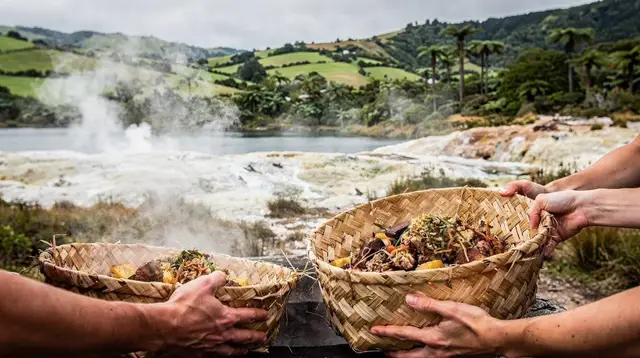
a visit to the Buried Village of Te WairoaIf food is part of how you want to understand the culture rather than only its visual art, what a hāngī is and where to eat one rounds out the picture the rock carvings only hint at from a distance.
Māori Rock Carvings at Lake Taupō: Frequently Asked Practical Questions
Can you drive or walk to the Māori rock carvings at Lake Taupō?
No. The carvings are cut into a cliff at Mine Bay on the lake’s western shore, and there is no public road, trail, or lookout that reaches them. The only approach is across the water, by boat, sailboat, or kayak.
Who is carved into the cliff at Mine Bay?
The main figure, around ten metres tall, represents Ngātoroirangi, the tohunga credited in Te Arawa tradition with guiding the ancestral canoe to this region and naming key landmarks around the lake. Smaller figures accompany the main carving in the same cove.
When were the Lake Taupō rock carvings made?
They are modern, not ancient: carving began in the late 1970s and the main figure was completed in 1980, made by a small group of Māori carvers as a community project rather than a historic or archaeological work.
How long does a cruise to the rock carvings take from Taupō?
Scheduled lakefront cruises to Mine Bay and back typically run from around ninety minutes to a couple of hours, depending on the operator and whether the trip includes other stops on the lake.
Is kayaking to the Māori rock carvings difficult?
It suits a reasonably fit paddler comfortable on open water rather than a first-time kayaker. Lake Taupō can turn choppy with little warning, the paddle to Mine Bay and back takes several hours, and conditions should be checked with a local operator before setting out independently.
Can you get out of the boat and touch the carvings?
No. The cove has no landing point, the cliff drops straight into the water, and the site carries cultural significance that rules out climbing on or touching the rock. Viewing is from the water only, and that is also the respectful way to experience it.
Is Lake Taupō the same trip as Rotorua’s geothermal parks?
No, they are separate destinations about an hour apart by road. The rock carvings are a Lake Taupō activity, usually done as part of a day trip from Rotorua rather than combined with Rotorua’s own geothermal parks in a single outing.
Do you need to book the rock carving cruise in advance?
Booking ahead is the safer approach, particularly in summer and around school holidays, since scheduled cruises run at fixed departure times and can fill. Weather can also affect sailings, so checking conditions before travelling from Rotorua is worth the extra step.
Māori culture & heritage tours on GetYourGuide
Verified deep-linked GetYourGuide tours. Book through these links and we earn a small commission at no cost to you.
Photos show the destination, not the operator's own images.