A geothermal valley you only reach by boat
Most of the geothermal sites around Rotorua are drive-up: park, walk in, follow the boardwalk. Orakei Korako breaks that pattern. The valley sits on the shore of Lake Ohakuri, an artificial lake created when the Waikato River was dammed for hydroelectric power in the 1960s, and the only way in is a short boat crossing operated by the site itself. That single detail — no road access, no car park next to the terraces — is the reason Orakei Korako stays quieter than Wai-O-Tapu or Waimangu, even though it sits in the same volcanic zone and shows some of the same features at a larger scale.
The name is usually translated as referring to a place of adorning, tied to local tradition about people preparing themselves at the terraces before continuing their journey. Whatever the exact etymology, the valley has been part of the geothermal landscape long before it became a tourist stop, and the current visitor experience — boat, boardwalk, cave — was built around features that already existed rather than the other way round.
Before the Ohakuri dam raised the lake level, the valley’s geothermal field was larger still. A portion of the original terraces now sits underwater, which is worth knowing before you arrive expecting an untouched primeval landscape: what you see today is what survived the flooding, and it is still one of the largest active silica terrace systems left in New Zealand, arguably the largest depending on how the geothermal authorities are counting them at Wai-O-Tapu on any given year.
Getting there from Rotorua or Taupō
Orakei Korako sits roughly between Rotorua and Taupō, reached from State Highway 1 by a signposted side road that ends at a small car park and jetty on the near side of the lake. From Rotorua, allow about an hour of driving before the boat even starts, since the turn-off is well past Wai-O-Tapu and Waimangu on the way south. From Taupō the drive is shorter. Neither distance is enormous, but this is not a stop you fold into a morning already built around Wai-O-Tapu — treat it as its own half-day, or pair it with a Rotorua to Taupō day trip that has room to breathe.
There is no public transport to the site. Self-driving is the standard way in, and it fits naturally into a broader loop covering Huka Falls and Craters of the Moon near Taupō on the same day. If you would rather not drive, some Rotorua-based tour operators run geothermal-focused day tours that can include Orakei Korako as a stop, though the more commonly sold combined tours pair Wai-O-Tapu with Waimangu rather than Orakei Korako, so check the itinerary carefully before booking if this valley specifically is the reason you are going. A scenic flight is the one way to see the valley without driving at all, and one local floatplane operator lands directly on the lake here as part of its route — worth considering if a flight over the Waikato River and the volcanic plateau appeals as much as the ground-level walk.
a floatplane flight over the Waikato River and Rotorua’s lakes that lands directly at Orakei Korako turns the approach itself into part of the experience, arriving on the water rather than crossing it by ferry.
Once you reach the entrance building on the road side of the lake, staff run a small boat across at regular intervals through the day. The crossing itself takes only a few minutes but sets the tone: from the water, the terraces are visible rising up the far bank before you even land, steam drifting off them depending on the morning.
The silica terraces
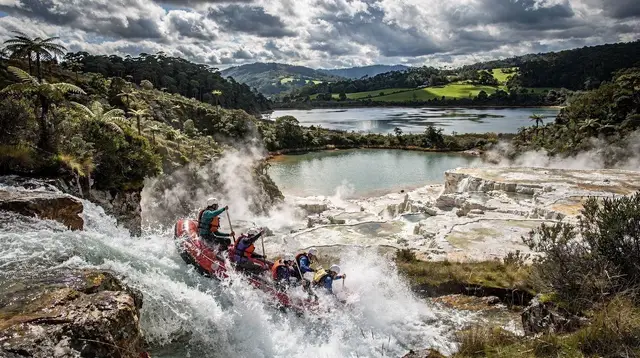
The main draw is the Golden Fleece Terrace, a wide, layered formation of sinter — silica deposited by geothermal water as it cools and the minerals it carries drop out of solution. The terrace has been building for an estimated few thousand years, water sheeting down over pale, ridged rock in colours that shift with mineral content and algae, from near-white through cream to soft ochre depending on where you are looking and how recently it rained. A boardwalk runs along and above it, close enough to see the texture of individual ridges without walking on the formation itself, which would damage it.
This is the point of comparison with Wai-O-Tapu’s Champagne Pool: both are photogenic mineral deposits built by the same underlying process, but Wai-O-Tapu’s terraces are smaller and more contained around a single feature, while Orakei Korako’s stretch along a hillside above the lake at a scale that takes longer to walk. Neither is objectively better; they are different expressions of the same geothermal system that runs the length of the Taupō Volcanic Zone.
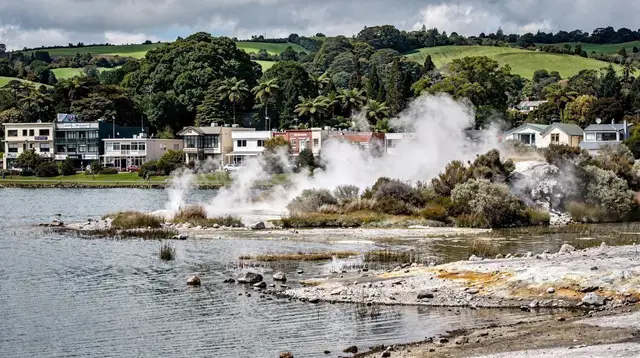
Beyond the main terrace, the boardwalk network loops past a series of smaller features: silica-lined pools, small geysers that are less predictable and less powerful than Pōhutu at Whakarewarewa, hot streams draining toward the lake, and patches of mineral-stained ground where nothing grows. Steam rises more visibly on cold mornings, which is one reason winter visits often produce more dramatic photographs than a hot midsummer afternoon, even though the underlying activity does not change with the seasons.
Ruatapu Cave
The feature that sets Orakei Korako apart from most other geothermal parks in the region is Ruatapu Cave, a natural cave you can walk into rather than simply view from outside. A set of steps leads down into the cave to a small pool of geothermally heated water at the bottom, lit by daylight from the entrance rather than artificial lighting throughout. The name translates roughly to “sacred pool,” and the space was traditionally significant to local Māori before it became part of the visitor route, which is worth keeping in mind while inside: this is a place with meaning attached to it, not simply a geological curiosity.
The steps down are narrow in places and can be damp underfoot, so footwear with grip matters here more than almost anywhere else in the valley — the same caution that applies generally to Rotorua’s geothermal sites is doubly relevant on wet stone steps below ground level. The cave is not large and the visit itself takes only a few minutes, but it is unusual enough — a geothermal pool inside a natural cave, rather than in the open air — that most visitors rank it among the more memorable single stops on the boardwalk.
Walking the boardwalk network
The full boardwalk loop covers a wider area than a single terrace and a cave suggest, threading through native bush between the geothermal features rather than running across bare mineral ground the entire way. Regenerating forest lines much of the path, which changes the character of the walk compared with the starker, more exposed landscapes at Wai-O-Tapu or Waimangu — here you move between shaded bush and open thermal ground rather than crossing one continuous crater field.
Signage along the way explains individual features, and the terrain is generally manageable for anyone reasonably fit, though there is more elevation change than a flat lakeside path, since the route climbs above the lake to follow the terraces and then descends again toward the cave. Budget the full two to three hours suggested for the site if you want to walk the complete network rather than the shorter loop; rushing it defeats much of the point of a place whose main appeal is having room to look without a queue forming behind you.
Comparing Orakei Korako with Wai-O-Tapu and Waimangu
Visitors planning a geothermal-focused day around Rotorua and Taupō often ask which of the three main parks — Wai-O-Tapu, Waimangu, or Orakei Korako — deserves the time, since fitting all three into one day is tight and arguably unnecessary given how much overlaps in what each shows.
| Site | Access | Signature feature | Typical crowd level |
|---|---|---|---|
| Wai-O-Tapu | Drive-up, ~27 km south of Rotorua | Champagne Pool, Lady Knox Geyser (triggered daily) | High, especially around the 10:15am geyser show |
| Waimangu | Drive-up valley walk | Frying Pan Lake, Inferno Crater, dated origin (1886 eruption) | Moderate |
| Orakei Korako | Boat crossing only | Golden Fleece Terrace, Ruatapu Cave | Low to moderate |
If you can only choose one and want the most reliably dramatic single moment, Wai-O-Tapu’s staged geyser and vivid Champagne Pool remain the benchmark, and the comparison guide to Rotorua’s geothermal parks covers that trade-off in more depth. If you have already done Wai-O-Tapu on a previous trip, or specifically want a quieter, boat-access site with a cave you can walk into, Orakei Korako is the one that offers something genuinely different rather than a variation on the same theme.
a combined day tour covering Wai-O-Tapu and Waimangu Volcanic Valley is the more commonly booked pairing for visitors without their own car, since Orakei Korako’s boat-access setup makes it harder to slot into a standard coach itinerary.
Combining the visit with Taupō
Because Orakei Korako sits roughly on the road between Rotorua and Taupō, it fits naturally into a loop that also covers Lake Taupō, Huka Falls, and Craters of the Moon — all a short additional drive once you are already south of Rotorua. This is one of the more efficient ways to see two distinct volcanic landscapes without doubling back, and it matches the general logic laid out in the Rotorua to Taupō day trip guide and the broader Rotorua-Taupō road trip itinerary for travellers with a few days to spend on the corridor.
Taupō itself adds a different kind of geothermal and volcanic interest, including the Māori rock carvings at Mine Bay, which are only reachable by boat or kayak — a nice parallel to Orakei Korako’s own water access, even though the carvings themselves are a 20th-century artwork rather than a geothermal feature.
a guided kayaking trip out to the Māori rock carvings on Lake Taupō works well as an afternoon activity if you base yourself in Taupō after a morning at Orakei Korako, since both involve getting out onto the water rather than staying on land.
Travellers short on time sometimes ask whether it is worth detouring to Orakei Korako at all versus spending the extra hour in Rotorua’s town-based geothermal sites such as Whakarewarewa or an afternoon eco-thermal tour. If your schedule is genuinely tight, a shorter geothermal stop closer to town, paired with more time at Te Puia or a cultural experience, may suit better than adding a boat crossing to the day. Orakei Korako rewards travellers who have a car, a full half-day free, and either a general interest in geothermal landscapes or a specific curiosity about the cave and the terraces that a standard Rotorua stop does not offer.
an afternoon eco-thermal tour around Rotorua’s geothermal sites is a reasonable substitute for visitors who want a geothermal outing without the extra driving time that Orakei Korako requires.
Practical details
Orakei Korako operates its own boat service across Lake Ohakuri during opening hours, and there is no way to reach the terraces without it — walking around the lake is not an option. Because the crossing and the walking loop both depend on daylight and weather, check the operator’s current opening hours and any track closures directly before you drive out, especially outside the main summer season when hours can be shorter. As with any geothermal site in this region, stay on the marked boardwalks: the ground beyond them can be far hotter and less stable than it looks, and this applies as much on the bush-lined sections here as on the more obviously bare thermal ground at Wai-O-Tapu.
Sturdy, closed footwear is worth having for the steps down into Ruatapu Cave and for the boardwalk sections that can be damp. There is limited shelter along the outdoor sections, so sun protection matters in summer given how strong UV levels get in this part of the North Island, and a layer for the boat crossing is worth having in cooler months. Facilities at the entrance are modest compared with the larger, more commercial setup at Wai-O-Tapu, in keeping with the site’s generally quieter, lower-key character.
There is no public transport option, and rental car access is the practical route for almost every visitor; if you are not comfortable driving in New Zealand, the guide to driving here for visitors covers the essentials — driving on the left, typical rural road conditions, and what to expect on state highways like the one running past the turn-off to the valley.
Orakei Korako: common questions
How do you get to Orakei Korako without a car?
There is no public bus service to the site, and it is not close enough to walk from either Rotorua or Taupō. Some Rotorua-based tour operators occasionally include it on a geothermal-themed itinerary, but the more commonly sold combined day tours pair Wai-O-Tapu with Waimangu instead, so confirm the exact stops before booking if reaching Orakei Korako specifically is the goal. A scenic floatplane flight that lands directly at the site is another option for visitors without their own transport.
Is the boat crossing included in the entry price?
The boat crossing across Lake Ohakuri is part of the standard visit and is operated by the site itself as the only way to reach the terraces from the car park side. It runs at regular intervals during opening hours rather than on a fixed timetable you need to book in advance.
How does Orakei Korako compare to Wai-O-Tapu?
Wai-O-Tapu is drive-up, more heavily visited, and centred on a daily triggered geyser and a strikingly coloured Champagne Pool. Orakei Korako requires a boat crossing, sees fewer visitors as a result, and is known for its larger silica terrace and Ruatapu Cave. Both sit within the same volcanic zone and share the same underlying geothermal processes, so the choice comes down to crowd tolerance and whether the cave specifically appeals.
Can you swim at Orakei Korako?
The pool inside Ruatapu Cave and the geothermal features across the site are not set up for swimming, unlike some of the free hot springs or commercial hot pools elsewhere in the region. This is a walking and viewing visit rather than a bathing one.
How long should you plan for a visit?
Most visitors need two to three hours on site once the boat crossing is included, enough time to walk the full boardwalk loop, see the main terrace, and go down into the cave without rushing. Add travel time from Rotorua or Taupō on top of that when planning your day.
Is Orakei Korako suitable for children?
The boardwalks are well maintained and the boat crossing is short and calm, so families with older children who can manage a longer walk with some steps and elevation change generally do fine. The steps down into Ruatapu Cave are narrower and can be slippery, so supervise closely there, and the walk overall is longer than a quick stop like a short boardwalk loop elsewhere in the region.
What is the best time of day or year to visit?
The site is open year-round, and cold winter mornings tend to produce the most visible steam against the air, which many photographers prefer. Arriving earlier or later in the day, rather than around the middle of the day when tour groups are more likely to be moving through, generally means quieter boardwalks and shorter waits for the boat.